 The Boring Project
Why Do Jobs Ask for Salary Expectations?
Why do jobs ask for salary expectations? Three different reasons, and one of them can end your application without telling you; this covers what the field does and what to put for salary expectations on application forms.
What the field is actually for
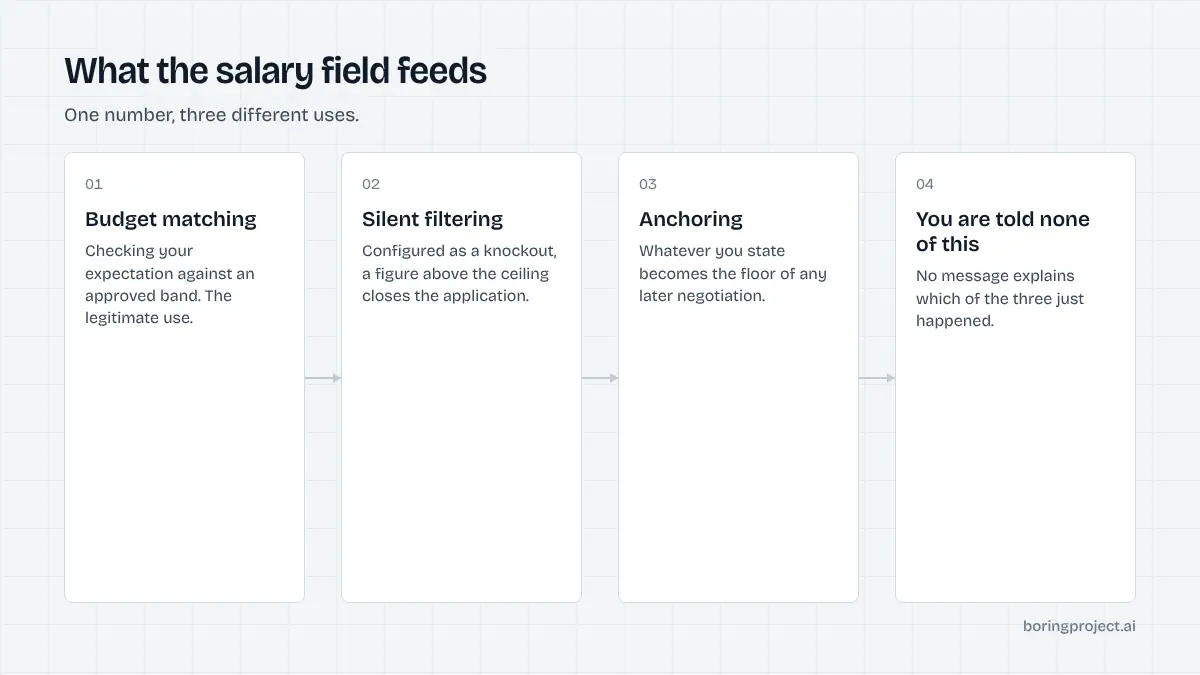
Budget matching, which is legitimate
The stated reason is usually true. A role has an approved salary band, and a candidate expecting far more than the band cannot be hired regardless of how good they are. Asking early avoids both sides spending interviews on a conversation that cannot end in an offer.
Where the band is published in the posting, this is a reasonable and honest use of the field.
Silent filtering, which is the one to know about
Here is why why do jobs ask for salary expectations is worth understanding rather than just answering. In most applicant tracking systems the salary field can be configured as a knockout: an employer sets a ceiling and any figure above it dispositions the application at submission.
You are not told this happened. There is no message explaining that your number was outside the band, and no opportunity to say you were flexible. It is one of the few places on an application form where a single number can end your candidacy invisibly, which is why the field deserves more thought than people give it.
Anchoring, which is why candidates resent it
The third use is negotiation. A number you give before you know the role, the team or the full package becomes the starting point for any later discussion, and it is very hard to revise upwards once stated.
That asymmetry is the real reason this question irritates people. The employer knows their band; you are guessing, and your guess is binding in practice while theirs is not disclosed.
What to put
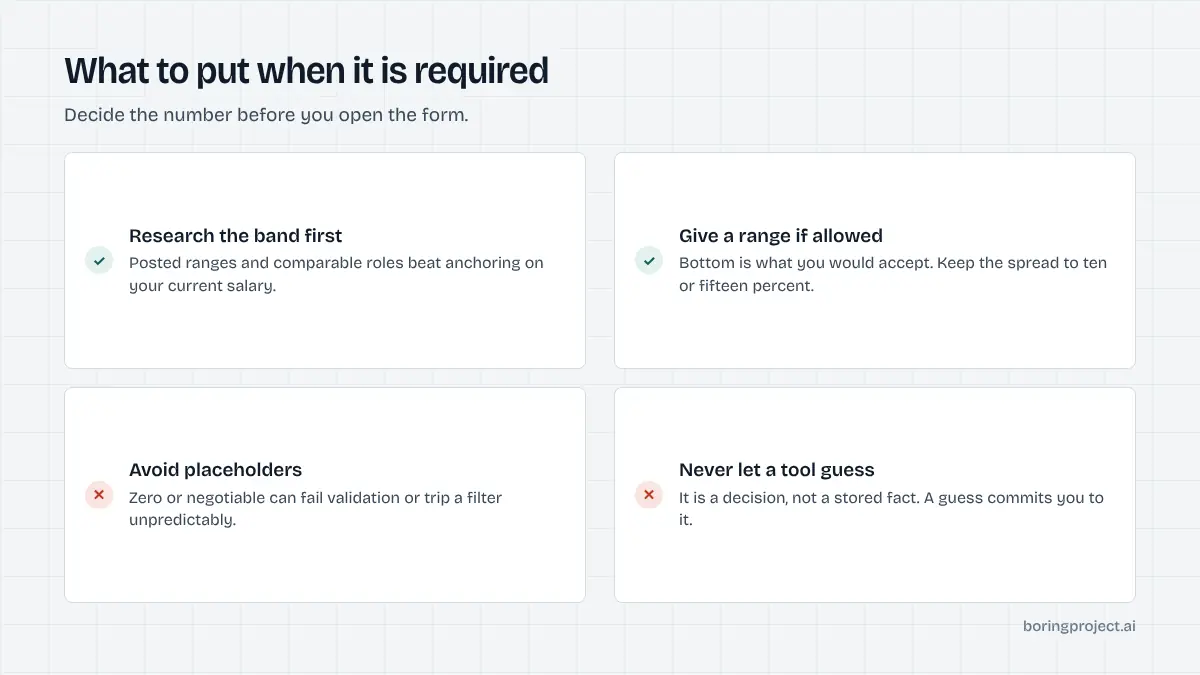
Research the band first
Before filling it, find the range. Many jurisdictions now require pay ranges in postings, and comparable roles at similar companies give a usable estimate. A number anchored to research is far better than a number anchored to your current salary, which is only relevant to your previous employer.
Give a range, with the bottom where you would accept
If a range is allowed, make the bottom a figure you would genuinely accept and the top ambitious but defensible. The bottom is the number that matters, because it is what you will be held to.
Avoid ranges so wide they read as evasive. A spread of ten to fifteen percent reads as considered; a spread of double does not.
When a single number is forced, and when you can decline
Some forms require one figure. Give a researched number at the upper end of what the role plausibly pays rather than your current salary, and raise flexibility in the first conversation. Writing "negotiable" in a numeric field usually fails validation, and writing a placeholder like zero can trip a knockout rule in unpredictable ways.
Some jurisdictions restrict employers from asking for salary history, which is different from expectations. Where the form offers a way to defer, taking it is reasonable. Where the field is mandatory and the posting shows no band, a researched range is the safest answer.
How this fits the rest of the form
It is a knockout question wearing ordinary clothes
The salary field looks like information gathering and behaves like a filter. That puts it in the same category as work authorisation and location questions, covered in what are knockout questions. Treat it with the same care.
Automated applying should never guess it
This is the clearest example of a question a tool must not answer on your behalf. Salary expectation is a decision, not a stored fact, and a system that picks a plausible number has committed you to a figure you never chose, on an application you may not have reviewed. Any tool worth using pauses here and asks once. The same logic applies across screening questions generally.
If you are the employer
Configuring salary as a hard knockout removes candidates who would have accepted your band but aimed high, and you never learn it happened. Publishing the range in the posting solves the problem in the other direction. When we file applications through The Boring Project we report exactly which answer stopped a submission, which is the visibility most teams lack.
Frequently asked questions
Why do employers ask for salary expectations before an interview?
Three reasons: to check your expectation against an approved band, to filter applications automatically where the field is configured as a knockout, and to anchor any later negotiation. The first is legitimate, the second is invisible to you, and the third is why the question feels unfair.
Can a salary expectation get my application auto-rejected?
Yes. In most applicant tracking systems the field can be set as a disqualifying question with a ceiling, so a figure above it closes the application at submission. You receive no explanation and no chance to say you were flexible, which is what makes this field riskier than it looks.
What should I put for salary expectations on an application?
A researched range whose lower bound is a figure you would genuinely accept, based on the posted band or on comparable roles rather than on your current salary. Keep the spread modest, around ten to fifteen percent, since very wide ranges read as evasive.
Should I put negotiable instead of a number?
It rarely works on a numeric field, which usually rejects non-numeric input, and placeholder values like zero can trigger filtering rules unpredictably. Where free text is allowed, a researched range with a note about flexibility is stronger than the word negotiable alone.
Is it legal for employers to ask this?
Asking about expectations is generally lawful. Asking for salary history is restricted in a number of jurisdictions, and the two are different questions. If a form asks what you currently earn rather than what you expect, that is worth checking against local rules.
Should an auto apply tool fill this field for me?
No. Salary expectation is a decision rather than a stored fact, so a tool that guesses commits you to a number you never chose, on an application you may not review. A well-built tool stops and asks once rather than picking a figure likely to pass.
Next step
Before your next application, look up the published range for that role or two comparable ones, and decide your number in advance. Deciding it under time pressure inside a form is how people give figures they later regret or that quietly knock them out.