 The Boring Project
What is a job application API?
What is a job application API? It is a service that applies to jobs the way a person would: send a job URL and a candidate profile, get a submitted application and a receipt back. This page explains what an api to apply on jobs actually does, what the request and response look like, and who tends to use one.
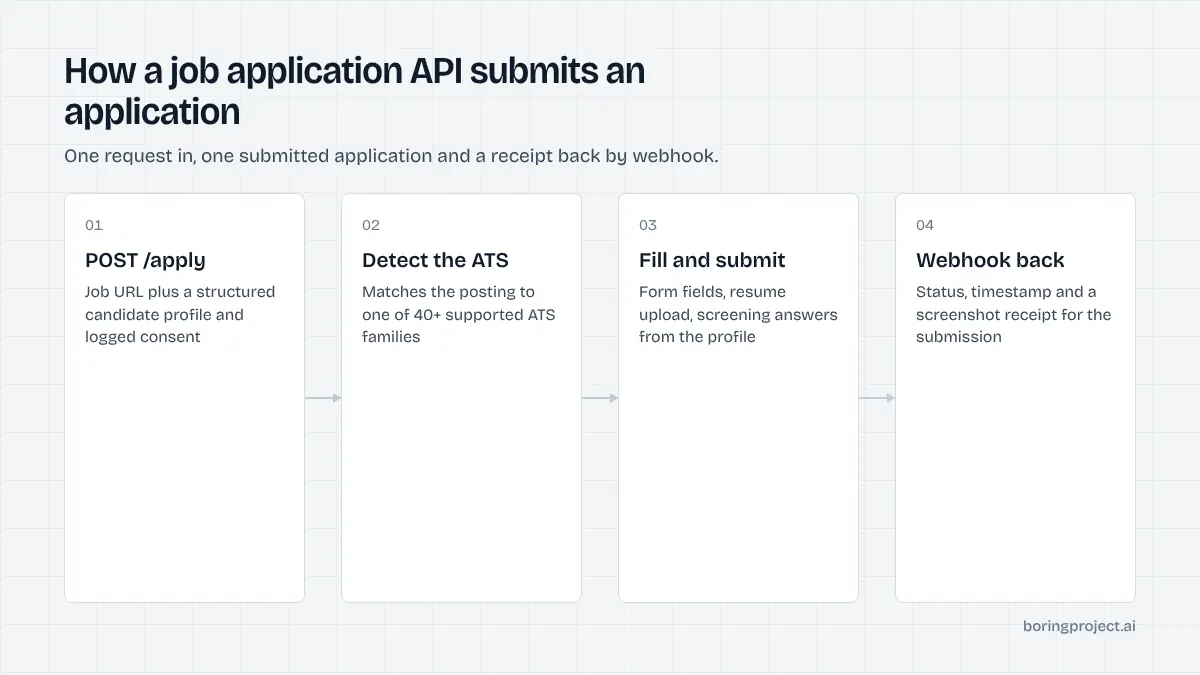
What the API does end to end
The shortest answer to what is a job application API is this: it is the thing that absorbs the busywork. Most of the work in a job application has nothing to do with the candidate's qualifications. It is account creation, resume parsing that gets half the fields wrong, repeated address entry, EEO forms, and screening questions that vary by employer. An apply API absorbs that work so your product can focus on matching, coaching, or placement.
The request
A request carries two things: where to apply and who is applying. The job is usually a URL to the posting on the employer's career site or ATS. The candidate is a structured profile: contact details, work history, education, work authorisation, salary expectations, links, and the resume file itself.
You also pass a consent record and, optionally, a set of known answers to common screening questions. A callback URL tells the service where to send results. That is the whole input; there is no per-employer configuration on your side.
ATS detection and form filling
When the request lands, the service loads the posting, identifies the applicant tracking system behind it, and routes to the matching adapter. Workday, Greenhouse, Lever, iCIMS, Taleo, SuccessFactors, SmartRecruiters, Ashby and Workable each render forms differently, and each has quirks such as account creation, multi-step wizards, or email verification.
The adapter then fills the form field by field from the profile, uploads the resume, handles any OTP email verification, and answers screening questions it can answer truthfully from the data provided. If the employer runs on a system that is not yet covered, the request fails cleanly rather than guessing. The detail of how adapters are built and maintained is covered in our guide to ATS integration for submitting applications.
The response and the receipt
Submission is asynchronous. You get an immediate acknowledgement with an application ID, then a webhook when the outcome is known.
There are three terminal states: submitted, needs_input, and failed. Each comes with a screenshot of the final confirmation page or the point of failure, so you have proof you can show a candidate or a client.
needs_input is the interesting one. It means the form asked something the profile could not answer, for example a certification question or a relocation preference.
The service never fabricates an answer. It returns the questions, you collect the answer, and you resubmit.
The screenshot receipt deserves a word of its own. It is taken at the final page reached, whether that is a confirmation or a failure, so it doubles as evidence for the candidate and as a diagnostic for you when something goes wrong.
Why not just build it yourself
Teams often start by scripting one or two ATS flows and assume the rest will follow. The problem is not the first integration; it is the fortieth, and the weekly breakage across all of them.
No public apply endpoints exist
ATS vendors expose APIs for employers to manage their own pipelines, not for third parties to submit candidates into any company's account. A posting on Workday or Taleo can only be applied to through the form. That means browser automation, and browser automation against forty systems that change their markup without notice.
Maintenance is the real cost
A single ATS update can break every application into that system until someone notices and ships a fix. A dedicated provider runs canary applications continuously, catches regressions within hours, and pays that cost once across all customers. An in-house team pays it alone, usually at the worst possible time.
Guardrails are hard to get right
Per-employer rate limits, consent logging, duplicate detection, and refusing to guess on screening questions are not features you add later. They are the difference between a tool recruiters trust and one that gets your candidates' emails flagged. For a fuller breakdown of the trade-offs, see build vs buy for job application automation.
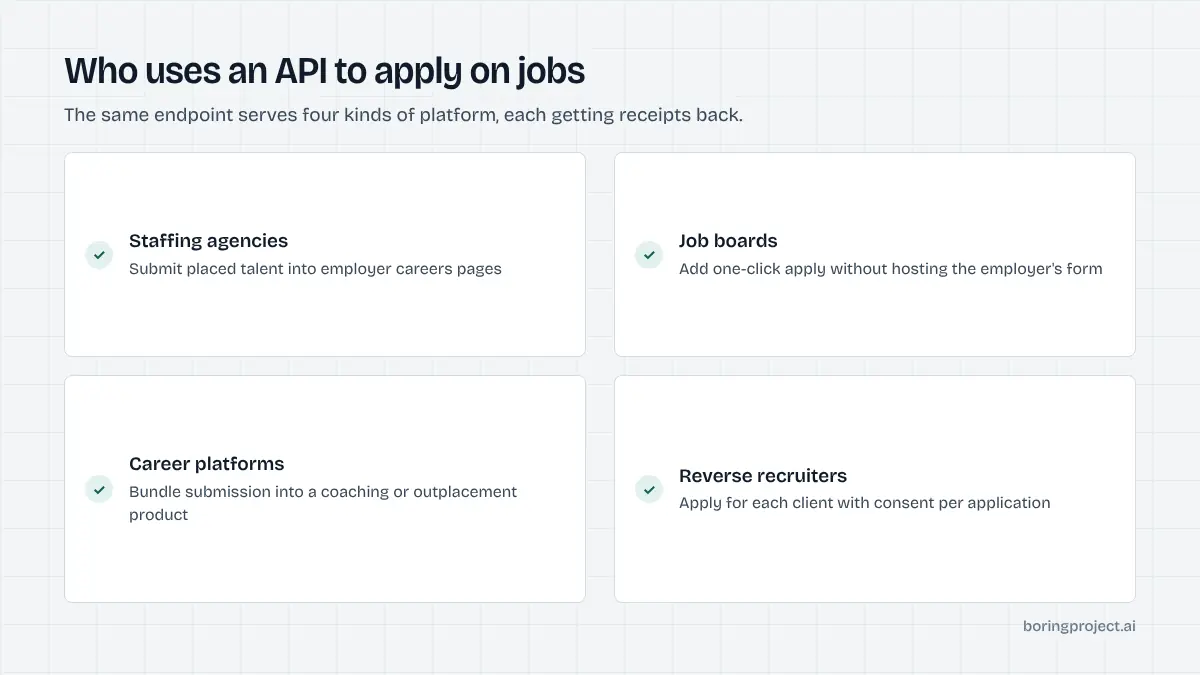
Who uses an api to apply on jobs
The same endpoint serves quite different businesses. What changes is the volume, the source of the job list, and what happens with the receipt.
Staffing agencies and reverse recruiters
Agencies apply on behalf of candidates they represent, often to dozens of roles per person per week. The receipt matters as much as the submission: it goes into the client report. Consent is already part of the engagement, so the main needs are throughput, accuracy on screening questions, and per-candidate tracking.
Job boards and career platforms
Boards lose a large share of candidates at the moment they redirect to an external career site. An embedded one-click apply keeps the candidate on the board, submits on their behalf, and reports back.
The board owns the relationship and the data; the API does the plumbing. Typical integration is a Search + Apply flow where the board's own feed becomes the job source.
Developers building job-search products
Resume builders, coaching tools, and AI job agents can add a real "apply" button without owning ATS automation. The integration is a POST, a webhook handler, and a UI for needs_input. Most teams have a working prototype in an afternoon and spend the rest of the week on their own product's edge cases rather than ours.
Frequently asked questions
What is a job application API?
A job application API is a programmatic service that submits applications on behalf of a candidate. You send a job posting URL and a structured candidate profile; the service identifies the employer's applicant tracking system, fills the form, uploads the resume, answers screening questions from the profile, submits, and returns a status plus proof of submission.
How is this different from an ATS API like Greenhouse or Lever?
ATS vendor APIs are built for employers to manage their own pipeline: read candidates, post jobs, move stages. They do not let a third party submit an application into an arbitrary employer's account. An apply API works from the candidate side, driving the public application form the same way a person would.
Does the candidate have to consent?
Yes. Every application should be tied to an explicit, logged consent from the candidate, scoped to the roles being applied for. The Boring Project requires consent on every request and rejects submissions without it. This protects the candidate, the employer, and your platform, and it is the main thing that separates legitimate automation from spam.
What happens when a form asks a question the profile cannot answer?
The application is paused and returned with a needs_input status, along with the specific questions. Your product collects the answer from the candidate and resubmits. The service never guesses or fabricates screening answers, because a wrong answer to a knockout question hurts the candidate more than a short delay does.
How long does a submission take?
Most submissions complete within a few minutes; the median on The Boring Project is around three. Time varies with ATS complexity, multi-page forms, account creation steps, and whether the employer requires email verification. Results arrive asynchronously by webhook, so your application should not block waiting on the response.
Which ATS platforms are supported?
Coverage includes Workday, Greenhouse, Lever, iCIMS, Taleo, SuccessFactors, SmartRecruiters, Ashby, Workable and around forty systems in total, plus many employer career sites built on them. Support is added per ATS family, and the long tail of custom career pages is handled where the form structure is stable enough to automate reliably.
Next step
If you are building a product that needs to submit applications, the Apply API is the direct route: one endpoint, webhook results, screenshot receipts, per-application pricing. Start with the API documentation for request schemas and example payloads.