 The Boring Project
What Are Knockout Questions on Job Applications?
What are knockout questions? They are the yes or no answers on an application form that can end your candidacy at submission, and this covers the mechanism, knockout questions examples and what to do when one blocks you.
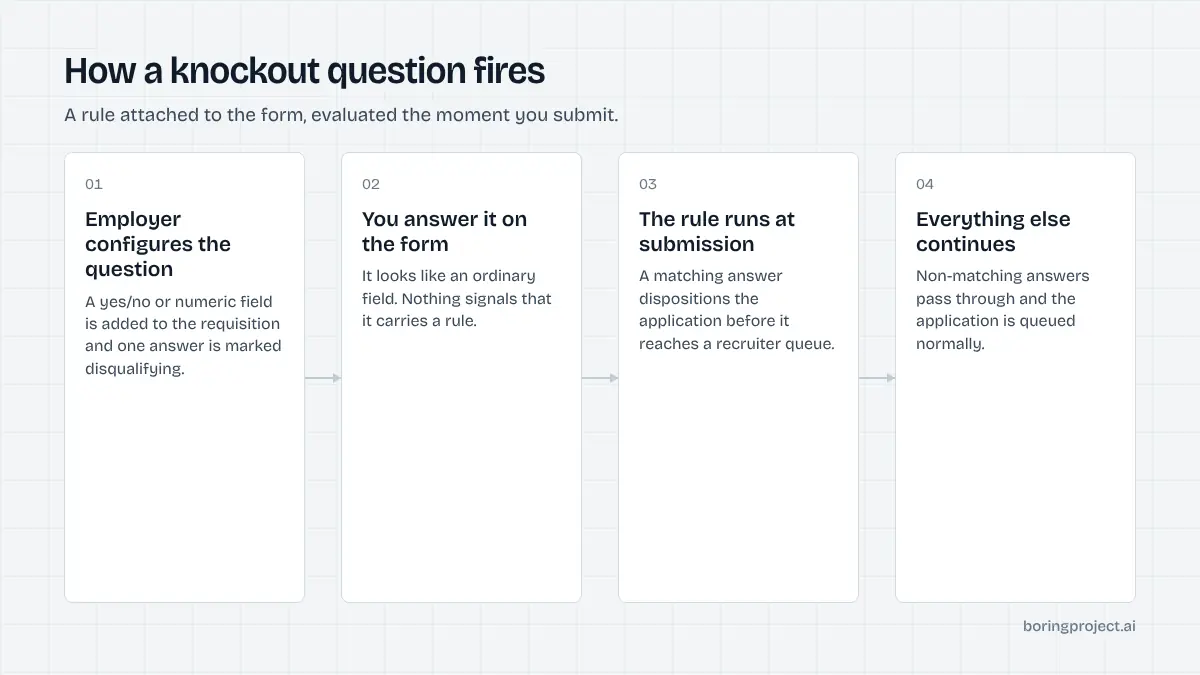
How a knockout question works
A rule attached to the form, not to your resume
When an employer configures a requisition, the applicant tracking system lets them attach questions to the application and mark particular answers as disqualifying. The candidate sees an ordinary form field. Behind it is a rule that runs the moment you submit.
So when people ask what are knockout questions, the accurate answer is that they are rules wearing the costume of ordinary form fields. If your answer matches the disqualifying condition, the system dispositions the application without placing it in the recruiter's queue. No person is involved and no judgement is made about your experience. This is the only mechanism in most applicant tracking systems that genuinely rejects automatically, which is why it explains nearly every story of a rejection arriving suspiciously fast.
Why employers use them
A role with several hundred applicants creates a volume problem that recruiters have few tools against. Knockout questions are the main one. If a role genuinely requires a licence, on-site presence in a particular city, or authorisation to work in the country, a question that filters on it removes applications nobody could have progressed anyway.
Used this way they are reasonable. The complaint from candidates is usually not that the mechanism exists but that the requirement was not stated in the posting, so the rejection feels arbitrary.
Knockout questions examples
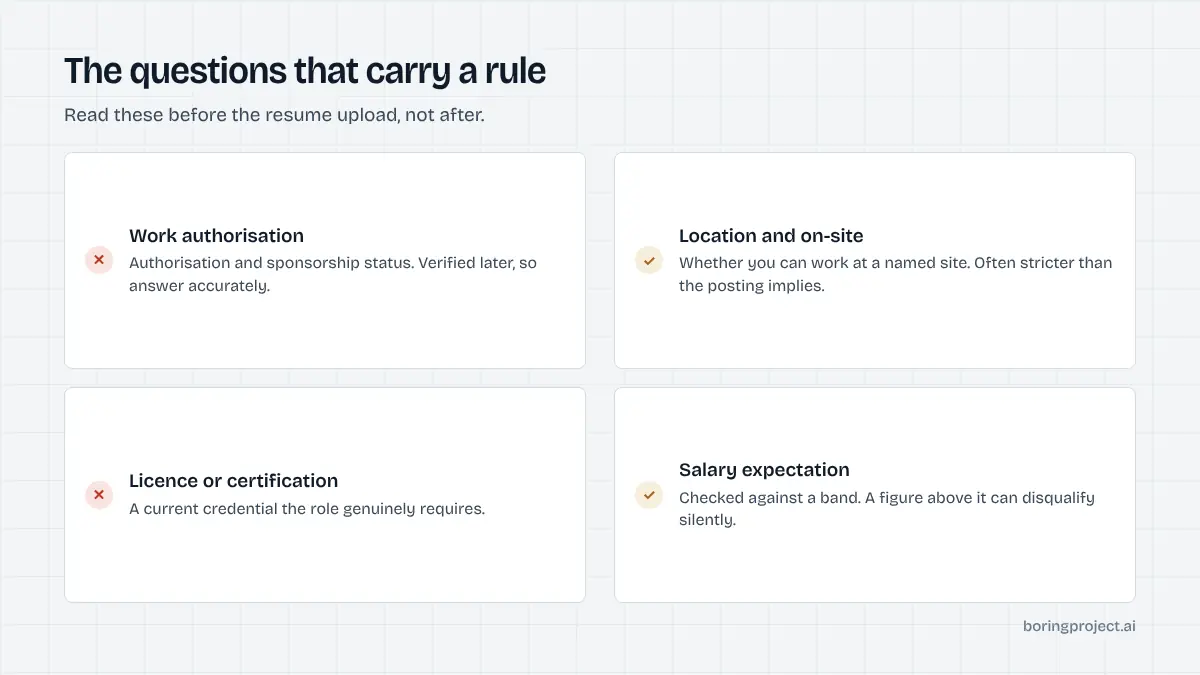
The recurring ones are narrow and predictable. Work authorisation and sponsorship. Minimum age. A current licence or certification. Ability to work on site at a named location. Salary expectation against a band. A minimum number of years with a specific skill. Willingness to undergo a background check or drug screening where lawful.
What to do about them
Slow down on the form
Most people spend hours on the resume and seconds on the questions, which is exactly backwards in terms of risk. The resume affects whether a recruiter is interested. The questions affect whether a recruiter ever sees you.
Read each one before clicking. A mis-click on notice period or relocation is unrecoverable on that application, and you will usually never learn that it happened.
Answer the ambiguous ones in the version that keeps you in
Some questions are genuinely fuzzy. "Are you willing to relocate" when you would move for the right offer. "How many years of experience with Kubernetes" when you have two years of heavy use and three of occasional use. These are judgement calls, not facts.
Answer in the way that is true and keeps the conversation open, then raise the nuance with a recruiter when you speak to one. What you cannot do is treat a hard factual question such as authorisation as a judgement call. The difference between a screening question and a hard requirement is worth understanding before you fill in the next one.
Do not answer falsely
This comes up constantly in recruiting forums and it is consistently a bad trade. Authorisation, licences and degrees are verified before an offer. Discovery after several interview rounds costs you the role and the time, and employers remember.
A knockout you genuinely fail is information: that role was never available to you. It is better to learn it in thirty seconds than after three interviews.
Knockout questions and automated applying
What a tool can answer safely
Anything that comes from a stored fact. Work authorisation status, years of experience with a named technology, whether you hold a given certification, your location. These are retrieved, not invented, and an automated application can fill them as reliably as you can.
What a tool should never guess
Anything that is a decision rather than a fact. Whether you will relocate. What salary you will accept. Whether you will take a role requiring five days on site. A tool that guesses at these submits applications on terms you did not agree to, and the knockout question is exactly where that becomes costly.
Any automated applying worth using pauses on these and asks once, rather than picking the answer most likely to get through. That is the behaviour to test for before you pay for one.
If you are the employer
The same mechanism looks different from the hiring side: knockout questions are the cheapest filter available and the easiest to misconfigure. A question set too strictly removes candidates you wanted, silently, with no signal that it happened. The Boring Project files applications across 40+ applicant tracking systems and reports exactly which ones stopped and why, which is the view most teams never get.
Frequently asked questions
What is a knockout question?
A question on an application form whose answer an employer has marked as disqualifying. Answer it the wrong way and the applicant tracking system closes the application at submission, before a recruiter opens it. They are usually yes or no, sometimes a number or a range, and they sit on the form rather than in your resume.
What are common knockout questions examples?
Are you legally authorised to work in this country. Will you now or in the future require sponsorship. Are you at least 18 years of age. Do you hold a current licence or certification for this role. Can you work on site at this location. What is your salary expectation. How many years of experience do you have with a named skill.
Are knockout questions legal?
Screening on genuine job requirements such as work authorisation, a required licence or the ability to work at a location is ordinary lawful hiring practice. Questions that screen on protected characteristics are not, and employment law in most countries restricts them. If a question seems to be probing age, health or family status rather than ability to do the job, that is worth noting.
Should I lie on a knockout question to get through?
No. Work authorisation and licence claims are verified before an offer, so a false answer surfaces after you have spent interviews on the process, and it can end your candidacy with that employer permanently. If you cannot meet a hard requirement the role was closed to you before you applied, which is frustrating but is not something to engineer around.
Why did my application get rejected within minutes?
A knockout answer almost certainly triggered it. Rejections arriving within minutes, overnight or at weekends are the signature of a rule firing at submission rather than a person reading. Review the yes or no questions you answered on that form rather than re-examining your resume.
Can automated applying tools answer knockout questions?
They can answer the ones that come from stored facts such as authorisation status or years of experience. They should not guess at the ones that are decisions, like whether you will relocate or what salary you will accept. A tool that invents answers to those will submit applications you would not have made, and the knockout is the point at which that becomes expensive.
Next step
Before your next application, read the screening questions first, before the resume upload. If any of them is a hard requirement you do not meet, you have saved yourself the form. If any is ambiguous, decide your answer deliberately rather than clicking through it. Our guide on whether an ATS auto rejects covers what happens to everything that is not a knockout.