 The Boring Project
How ATS Screening Questions and Knockouts Work
ATS screening questions are the structured questions an employer adds to an application form, and knockout questions are the subset that can reject you automatically. This page explains the types, how the rules run, why honest answers matter, and how application automation should handle them.
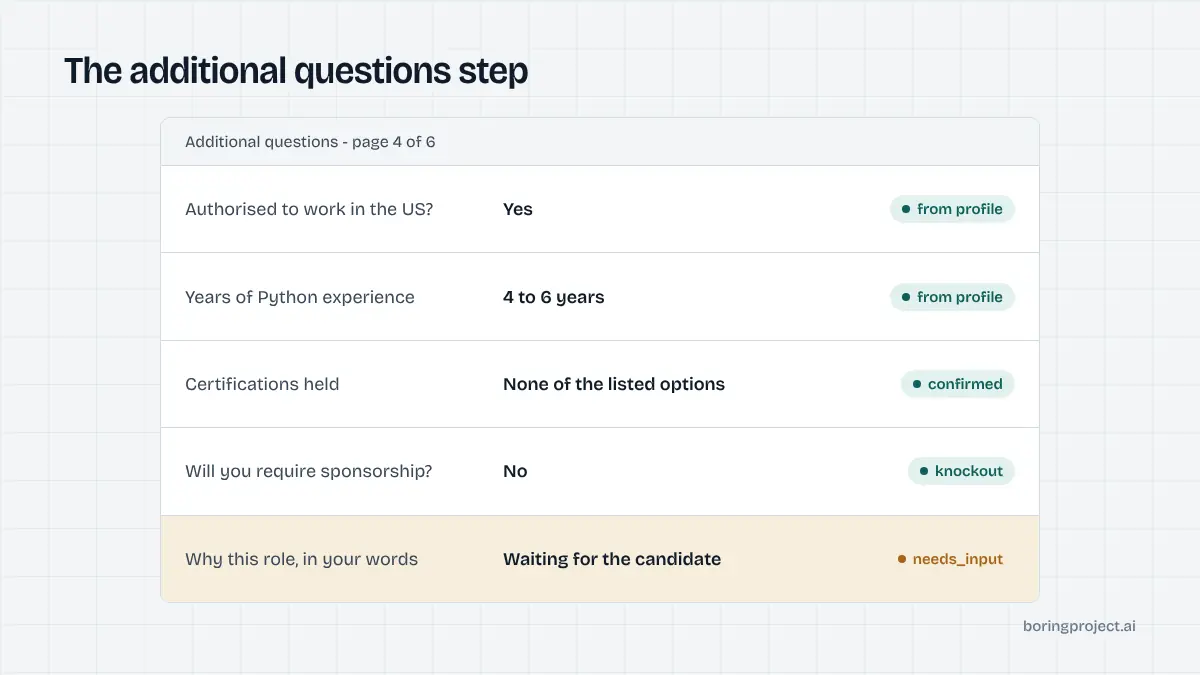
The question types you will meet
Employers configure ATS screening questions inside their applicant tracking system when they publish a role. The platform supplies the field types; the recruiter or hiring manager writes the content, so most forms mix several kinds.
Two postings for the same title at the same company can carry completely different question sets, because the configuration belongs to the individual requisition rather than to the platform.
Eligibility and legal questions
These are the yes/no questions about things the employer cannot waive: authorisation to work in the country, need for visa sponsorship now or in future, minimum age, and in regulated fields a required licence or clearance. They are the most common knockouts because the answer is binary and the consequence of a wrong hire is high.
Qualification and experience questions
Dropdowns and numeric fields asking for years of experience with a skill, highest education level, specific certifications, or proficiency with a named tool. These may be knockouts (minimum three years) or may be scored (more experience ranks higher). You cannot tell which from the form.
Logistics and preference questions
Willingness to relocate, availability to start, salary expectations, shift availability, and whether you can work on-site. Location-based questions are increasingly used as knockouts for roles that are genuinely on-site. Salary questions are more often used for ranking or for recruiter notes than for automatic rejection.
| Type | Typical format | Often a knockout? | Example |
|---|---|---|---|
| Eligibility | Yes / No | Yes | Are you legally authorised to work here? |
| Qualification | Dropdown, number | Sometimes | Years of experience with Python |
| Logistics | Yes / No, dropdown | Sometimes | Can you work on-site three days a week? |
| Free text | Paragraph | Rarely | Why are you interested in this role? |
| Voluntary disclosure | Dropdown | No | Demographic and veteran status |
Voluntary disclosure questions are legally separated from hiring decisions in most jurisdictions and are not used for screening. Everything else on the form can be.
How knockout logic runs
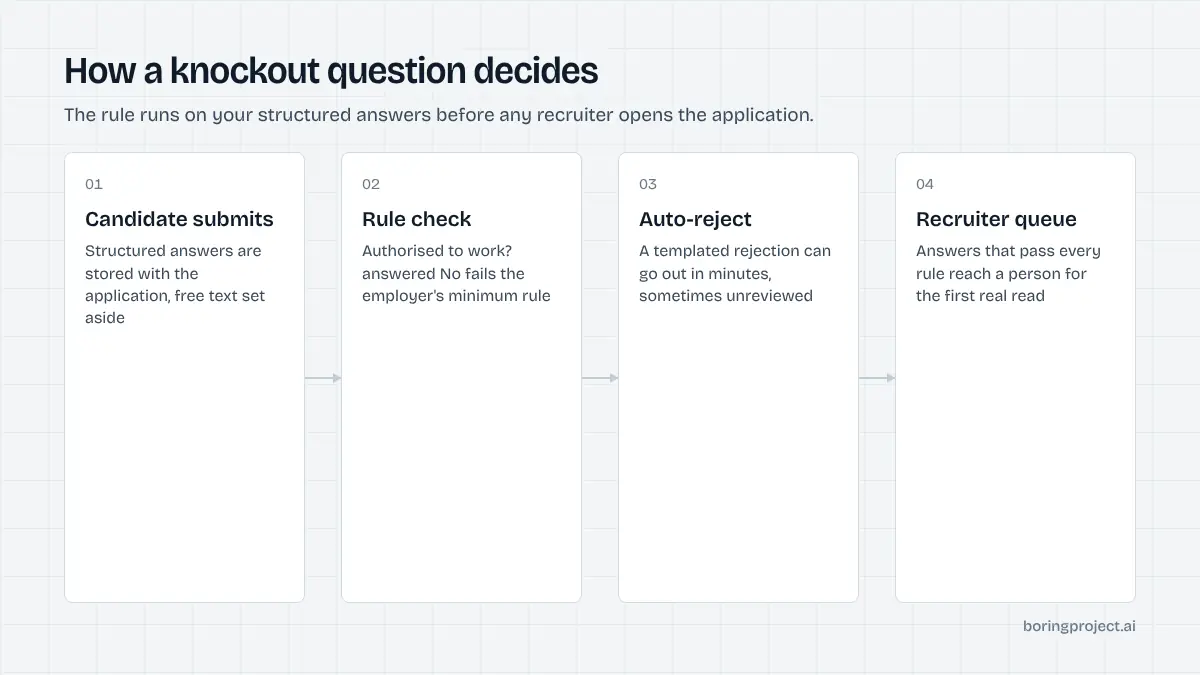
A knockout is simply a rule attached to a question: if the answer equals a disqualifying value, the candidate is flagged. The mechanics differ by platform but the pattern is consistent.
Nothing about the rule is visible while you are filling the form. A disqualifying question looks exactly like a scored one, which is why guessing at what the employer wants to hear is such a poor bet.
What the rule does
When you submit, the system compares your answers to the configured rules. A failed rule typically moves you to a "does not meet basic qualifications" status.
Depending on configuration, it may trigger an immediate templated rejection email, hide you from the recruiter's default view, or simply rank you at the bottom. A same-day rejection after an application is the clearest external sign that a knockout fired.
Platforms vary in how visibly they support this. Workday, iCIMS, Taleo and SuccessFactors all offer disqualifying question configuration to employers, which is one reason applications on those platforms feel more gated. The field layout on Workday in particular is covered in our walkthrough of how to auto apply on Workday.
Why honest answers are the only strategy
It is tempting to answer whatever gets past the gate. That fails in three ways. First, the answers are stored with your application and compared against your resume, references and background check.
Second, many employers keep the auto-rejected pool and revisit it; a false answer there is a permanent record. Third, an offer made on the basis of an incorrect eligibility answer is routinely withdrawn when discovered.
An accurate "no" that produces a fast rejection costs you nothing, because the employer was not going to hire you for that role. An inaccurate "yes" costs time on both sides and can close a door at that company for good.
How automation should handle screening questions
If a tool is submitting applications on your behalf, its behaviour on this step matters more than anything else it does. The failure modes are predictable.
Ask any vendor what their system does with a question it has never seen before. The answer tells you most of what you need to know about how it treats this whole step.
Answer from confirmed data only
A sound tool keeps a profile of facts you have verified: authorisation status, sponsorship need, years in each role or skill, licences and certifications, location and relocation preferences, availability. When a question maps cleanly to one of those facts, it answers. The mapping should be visible to you, and you should be able to correct it.
Stop on anything new
When a question does not map to a known fact, the right behaviour is to pause the application and ask you, then resume. In practice this looks like a "needs input" status with the exact question attached.
Tools that lack this state have only two options, fail or guess, and most pick guess because it makes their success numbers look better. The product design around this is explained in screening questions automation.
Never optimise for passing the gate
The purpose of automation is to remove typing, not to game eligibility. A tool that advertises higher pass rates on knockout questions is telling you it answers them favourably regardless of truth.
Beyond the ethical problem, it produces exactly the outcome you are trying to avoid: interviews or offers that collapse when the discrepancy surfaces. Prefer tools that report how many applications they paused for your input, because that number is evidence they are not inventing answers.
Frequently asked questions
Are the screening questions the same on every platform?
No. The employer writes the questions; the platform only provides the field types and the rule engine. Workday, Greenhouse, iCIMS, Taleo and the others each have their own way of marking a question as disqualifying, and recruiters configure them differently from one posting to the next. Two roles at the same company can have completely different screens.
Can I see which questions are knockouts before I answer?
Usually not. Platforms do not label disqualifying questions to candidates. You can infer them: yes/no questions about legal requirements, licences, minimum experience and location are the usual candidates. Treat any question with a clear right answer for the employer as a potential knockout and answer it accurately.
What happens if I answer a knockout question incorrectly by accident?
If you fail the rule, most systems mark you as not meeting basic qualifications and may send a templated rejection, sometimes within minutes. Some employers let recruiters review the auto-rejected pool, many do not. If you notice the mistake quickly, a short email to the recruiter with the correct answer occasionally helps, but there is no guaranteed route to reopen an application.
Should an auto apply tool answer screening questions for me?
Only from information you have confirmed. A tool can safely answer questions whose answers live in your profile: authorisation, years in a role, licences you hold, willingness to relocate. For anything it has not seen before, it should stop and ask you. A tool that guesses to complete the form is making claims to employers on your behalf.
Do free-text screening questions get read by a person?
Often yes, but usually after the rule-based questions have filtered the pool. Some platforms also run keyword matching on free-text answers. Keep them short, specific and consistent with your resume. A free-text answer that contradicts your stated experience elsewhere in the form is one of the quickest ways to lose a reviewer's trust.
Why do some applications ask the same questions my resume already answers?
Because structured answers are easier to filter than parsed resume text. A recruiter can sort or rule on a dropdown value instantly; extracting the same fact from a PDF is unreliable. The duplication is annoying but intentional, and it means your structured answers, not your resume, decide the first cut.
Next step
The job application API that powers Search + Apply and Managed Applies answers screening questions only from a candidate's confirmed profile, returns a needs_input status with the exact question when it meets something new, and never fabricates an answer to get a form through. Every submission also comes back with a screenshot receipt, so you can see precisely what was answered.