 The Boring Project
Does ATS Auto Reject Your Application?
Does ATS auto reject applications? Mostly it does not, and the exception matters more than the myth; this explains the one mechanism that produces real ats automatic rejection and what it means for how you apply.
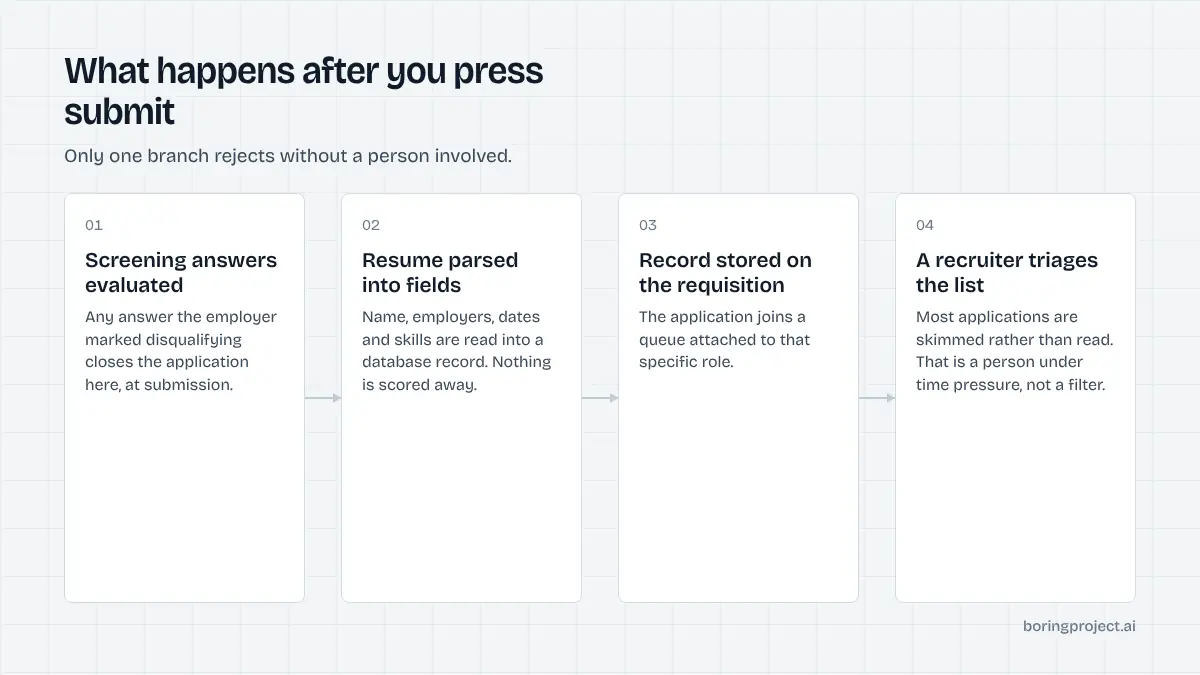
What actually happens when you press submit
The resume goes into a database, not a judge
An applicant tracking system is, at its core, a database with a workflow on top. When you submit, the system parses your resume into fields — name, employers, dates, titles, skills — and stores the record. It then places the application in a queue attached to that requisition.
Nothing in that sequence scores your resume and discards it. Recruiters who administer these systems say this repeatedly, and the ones with a decade of experience across agencies, banks and large tech employers say they have never configured a content-based automatic rejection. The resume is stored whether it is beautifully written or terrible.
Where the "75% are auto-rejected" claim came from
The figure circulates constantly and does not survive contact with people who run the systems. What is true is that most applications are never read closely, which feels identical from the outside and is a different problem. A recruiter working a role with four hundred applicants will read a fraction of them properly. That is triage by a human under time pressure, not a machine deleting you.
The distinction matters because it changes what you should do. If a robot were scoring your resume, the answer would be keyword stuffing. Since a person is skimming a ranked list, the answer is being genuinely findable and relevant.
The one thing that does reject automatically
Knockout questions. These are the yes or no questions on the form: are you legally authorised to work here, do you require sponsorship, do you hold this licence, can you work on site, what is your salary expectation. An employer can mark an answer as disqualifying, and the system dispositions the application at submission.
This is why people receive rejections within minutes, at night, at weekends. We cover how they are configured in how ATS screening questions work.
What this changes about applying
Read the questions more carefully than you write the resume
Most candidates spend hours on a resume and seconds on the screening questions, which inverts the actual risk. A mis-click on notice period, work authorisation or willingness to relocate ends the application immediately and irreversibly, while a slightly weaker resume bullet costs you very little.
Slow down on the form. If a question is ambiguous — "are you willing to relocate" when you are open to it under some conditions — answer the version that keeps you in the process and raise the nuance with a recruiter later.
Do not lie to get past a knockout
The temptation is obvious and visible all over the recruiting forums. It is a bad trade. Work authorisation and licence claims are verified before an offer, and being caught ends the process later, after you have invested interviews in it, and sometimes blacklists you with that employer.
If you genuinely do not meet a hard requirement, the role was closed to you before you applied. That is frustrating but it is not a filter you can outwit.
Fix formatting to be found, not to survive
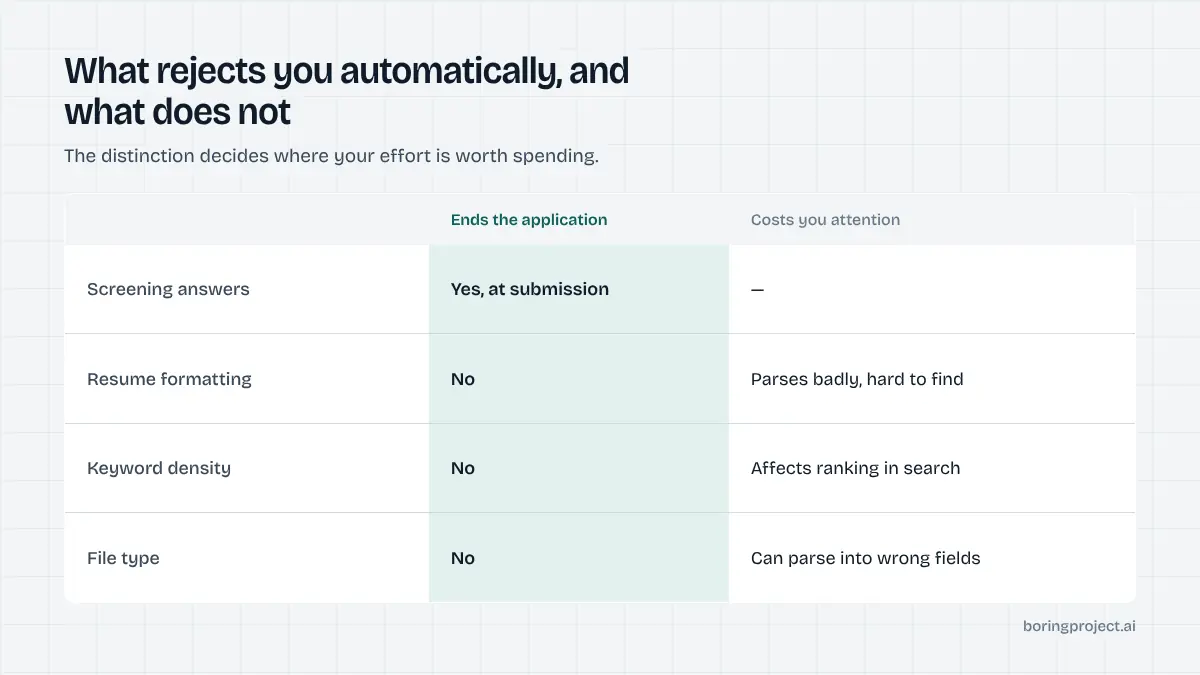
Formatting still matters, for a different reason than the one usually given. Tables, multi-column layouts, text inside headers and skills rendered as images parse unreliably. The record that results has fields in the wrong place or missing entirely.
That does not delete you. It makes you hard to retrieve when a recruiter searches the database for a skill, and it makes your profile look thin next to candidates whose details parsed cleanly. A single-column document with plain headings solves it.
So does ATS auto reject?
The accurate answer
The short answer to does ats auto reject is: not on your resume, yes on your answers. The resume is parsed and stored. The screening questions are evaluated at submission and can disposition you instantly. Almost every story of an inexplicably fast rejection resolves to the second mechanism.
What to do differently tomorrow
Treat the application form as the part that can end your candidacy and the resume as the part that wins attention once a person is looking. Answer screening questions accurately and deliberately. Keep the resume single-column and parseable so you surface in searches.
If you are on the other side of this
Employers configuring these systems have the opposite problem: hundreds of applications per role and knockout questions as the main lever. Our note on automating screening questions covers what can and cannot be answered reliably at volume, which is the same question from the employer's chair. If you are building applying into a product, The Boring Project files applications across 40+ ATSs and reports back what each one actually did with them.
Frequently asked questions
Does an ATS automatically reject resumes based on keywords?
Generally no. The widespread belief that a system scores your resume and discards it below a threshold does not match how these products are configured in practice. Recruiters who administer these systems consistently report that keyword matching is used to rank and search candidates, not to delete them. Your resume lands in a database either way.
So what does reject you automatically?
Knockout questions. These are the yes or no questions on the application form itself, covering work authorisation, location, salary expectations, a required licence or a minimum number of years. An employer can configure an answer to disposition the application immediately. That is a real automatic rejection and it happens at submission, before any person looks.
Why did I get rejected three minutes after applying?
Almost always a knockout question. The timing people find suspicious is the clearest evidence of the mechanism: a rejection arriving at 10pm on a Saturday within minutes of submitting was triggered by the form, not by a recruiter reading at the weekend. Look back at the yes or no questions you answered rather than at your resume.
Does resume formatting cause automatic rejection?
Formatting causes parsing problems, which is a different failure. Tables, columns, text in headers and images can parse badly, so fields land in the wrong place or arrive empty. Nothing is deleted, but a recruiter searching the database may not find you, and a half-empty profile reads poorly. Fix formatting to be found, not to avoid a robot.
Do bigger companies auto-reject more?
Volume changes the configuration rather than the technology. A role with hundreds of applicants is more likely to have knockout questions switched on and set strictly, because that is the lever available to the team. The same system at a small employer may have none configured at all.
How do I avoid being filtered out automatically?
Answer the screening questions accurately and read them carefully, because a mis-click on work authorisation or notice period ends the application. Do not answer falsely to get past a knockout: it is discovered at offer stage and costs you the role. If you genuinely do not meet a hard requirement, that role was closed to you before you applied.
Next step
Go back to the last three applications you submitted and look at the screening questions rather than the resume. If any of them asked about authorisation, relocation, salary or a licence, that is where a fast rejection came from, and it is the part worth slowing down on next time.