 The Boring Project
Do Job Applications Expire?
Do job applications expire? The application closes with the role but your record usually does not; this separates the two and answers how long do job applications stay on file.
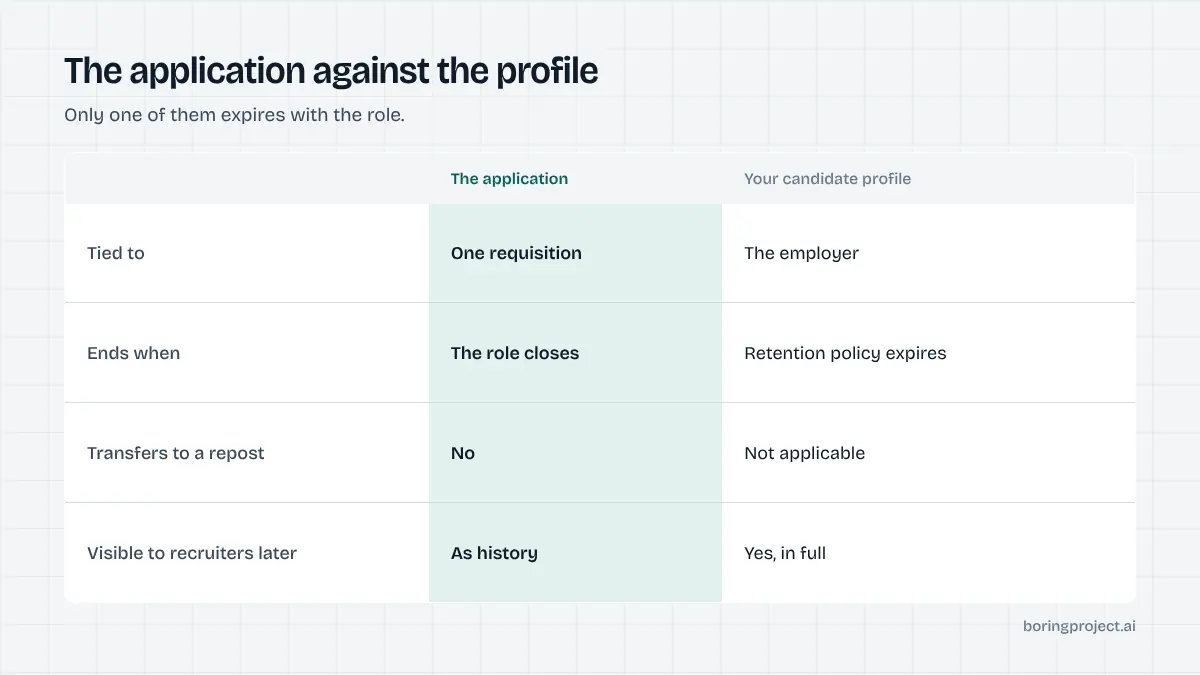
Two different things, two different lifespans
The application is tied to a requisition
An application exists against a specific job. When that requisition closes, the application closes with it and cannot be revived. If the role is posted again as a new requisition, your old application does not carry across, which is exactly why reapplying to a reposted role is often necessary.
So the answer to do job applications expire is yes, in the sense that matters for being considered: once the role closes, that application is finished.
The candidate profile usually persists
Your candidate record in that employer's system is a different object and generally stays. It holds your resume, contact details, parsed work history and the history of every application you made there.
This is the part candidates underestimate. Years later a recruiter at that company can search their database, find your profile, and see everything you have ever applied for. The record outlives any individual application.
Retention is a legal matter, not a product one
How long the record is kept is set by the employer's retention policy, which is shaped by local employment and data protection law rather than by the software. Obligations around demonstrating fair hiring often require keeping applicant records for a defined period, and data protection rules in many jurisdictions give you a right to request deletion.
There is no single number. Policies commonly run from one to several years, and they vary by country and employer.
What this means practically
An old application rarely helps you
Do not assume an application from last year keeps you in consideration. It does not. If a role you want is open now, apply now, regardless of what you submitted before.
An old record occasionally does
The profile can work in your favour. Recruiters do search their own databases for candidates, particularly for hard-to-fill roles, and a well-parsed profile from an earlier application is sometimes how people get contacted out of nowhere. That is an argument for a clean, parseable resume even on applications that go nowhere, as covered in what an applicant tracking system is.
Rejections persist, and how to refresh your record
Dispositions are recorded. A recruiter looking at your profile may see that you were rejected for a role two years ago and at what stage. In most cases this is neutral, since circumstances change. It does mean a pattern of many applications and many rejections at one employer is visible as a pattern.
Some systems let candidates update their profile, many do not, and the practical route is usually to apply to a new role with a current resume, which refreshes what the employer holds. Where you want data removed entirely, a request to the employer's privacy or recruitment contact is the mechanism, not the application form.
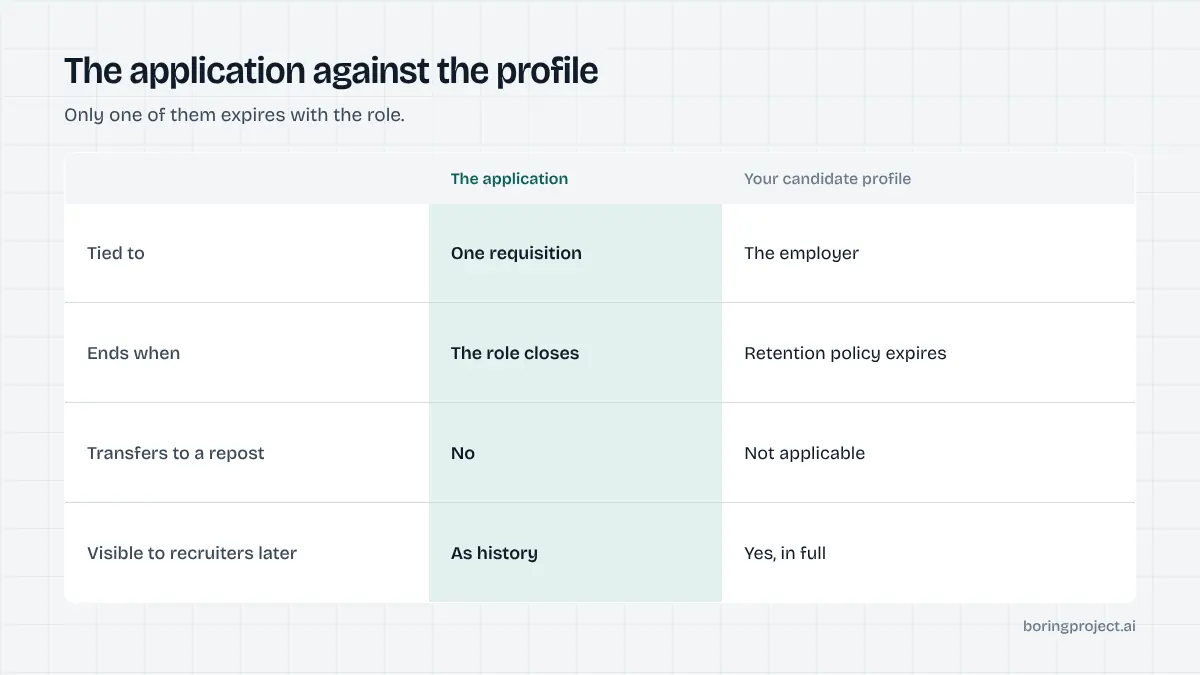
Edge cases worth knowing
Unfinished applications
A started-but-unsubmitted application is usually held for a period and then discarded, and it is not visible to recruiters as an application. Half-finished applications are where most candidate effort disappears, and they count for nothing.
Talent pools
Some employers move strong unsuccessful candidates into a named talent pool for future roles. This is a real practice and it is the closest thing to an application that keeps working for you, though it is far less common than careers pages imply.
Reposted roles
When a role is reposted as a new requisition, your previous application does not transfer, which is covered in why companies repost the same job. Check the requisition identifier before deciding whether to reapply.
If you are applying on behalf of many candidates, record persistence matters more, because repeated applications accumulate visibly against one employer. Keeping your own log of what was submitted and when is the only reliable view, which is why The Boring Project returns a receipt for every attempt.
Frequently asked questions
Do job applications expire after a certain time?
The application itself closes when the requisition closes and cannot be revived, so in the sense that matters it does expire. Your candidate record in that employer's database is a separate object and usually persists well beyond the role.
How long do job applications stay on file?
It depends on the employer's retention policy, which is driven by employment and data protection law rather than by the software. Periods commonly run from one to several years and vary by jurisdiction. There is no single industry standard.
Can a company see jobs I applied for years ago?
Generally yes. Your candidate profile holds the history of applications at that employer, including dispositions, and a recruiter opening it can see that history. This is one record per employer, not shared between companies.
Does an old application keep me in consideration?
No. If a role is open now, apply now. Old applications are attached to closed requisitions and do not transfer. The exception is a named talent pool, which some employers maintain for strong unsuccessful candidates.
Can I delete my application data?
Usually you can request it, through the employer's privacy or recruitment contact rather than the application form. Data protection rules in many jurisdictions give candidates a deletion right, though employers may be required to retain some records for a defined period.
Do unfinished applications count for anything?
No. An application you started but never submitted is not visible to recruiters as an application and is typically discarded after a period. Finishing in one sitting is the practical fix, since returning to a half-completed form rarely happens.
Next step
If you applied somewhere more than a few months ago and the role is open again, treat the old application as gone and apply fresh with a current resume. It also refreshes the profile the employer holds on you, which is the part that persists.