 The Boring Project
Does Workday Auto Reject Applications Automatically?
Does Workday auto reject applications? Only through screening answers, never on your resume; this covers what happens at submission, why rejections arrive at odd hours, and what workday application in progress actually means.
What Workday does when you submit
Each employer runs a separate tenant
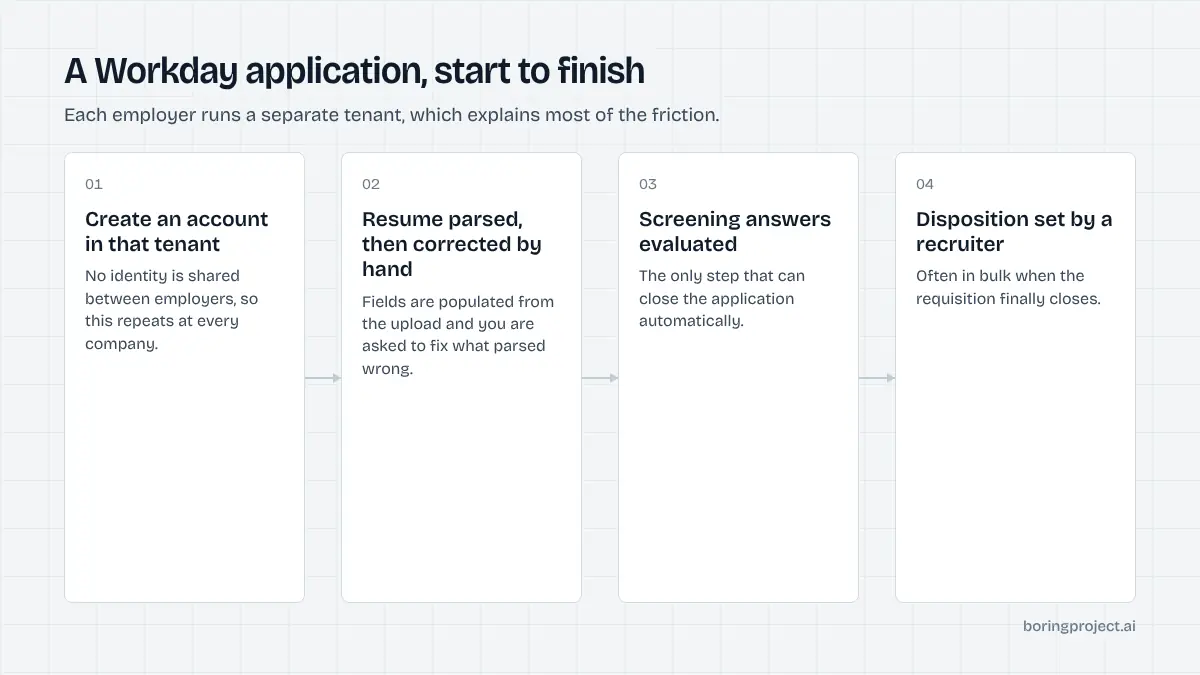
The single most useful fact about Workday is that it is not one system. Every employer runs its own tenant: a separate instance with its own database, its own configuration and its own candidate records. Your account at one company does not exist at another.
This explains the complaint that dominates every discussion of Workday. You are not re-registering because of a bug or an oversight. There is no shared candidate identity across tenants, so there is nothing to sign in to. It also explains why the same product feels strict at one employer and relaxed at another: the configuration is theirs, not Workday's.
What can reject you automatically
The same mechanism as every other applicant tracking system: screening questions with disqualifying answers. The employer attaches questions to the requisition and marks particular responses as knocking the application out. Workday evaluates them at submission.
So the answer to does workday auto reject applications is yes, but only through those answers, and only where the employer switched them on. That is the whole of the automatic rejection surface. There is no resume scoring step that discards applications on content, and recruiters administering these tenants consistently say they have never configured one. The behaviour described in does ATS auto reject applies here specifically.
Why the rejection arrives at 2am
Because a rule fired, not because somebody read your application overnight. The notification then goes out on whatever schedule the tenant is configured for, which is frequently a batch job running outside business hours. Candidates read the timing as contempt. It is a cron job.
Reading the statuses correctly
In progress means open, not read
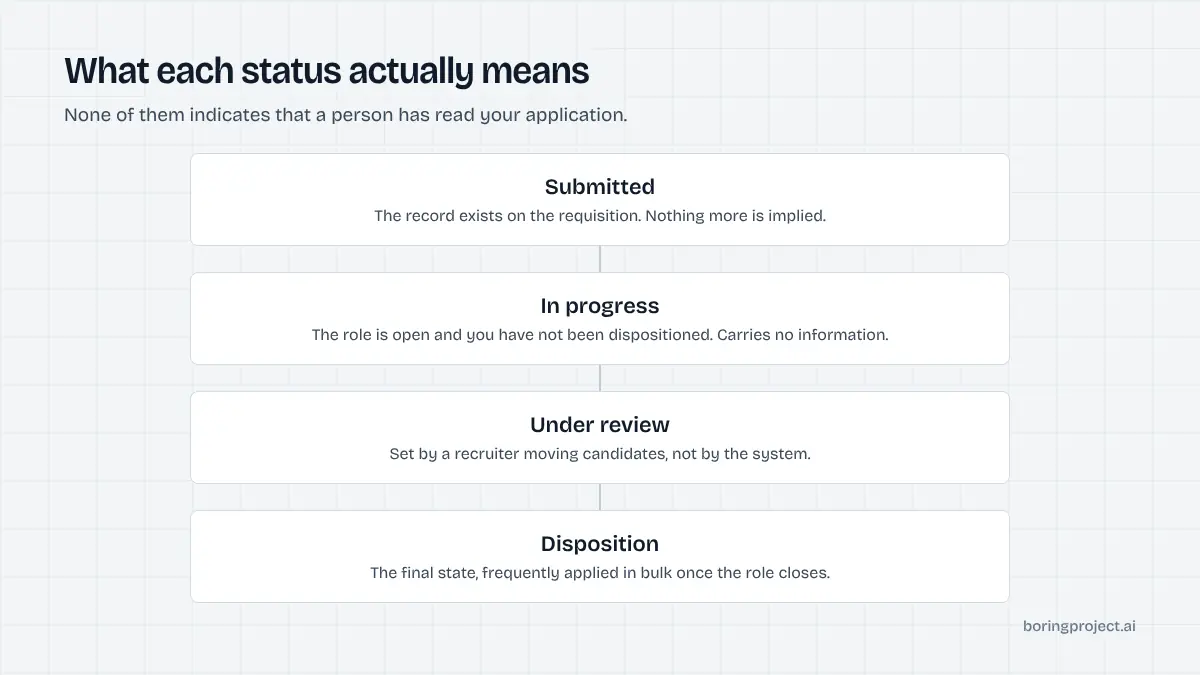
The status candidates find most maddening is the one that never changes. In progress means the requisition is open and your application has not yet been dispositioned. It carries no information about whether anyone has looked at it.
A team can interview a shortlist for six weeks while every other application sits in that state. When the role finally closes, the remaining candidates are often dispositioned in bulk, which is why hundreds of people receive rejections from the same company within the same hour.
Why so many applications get abandoned
Workday applications commonly run to several pages and often require an account before you can submit. The resume upload parses into fields, and then candidates are asked to correct the parsing by hand, which is the step that generates most of the frustration: you have uploaded the information and are now retyping it.
Hiring managers have noted the side effect, which is that roles posted through Workday receive fewer applicants than the same role elsewhere. If you are prepared to finish the form, the competition is sometimes thinner than it looks. Our guide to applying on Workday covers the mechanics.
What formatting actually affects
Not rejection. Retrieval. Workday parses your resume into profile fields, and a multi-column layout, a table, or contact details inside a document header parse unreliably. The result is a record with blank or wrong fields.
The application is still submitted. What you lose is being found when a recruiter searches the tenant for a skill, and the impression made by a profile that looks half-filled next to one that parsed cleanly. A single-column document with plain headings avoids it.
What to do with this
If you are applying
Answer the screening questions deliberately, because that is the only step that can end the application on its own. Expect to create an account per employer and budget the time rather than abandoning half-finished applications, which is the most common self-inflicted loss in this system. Treat in progress as no information at all.
If the account friction is the blocker
It is worth being honest that this is a real cost and not a trivial one. Candidates routinely report skipping roles they wanted because the application ran to twenty minutes. If a role matters, the friction is working in your favour: fewer people finish.
If you are applying on behalf of other people
Staffing agencies and career platforms hit this at a different scale. Every candidate needs an account in every employer's tenant, every form has to be completed and every submission has to be evidenced. Doing that by hand does not survive contact with volume. That is the problem our job application API exists to solve: one schema across Workday, Greenhouse, Lever and 40+ other systems, with a receipt for every attempt.
Frequently asked questions
Does Workday automatically reject applications?
Workday can disposition an application at submission when the employer has configured a disqualifying answer on a screening question. It does not score or reject your resume on content. The behaviour you experience depends on how that employer's tenant is configured, not on Workday as a product, which is why the same system feels different company to company.
Why did I get a Workday rejection email within minutes?
A screening answer matched a disqualifying condition, so the application closed at submission and the notification went out on the employer's configured schedule. The speed and the odd hours are the signature of a rule firing rather than a recruiter working. The cause is on the form you filled in, not in your resume.
Why does my Workday application stay at in progress for weeks?
In progress means the requisition is open and your application has not been dispositioned. It is not a signal that anyone has read it. Requisitions stay open while a team interviews a shortlist, and candidates who were not shortlisted often sit untouched until the role closes and everyone is bulk-dispositioned at once.
Does Workday reject you for resume formatting?
No, but formatting determines how well the resume parses into the profile fields. A multi-column layout or text inside a header can populate the wrong fields or leave them blank, which makes you harder to find when a recruiter searches the tenant and leaves a thin-looking profile. The application is still submitted either way.
Why do I need a new Workday account for every company?
Each employer runs its own Workday tenant, a separate instance with its own database and its own candidate records. There is no shared identity across tenants, so an account at one company means nothing at another. That is an architecture decision rather than a deliberate obstacle, though the effect on candidates is the same.
Does applying through Workday take longer than other systems?
Usually yes. Workday typically spans several pages and often requires an account before you can submit, where Greenhouse, Lever and Ashby commonly take a single page without registration. That difference is the main reason candidates report abandoning Workday applications more often than any other system.
Next step
If a Workday application matters to you, finish it in one sitting rather than saving it for later, since the account friction is what stops most people from returning. And stop reading in progress as a signal: check the requisition itself, which disappears from the careers site when the role closes.