 The Boring Project
Why Do Companies Repost the Same Job?
Why do companies repost the same job? Usually for dull administrative reasons rather than sinister ones; this covers the six real causes and answers should i reapply to a reposted job.
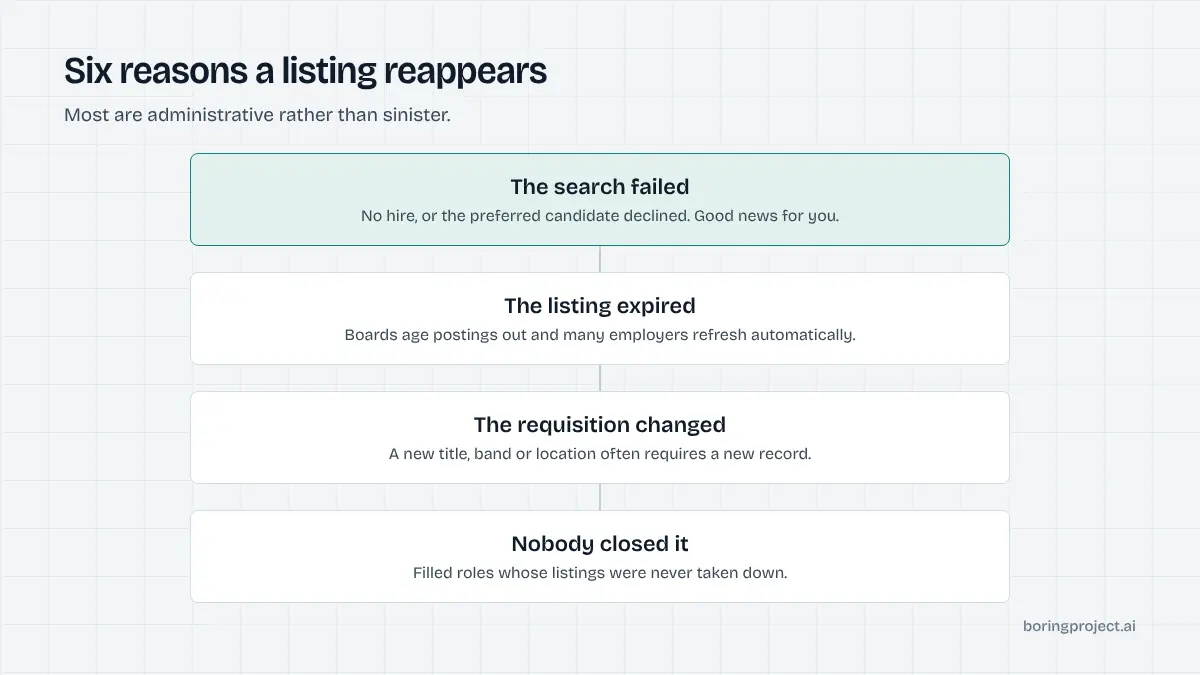
The six reasons
The search failed, or the listing simply expired
The most common answer to why do companies repost the same job is the dullest one. The shortlist did not produce a hire, the preferred candidate declined, or the offer fell through at the last stage. The team closes the requisition and opens it again to refresh the posting and restart sourcing. This is good news for a candidate: the role is real, and the employer has already demonstrated that their first attempt did not work.
The other mundane cause is expiry. Job boards age postings out, and many employers refresh automatically to keep visibility. A listing that reappears every thirty days is often the same unchanged requisition being renewed rather than anything new happening.
The requisition changed, or there are several openings
A change to the title, salary band, level or location frequently requires closing one requisition and opening another, because the original is tied to an approved budget line. The role looks reposted; administratively it is a different record, and that distinction decides whether your earlier application still exists.
Separately, one posting often covers multiple openings. As each is filled the requisition may be closed and reopened for the next, which looks identical from outside.
Pipeline building, or nobody closed it
Some employers keep a listing live to collect applications for anticipated openings rather than a current one. This shades into the ghost job complaint, and it is a genuine practice, though less universal than the internet suggests.
The last cause is the most ordinary. Requisitions are left open by accident more often than people expect: a role is filled, the listing is never taken down, and it continues attracting applications nobody reads. This is also the most common explanation for an application sitting untouched, covered in why an application says in progress.
Telling the difference
Check the requisition identifier
Many postings carry a requisition number in the URL or the page. A reposting with the same identifier is a renewal of the same record. A different one means a new requisition, which suggests a genuine amendment or restart.
Look at what changed
Compare the text. A changed salary band, seniority or location tells you the role was reshaped and your previous application may have been against a role that no longer exists. Identical text with a new date is usually just a refresh.
Watch the frequency
A posting that reappears every month for six months without any change is the pattern most consistent with pipeline building or an abandoned requisition. A role that reappears once, two months after you applied, is far more likely to be a failed search.
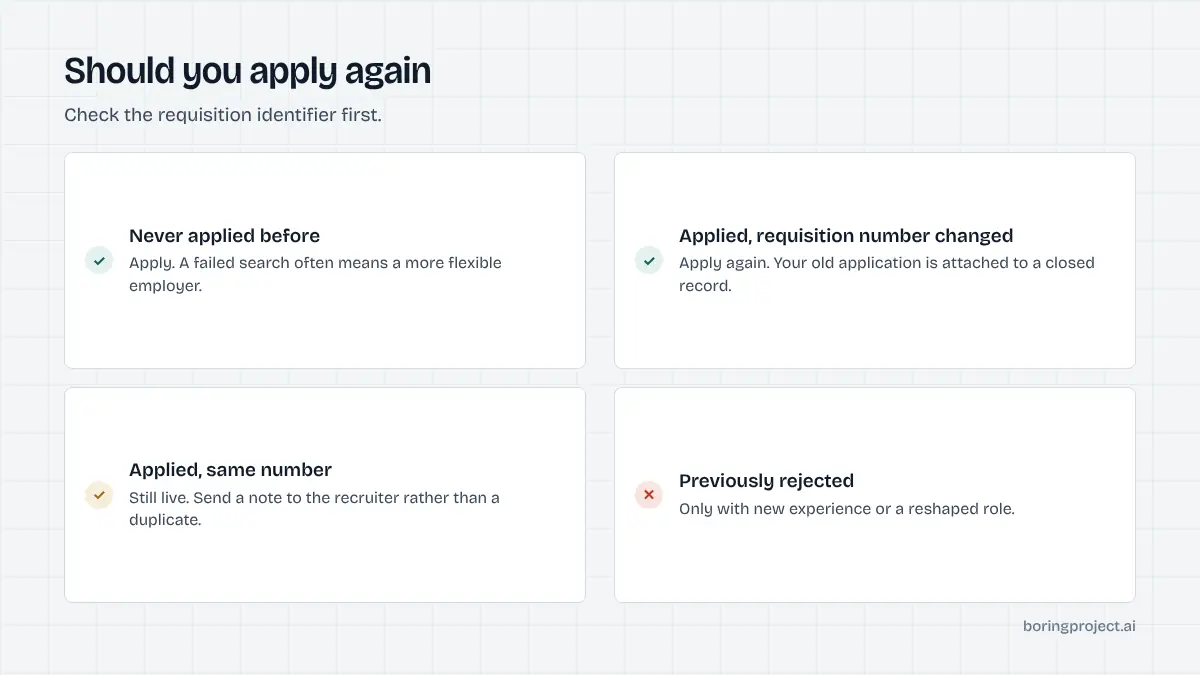
Should you apply again
If you never applied, apply
A reposted role is a normal opening and frequently a better opportunity than a fresh one, because a failed first search means the employer is more flexible and often more urgent.
If you applied and heard nothing, usually yes
When the requisition number has changed, your earlier application was attached to a record that no longer exists, so reapplying is the only way to be considered. When the number is the same, your application is still attached and a duplicate adds nothing, though a brief note to the recruiter costs little.
If you were rejected, only with something new
Reapplying after an explicit rejection works when something material has changed: new experience, a qualification you now hold, or a reshaped role with different requirements. Reapplying to the same requirements with the same profile reproduces the first outcome.
Reposted roles are where automated applying most often produces duplicates, since a tool sees a new listing and submits again. That creates repeated records against one employer and reads badly, as covered in what an applicant tracking system is. The Boring Project returns a receipt per application so duplicates are visible rather than silent.
Frequently asked questions
Why does the same job keep getting reposted?
Most often because the first search did not produce a hire, or because the listing expired on a timer and was automatically refreshed. Other common causes are an amendment to the title or salary that required a new requisition, several openings under one posting, pipeline building, and requisitions nobody closed after the role was filled.
Does a reposted job mean they rejected everyone?
Not necessarily, though a failed search is the single most common reason. It can equally mean the preferred candidate declined, the offer fell through, or the posting simply aged out and was renewed unchanged.
Should I reapply to a reposted job?
If you never applied, yes. If you applied and heard nothing and the requisition number has changed, yes, because your earlier application was attached to a record that no longer exists. If the number is unchanged, your application is still live and a duplicate adds nothing.
Is a reposted job a ghost job?
Sometimes, but less often than the internet suggests. Pipeline-building postings and abandoned requisitions do exist. A listing reappearing monthly for six months with no changes fits that pattern; a role reappearing once after a couple of months usually reflects a failed search.
How can I tell if the role is really open?
Check the requisition identifier in the URL or on the page, compare the posting text for changes to salary, level or location, and note how often it reappears. A new identifier with amended text is a genuine new requisition.
Will applying twice hurt my chances?
Duplicate applications against the same live requisition add nothing and can look careless. Applying to a genuinely new requisition for the same role does not count as a duplicate, since the earlier record is closed.
Next step
When you see a role reposted, check the requisition number against your record of the first application. If it changed, apply again. If it did not, send one short note to the recruiter instead of a duplicate application.