 The Boring Project
Is It Bad to Apply to Multiple Jobs at One Company?
Is it bad to apply to multiple jobs at the same company? Not in itself, and the pattern matters far more than the number; this covers what recruiters see when you are applying to multiple roles same company.
What the employer actually sees
One candidate record, several applications
People asking is it bad to apply to multiple jobs at the same company usually want to know what the recruiter can see. Inside an applicant tracking system you exist as a single candidate record in that employer's instance, with applications attached to specific requisitions. A recruiter opening your profile can usually see every role you have applied for at that company, including ones handled by colleagues.
So the premise of the question is right: it is visible. Whether it counts against you depends entirely on what the pattern says about you.
A focused pattern reads as interest
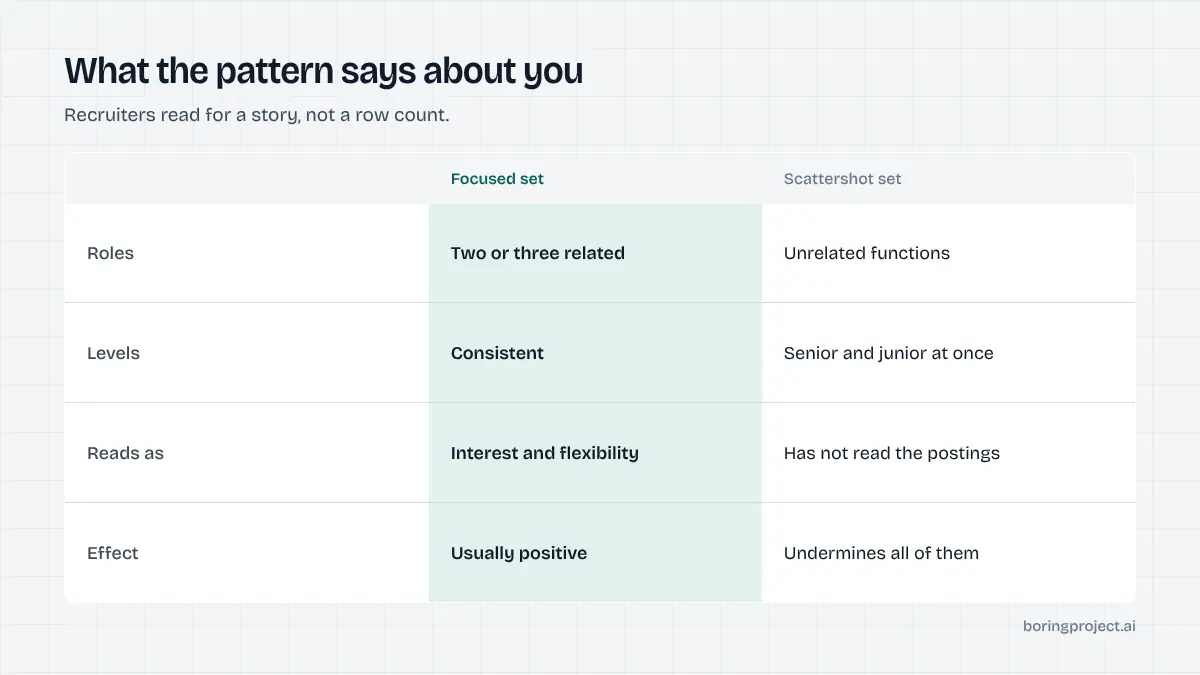
Two or three applications to related roles, at a level consistent with your background, reads as someone who wants to work there and is flexible about where they land. Recruiters generally regard that positively, and in many companies they will consider you for a sibling role without you applying separately.
A scattershot pattern reads as noise
Applications across unrelated functions, or spanning several seniority levels, read as someone applying to everything. That does damage, because it suggests you have not read the postings and are not a considered candidate for any of them.
The clearest version is applying to a senior role and a junior one in the same week. Whichever is the honest fit, the pair undermines both.
How many is too many
Two or three related roles is normal
There is no published limit and employers do not enforce one. In practice, two or three applications to genuinely related roles over a reasonable period is unremarkable and will not be held against you.
The number matters less than coherence and timing
So when people ask is it bad to apply to multiple jobs at the same company, the honest answer is that the count is not the issue. Five applications across one function at one level is more coherent than two applications across unrelated departments. Recruiters are reading for a story, not counting rows.
Three applications spread across six months read differently from three in one afternoon. The first looks like someone tracking a company they want to join. The second looks like someone who opened the careers page and applied to everything on it.
If you want to apply to a second role, a gap of a few weeks does most of the work in making the pattern read well, and it also gives the first application time to be looked at on its own.
Reapplying to the same role is different
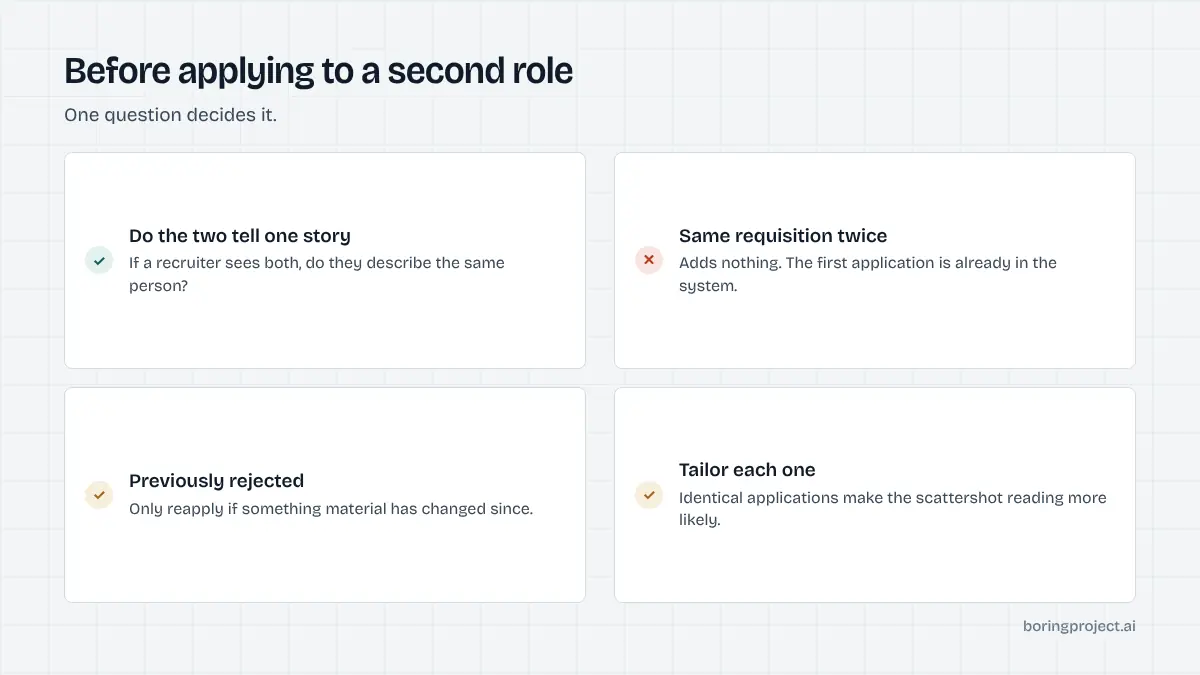
Applying twice to the same requisition creates a duplicate record and achieves nothing, since the first application is already in the system. Reapplying to a role you were previously rejected from is worth doing only when something has genuinely changed, such as new experience or a qualification you now hold.
Doing it well
Tailor each one, at least a little
If the roles differ meaningfully, the applications should too. Identical applications to three different jobs make the scattershot reading more likely, because the recruiter can see you did not distinguish between them.
Prefer the role you actually want
If you would clearly prefer one, apply to that one first and give it your best application. You can mention openness to related roles in a cover letter or in a first conversation, which often achieves the same outcome as applying to several without the pattern cost.
Expect recruiters to triage on your behalf
In many companies a recruiter who sees a strong candidate in the wrong requisition will move them, as covered in what an applicant tracking system is. That is an argument for making one excellent application rather than three mediocre ones, which is also how a resume survives the skim described in do recruiters actually read resumes.
Automated applying makes this pattern easier to create accidentally, since a tool matching loosely on keywords can submit you to six unrelated roles at one employer in a morning. That is the worst version of the scattershot pattern and it is invisible to you unless the tool reports what it submitted. The Boring Project returns a receipt for every application for exactly that reason.
Frequently asked questions
Can recruiters see all the jobs I applied for at their company?
Usually yes. You exist as one candidate record in that employer's system with applications attached to individual requisitions, and a recruiter opening your profile can typically see the full list, including applications handled by colleagues.
How many jobs can I apply to at one company?
There is no enforced limit. Two or three applications to genuinely related roles is unremarkable. The problem is never the raw count, it is whether the set makes sense together, since applications spread across unrelated functions and levels read as indiscriminate.
Does applying to multiple roles hurt my chances?
Only when the pattern is incoherent. A focused set at a consistent level reads as genuine interest and flexibility. Applications to a senior and a junior role in the same week undermine both, because they suggest you have not assessed your own fit.
Should I apply to the same job twice?
No. The first application is already in the system and a second creates a duplicate record without adding information. Reapplying later is worth doing only if something material has changed, such as new experience or a qualification you have since obtained.
Will a recruiter move me to a better-fitting role?
Often, yes. Recruiters routinely redirect strong candidates toward a more suitable open requisition. That is a good argument for one strong application rather than several weaker ones spread across the department.
Does automated applying make this worse?
It can. A tool matching loosely on keywords may submit you to several unrelated roles at one employer in quick succession, producing the scattershot pattern without your knowledge. Narrow the criteria and use a tool that reports exactly what it submitted.
Next step
Before applying to a second role at a company, ask whether the two applications tell a consistent story about what you do. If they do, apply. If they do not, pick the one you actually want and put the effort there.