 The Boring Project
Why Does My Application Say In Progress?
Why does my application say in progress? Because the role is open and nobody has dispositioned you, which is not the same as being read; this explains each status and the application under review meaning candidates misread most often.
What the status actually reports
It describes the record, not the attention
In progress means your application exists against an open requisition and has not been given a final disposition. That is the entire content of the message. It does not mean a recruiter has opened it, shortlisted it, or formed any view at all.
The reason why does my application say in progress feels like news is that the words suggest progress. This is the gap that makes the status so frustrating. Candidates read it as "being considered" because that is what the words suggest in ordinary English. In the system it is closer to "not yet closed".
Why it sits unchanged for weeks
A requisition stays open while hiring happens. A team may spend six weeks interviewing a shortlist of four people. During that time every other application remains exactly where it was, because nobody has a reason to touch them and most systems do not require a decision until the role closes.
When the role is finally filled, the remaining applications are frequently dispositioned in bulk. That is why hundreds of candidates receive rejection emails from the same company within the same hour, often months after applying.
The statuses that actually carry information
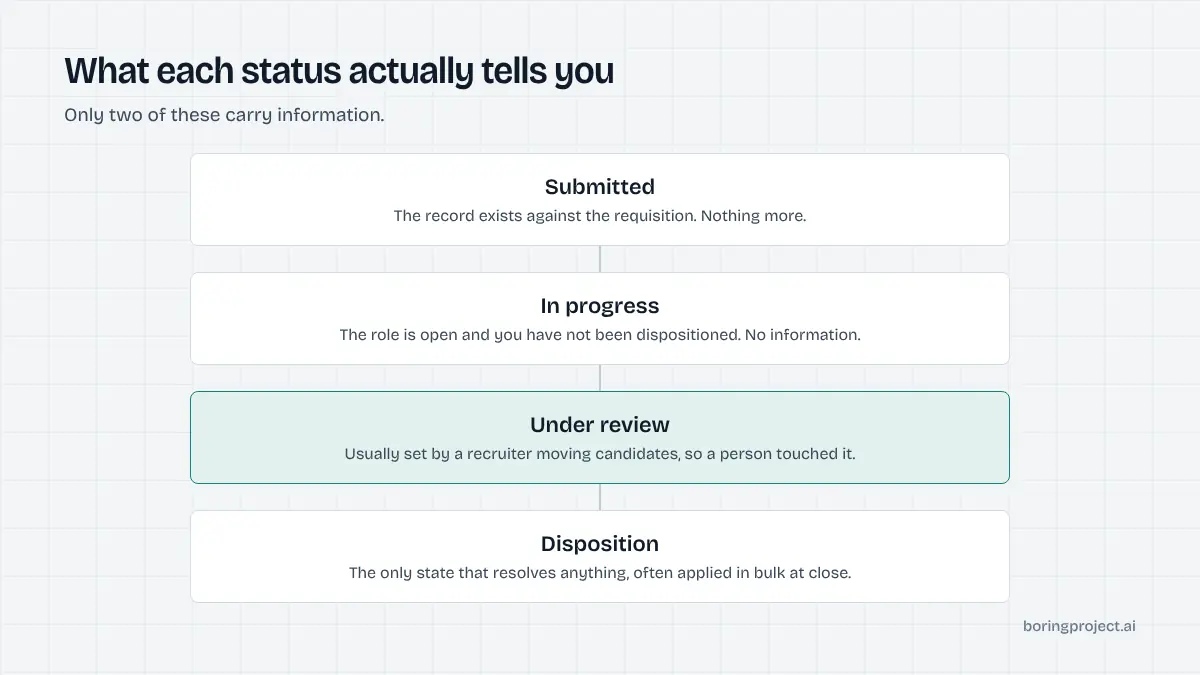
Submitted means the record exists. In progress means open and undispositioned. Under review is usually set by a recruiter moving candidates, so it does indicate human contact, though not necessarily a positive one. A final disposition is the only state that resolves anything.
The practical reading is that only two of those tell you much: under review means someone touched it, and a disposition means it ended. Everything else is the absence of news.
How to read the silence
Check the requisition, not the status
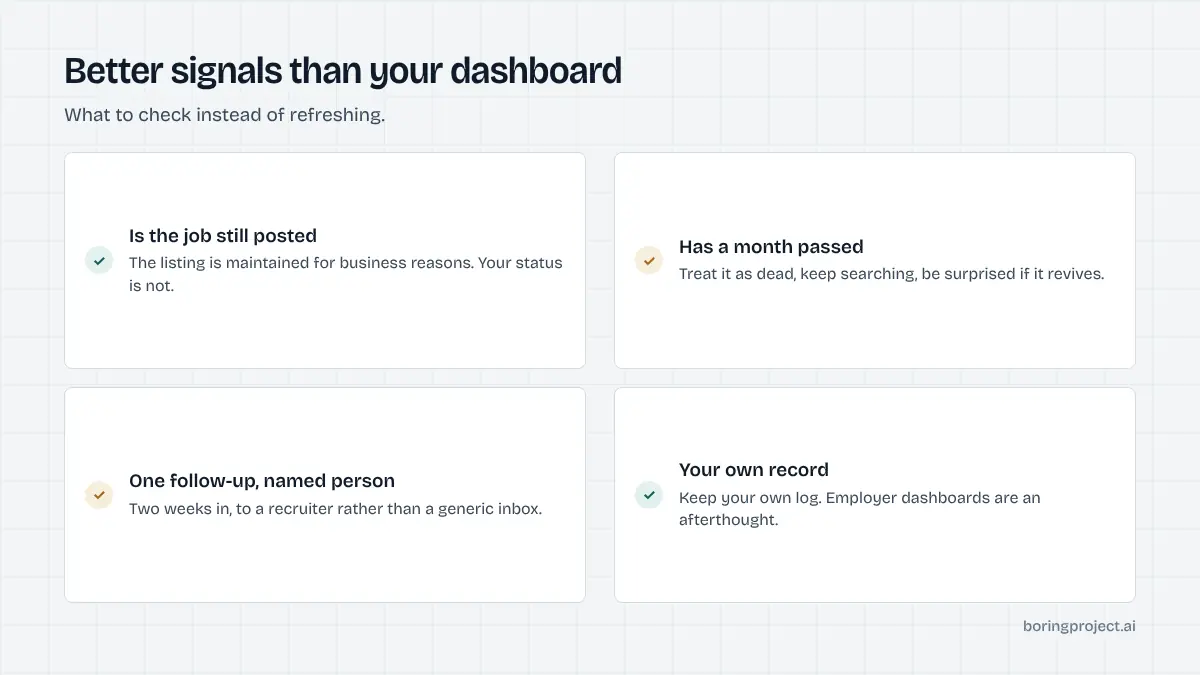
A more reliable signal than your dashboard is whether the job is still posted. If the listing has disappeared from the company's careers site, the role is likely filled or cancelled regardless of what your status says. If it is still up after two months, the process is slow or stalled rather than finished.
This is the single most useful habit, because the requisition is maintained for business reasons while your candidate-facing status is often an afterthought.
Expect no news
Most applications end without any notification at all. Teams close requisitions without dispositioning every candidate, systems have notification settings switched off, and emails land in spam. Treating silence as a rejection after a reasonable interval is realistic rather than pessimistic.
A sensible rule is to consider an application dead after a month of no contact, continue searching as though it does not exist, and be pleasantly surprised if it revives. Keeping your own record of what you sent and when is more reliable than any employer dashboard, which is the case for tracking applications yourself.
When following up helps
Following up is worth doing once, through a named person rather than a generic address, roughly two weeks after applying. A short message confirming continued interest occasionally surfaces an application that was overlooked.
What does not help is repeated follow-up, or messaging to ask why the status has not changed. The person receiving it usually cannot see anything you cannot see and has no answer to give.
Why systems behave this way
Nobody is required to tell you
Candidate communication is rarely a legal obligation and almost never an enforced one. The system is built to satisfy the employer's record-keeping and workflow needs, and the candidate-facing status is a by-product rather than a feature anyone is accountable for.
Each employer configures it differently
Two companies on the same product can behave completely differently. One sends an acknowledgement, a status change and a rejection. Another sends nothing from submission to silence. That variation is configuration, not the product, which is why advice about what a status means is so inconsistent between people. The same applies to Workday specifically, covered in does Workday auto reject applications.
What a well-built process looks like
The contrast is instructive. A process that acknowledges submission, reports a decision, and does so promptly costs very little to configure and is rare enough that candidates notice. When we file applications through The Boring Project we return a receipt for every attempt precisely because the alternative, not knowing what happened, is the normal state of this industry and it is a bad one.
Frequently asked questions
What does in progress mean on a job application?
It means your application sits against a requisition that is still open and has not been given a final disposition. It does not indicate that a recruiter has read it, shortlisted it or formed any opinion. It is best understood as the absence of a decision rather than evidence of consideration.
How long can an application stay in progress?
Indefinitely. Applications routinely sit unchanged for weeks or months while a team interviews a shortlist, and many are only dispositioned in bulk when the role finally closes. Some are never dispositioned at all, so the status simply stops changing.
What is the application under review meaning?
Under review usually indicates a recruiter has moved your record into a review stage, so unlike in progress it does imply human contact. It does not mean the review was favourable, and on some configurations it is applied automatically to everyone, so treat it as weak positive signal at best.
Should I follow up when my application says in progress?
Once is reasonable, about two weeks after applying, and ideally to a named recruiter rather than a generic inbox. Repeated follow-up does not help, and asking why a status has not changed rarely produces an answer, since the person reading your message often sees the same screen you do.
Does in progress mean I was not rejected?
Only that no rejection has been recorded. Plenty of applications are effectively dead while still showing an open status, because the team filled the role and never dispositioned the remaining candidates. Checking whether the job is still posted is a better signal than the status itself.
Why do I get rejections months after applying?
Because the requisition finally closed and the remaining applications were dispositioned in one batch. That is why large groups of candidates receive rejection emails from the same employer within the same hour, long after the role was actually filled.
Next step
Go and check whether the roles you are waiting on are still posted on the company's careers site. That takes two minutes and tells you more than any status field, because the listing is maintained for business reasons while your dashboard is not.