 The Boring Project
Do Cover Letters Still Matter in 2026?
Do cover letters still matter? In specific, predictable situations rather than universally; this sets out when one is actually read, and answers are cover letters necessary for the roles you are targeting.
When they are read and when they are not
On high-volume roles, usually not
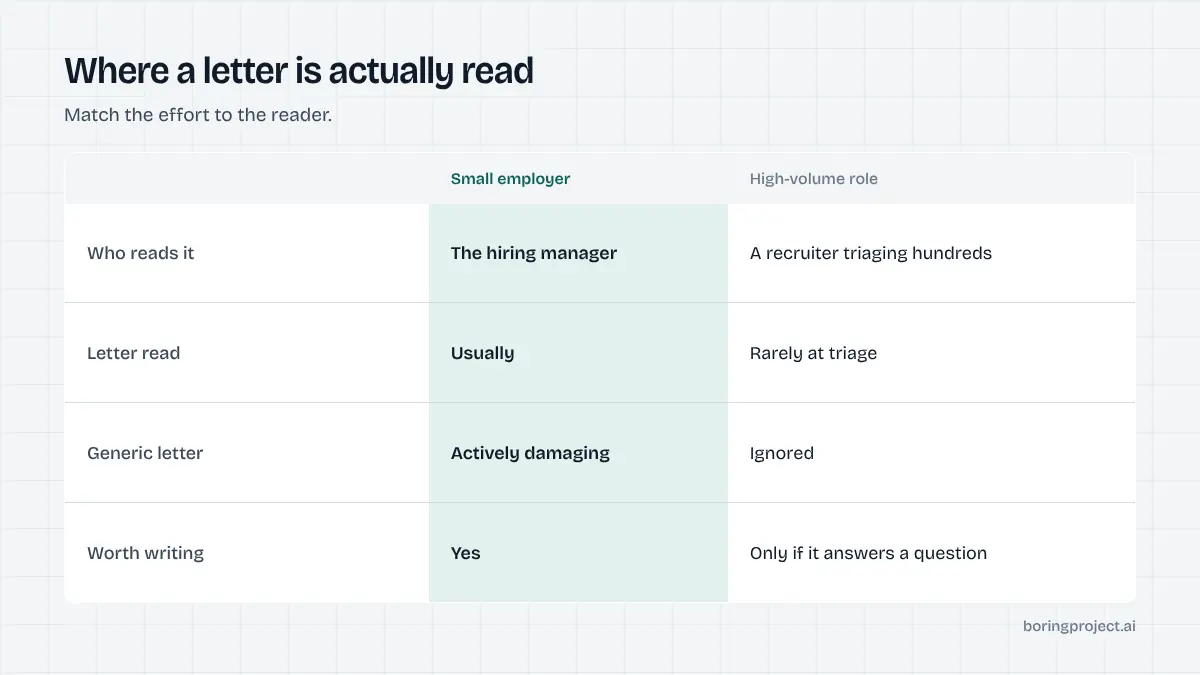
Asking do cover letters still matter only has an answer once you know who is reading. A recruiter triaging four hundred applications is scanning for title, employer and requirement match, as covered in do recruiters actually read resumes. A cover letter adds reading time per candidate at exactly the moment there is none available.
If the role is at a recognisable employer with hundreds of applicants, assume the letter will not be read unless something in the resume prompts someone to look further.
At small employers, often yes
Here do cover letters still matter flips to a clear yes. The picture inverts at companies without dedicated recruiters, where the hiring manager reads applications directly. They are looking at a smaller pile and they care about motivation and fit in a way a volume recruiter cannot afford to.
This is the clearest case where a letter changes outcomes, and it is also where generic letters do the most damage, because the reader is the person who wrote the job description.
When the resume raises a question, or the field exists
A career change, an employment gap, a relocation, a move between industries, or applying slightly outside your apparent level all create a question in the reader's mind. A short letter answering it directly is the only place in the application where you can.
Without one, the reader supplies their own explanation, and it is usually less favourable than the truth.
Some applicant tracking systems record whether a cover letter was supplied and some recruiters filter on it, as a rough proxy for effort. That varies by employer and is not something you can detect from outside, which is a mild argument for supplying one when the field exists. The underlying system behaviour is covered in what an applicant tracking system is.
What to write when it counts
Three short paragraphs
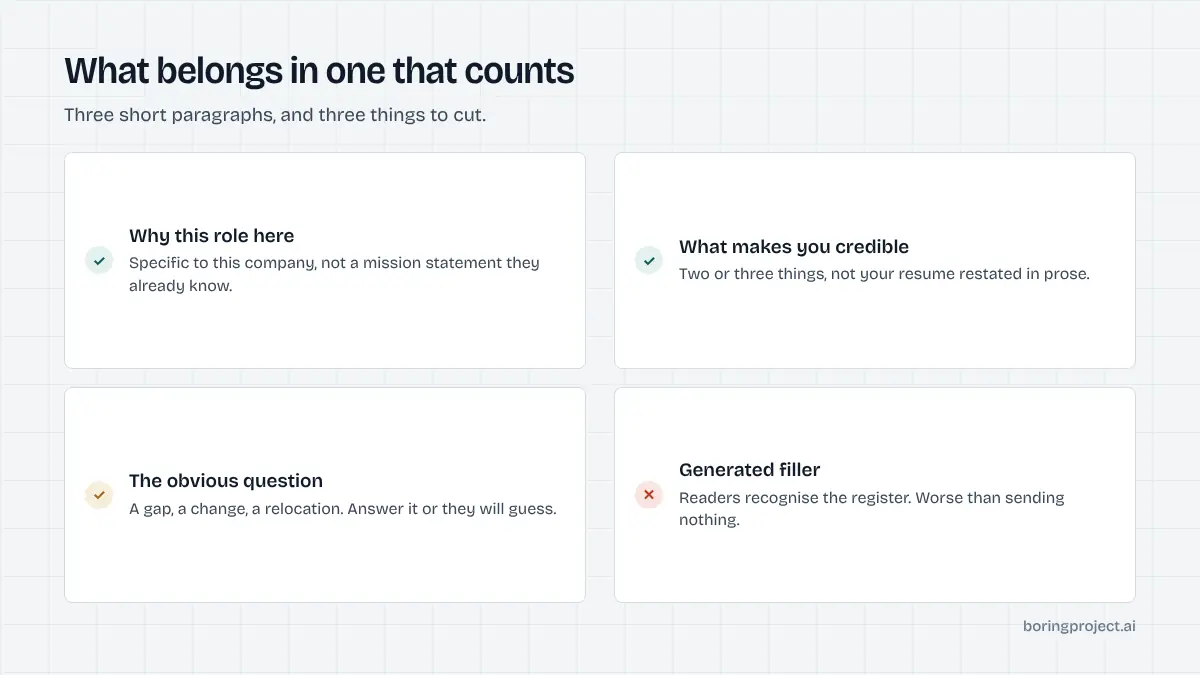
Why this role at this company specifically. The two or three things in your background that make you credible for it. What you want, stated plainly. Anything beyond that is rarely read even by someone who wanted to read it.
Answer the obvious question
If your application raises a question, that is the letter's job. Do not leave the career change unexplained and write a paragraph about being passionate instead.
Leave out the filler, generated filler included
The three things that consistently waste the reader's attention are restating your resume in prose, declaring enthusiasm without specifics, and a long opening paragraph about the company's mission that they already know. Cut all three.
Generated letters are now common enough that readers recognise the register. A generated letter that says nothing specific is worse than no letter, because it signals effort that was not actually spent. If you use a tool to draft, the specifics about this role and this company have to be yours.
A practical rule
Match effort to readership
Write a real letter when the employer is small, when the role matters to you, or when your application raises a question. Skip it, or use a short tailored paragraph, on high-volume applications where it will not be read.
Never send a generic one
The generic letter is the worst option available: it costs you time, it is not read on volume roles, and where it is read it actively damages you. If you are not going to tailor it, do not send it.
If you are applying at volume
Automated applying usually offers a generated letter per role, and this is the feature to treat with most scepticism. A plausible-sounding letter that invents motivation or experience is a claim made on your behalf. Tools that assemble a letter from facts you supplied are useful; tools that write whatever sounds good are not, which is the same distinction that matters across application infrastructure generally.
Frequently asked questions
Do cover letters still matter?
In specific situations rather than universally. At small employers where a hiring manager reads applications directly, they matter a great deal. On high-volume roles at large companies they usually go unread. They also matter whenever your application raises an obvious question, such as a career change or a gap.
Are cover letters necessary if the field is optional?
Supplying one is a mild positive, because some systems record whether a letter was provided and some recruiters use it as a rough proxy for effort. The stronger consideration is whether you will write a tailored one, since a generic letter is worse than none.
How long should a cover letter be?
Three short paragraphs is plenty: why this role at this company, what makes you credible for it, and what you want. Anything longer is rarely read even by a reader who intended to read it.
Does anyone read cover letters at large companies?
Often not at the triage stage, where a recruiter is scanning hundreds of applications for title and requirement match. A letter may be read later, if the resume has already prompted interest, which is an argument for making the resume do the initial work.
Should I use AI to write my cover letter?
Drafting with a tool is fine; sending something generic is not. Readers now recognise the register of a generated letter, and one that says nothing specific signals effort that was not spent. The specifics about this role and this company have to come from you.
What should I never put in a cover letter?
Your resume restated in prose, enthusiasm asserted without evidence, and a long opening about the company's mission that the reader already knows. Those three consume the attention you needed for the thing that actually makes you credible.
Next step
Sort your current applications into two piles: small employers or roles that matter, and everything else. Write real letters for the first pile only, and stop spending time on generic letters for the second.