 The Boring Project
Do Recruiters Actually Read Resumes?
Do recruiters actually read resumes? Yes, but briefly and not all of them; this covers what happens in the skim, how long do recruiters look at a resume in practice, and what survives it.
What actually happens to your resume
A person opens it, for a short time
Do recruiters actually read resumes? Yes: resumes are read by people. The widespread belief that a machine filters them out before any human looks is, for most employers, wrong: the applicant tracking system stores and organises applications rather than discarding them on content.
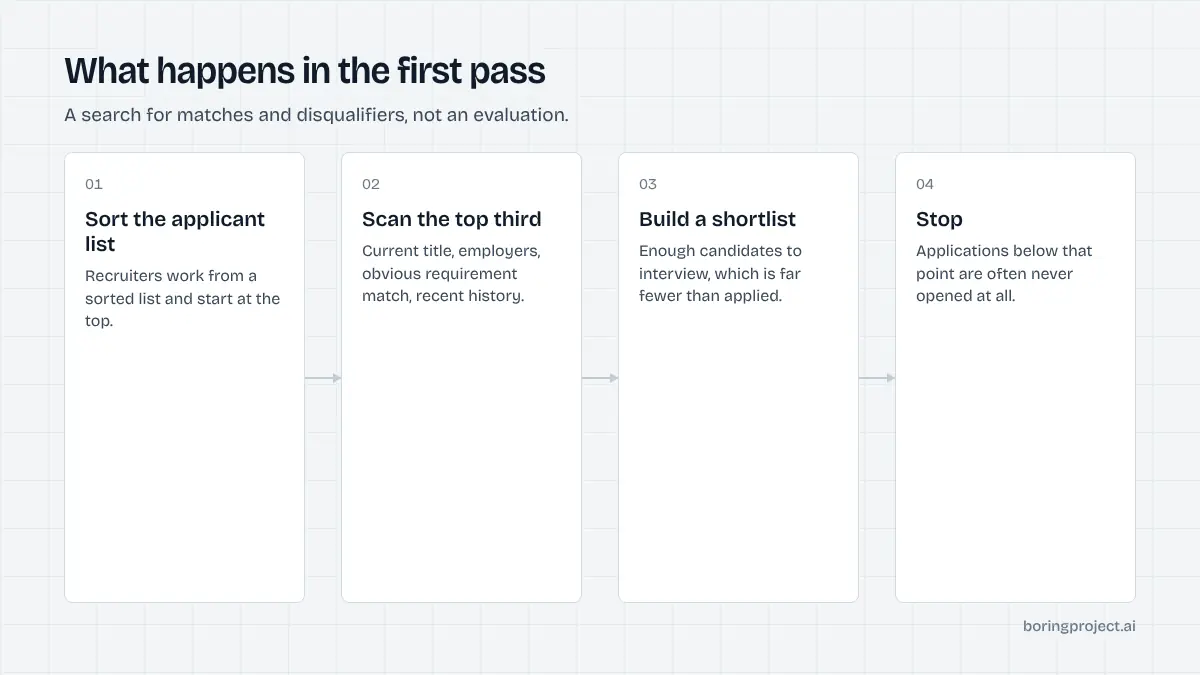
What is true is that reading is brief and not universal. A recruiter working a role with four hundred applicants will not give each one careful attention. They will sort the list, skim from the top, and build a shortlist long before reaching the end. That feels identical to being filtered by a robot, and it produces the same outcome, but the mechanism matters because it changes what helps.
What they are doing in those seconds
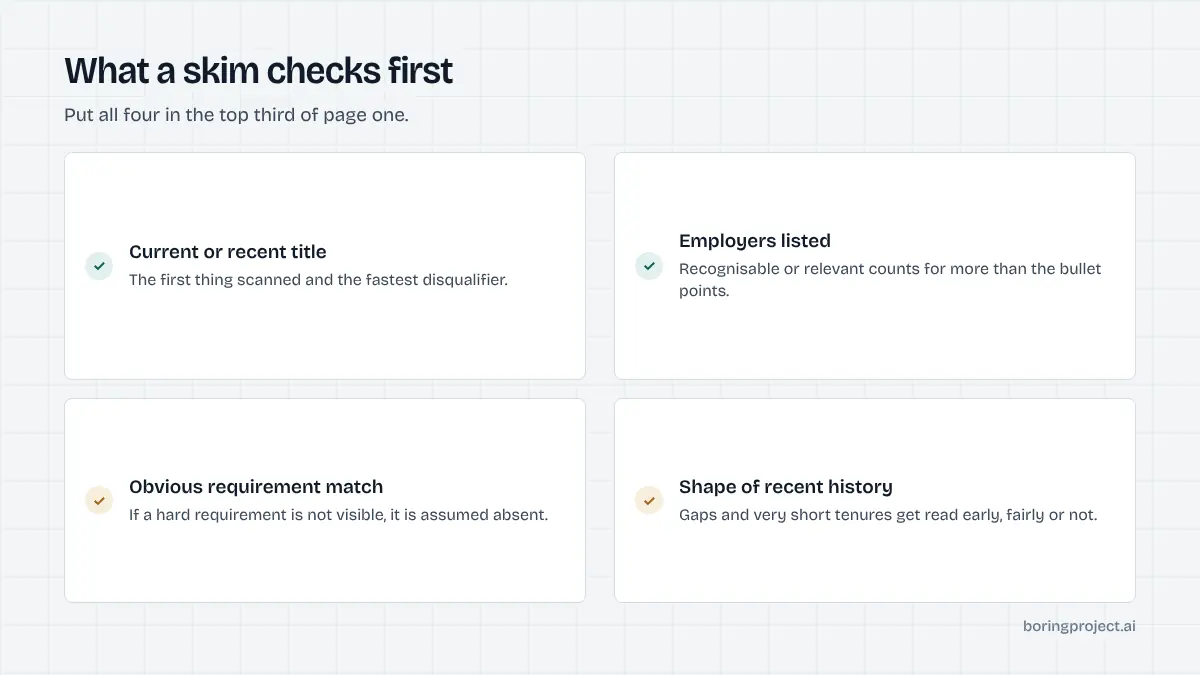
The first pass is not an evaluation, it is a search for disqualifiers and matches. Current or most recent title. Whether the employers listed are recognisable or relevant. Whether the obvious hard requirements appear anywhere. Length and shape of the recent history.
A resume that answers those four things in the top third survives the pass. One that buries them under a profile paragraph, a skills matrix and a list of hobbies often does not, not because the content is bad but because the reader did not reach it.
Not every application is opened
This is the part people find hardest to accept. On a high-volume role, some applications are never opened at all. The recruiter builds a shortlist from the first portion of a sorted list and stops when they have enough people to interview.
That is why applying early genuinely matters more than most resume advice does, and why response rates fall as a posting ages.
What survives a skim
The top third carries everything
Whatever matters most should be visible without scrolling. Your current title, your most recent employer, and the two or three things that make you credible for this specific role. If a hiring manager would need to know it to decide whether to talk to you, it belongs above the fold.
Plain structure beats design
A single-column document with plain headings reads faster and parses more reliably. Multi-column layouts, tables and text inside headers cause two separate problems: a recruiter's eye has to work harder, and the system parses fields incorrectly so you are harder to find in a database search. Our note on what an applicant tracking system is covers the parsing half.
Language from the posting, not keyword stuffing
Using the actual terms of the role helps, because recruiters search the database with those terms and because it signals you read the posting. Stuffing a wall of keywords does not help and reads badly to a person, which is the audience that decides.
The common advice to optimise for a machine score leads people to do the opposite of what works, since the score they are optimising for mostly does not exist. The one genuinely automatic filter is the screening questions, covered in does ATS auto reject.
What this changes
Apply earlier
Since shortlists fill from the top of a sorted list, timing is a lever most candidates ignore. An application sent in the first days of a posting is read in a different context from one arriving after two hundred others.
Stop optimising for the wrong reader
A great deal of resume advice is addressed to an imaginary AI gatekeeper. The real reader is a busy person giving you a few seconds. Write for them: clear titles, legible structure, the relevant facts first, no decoration that slows the eye.
If you are hiring rather than applying
The volume problem is genuine and it is getting worse, with automated applying increasing the number of applications per role. Teams respond by tightening screening questions, which filters out suitable candidates alongside unsuitable ones. When we file applications through The Boring Project we return a receipt for every attempt, because the only way to improve this is for both sides to know what actually happened to an application.
Frequently asked questions
Do recruiters actually read every resume?
No. On a high-volume role, a recruiter sorts the list, skims from the top and builds a shortlist before reaching the end, so some applications are never opened. The ones that are opened are read briefly, looking for a match and for disqualifiers rather than being evaluated in depth.
How long do recruiters look at a resume?
Briefly, and the widely quoted six or seven second figure comes from eye-tracking studies rather than from anything measured inside hiring software. The useful takeaway is not the exact number but the behaviour: the first pass is a scan for title, employer and obvious requirement match, not a careful reading.
Is my resume rejected by AI before a human sees it?
For most employers, no. Applicant tracking systems store and organise applications rather than discarding them on resume content. The automatic filter that does exist is the screening questions on the form, where an employer can mark particular answers as disqualifying.
What do recruiters look at first?
Current or most recent job title, the employers listed, whether obvious hard requirements appear, and the shape of recent history including any gaps. If those are visible in the top third of the first page, the resume survives the first pass.
Does a longer resume get read more thoroughly?
Usually the opposite. Length increases the chance that the relevant material is buried below where the reader stops. Two pages is unremarkable for an experienced candidate, but everything that decides the shortlist should still appear in the first third of page one.
Does applying early actually help?
Yes, more than most resume changes do. Because shortlists are built from the top of a sorted list and recruiters stop once they have enough candidates, an application sent in the first days of a posting is considered in a far less crowded context than one arriving later.
Next step
Open your resume and look only at the top third of page one. If your current title, your most relevant employer and the main requirement of the roles you are targeting are not all visible there, that is the edit worth making before you send another application.