 The Boring Project
What Is an Applicant Tracking System?
What is an applicant tracking system? A database with a hiring workflow attached, not a gatekeeper that reads your resume; this explains how does an ats work in practice and which ones you will meet.
What the software actually is
A database with a workflow on top
An applicant tracking system is the software an employer uses to receive, store and move candidates through hiring. It has three parts: the careers site and application form you interact with, a database holding every applicant record, and a workflow where recruiters and hiring managers move candidates between stages.
So what is an applicant tracking system, stripped of the mythology? That is the whole of it. The mental model most candidates carry, of a gatekeeper AI reading resumes and deciding who is worthy, describes something these products largely do not do. The software's primary job is organisation: keeping thousands of applications attached to the right requisition with an audit trail.
What it does with your application
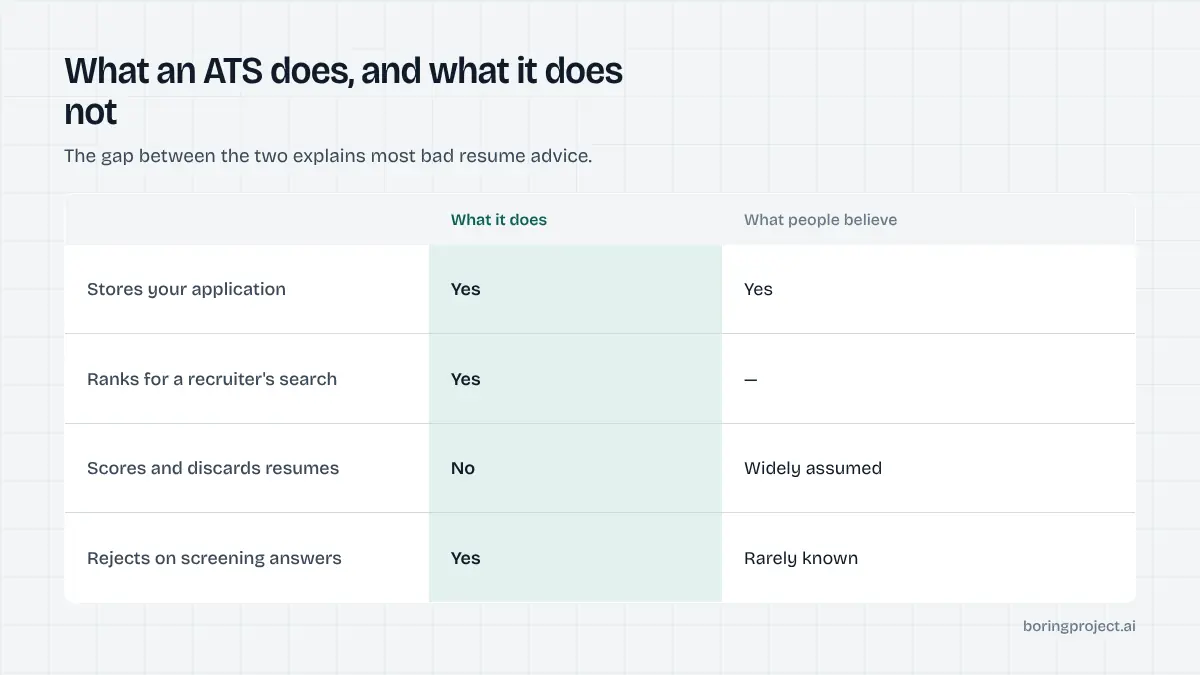
When you submit, three things happen. The system parses your resume into structured fields so the record is searchable. It evaluates any screening questions the employer configured. It attaches the record to the requisition and places it in a queue.
Only the middle step can end your application on its own, and only when the employer has marked specific answers as disqualifying. The parsing step does not judge, it transcribes. This distinction is the single most misunderstood thing about these systems and we cover it fully in does ATS auto reject.
Why employers buy one
Record-keeping obligations, mostly. Hiring carries legal requirements around data retention, equal opportunity reporting and demonstrating a consistent process. A spreadsheet of applicants does not satisfy those. Add a few hundred applications per role and you need software to attach each one to the right job with a documented history.
Candidate experience is not the primary design goal, which explains a great deal about how these forms feel to fill in.
The systems you will actually meet
A small number dominate
Most published roles route to a dozen or so systems. Workday, Greenhouse, Lever, iCIMS, Taleo, SuccessFactors, SmartRecruiters, Ashby and Workable cover an enormous share of what you will encounter, with Workday concentrated among large enterprises and Greenhouse, Lever and Ashby common in technology companies.
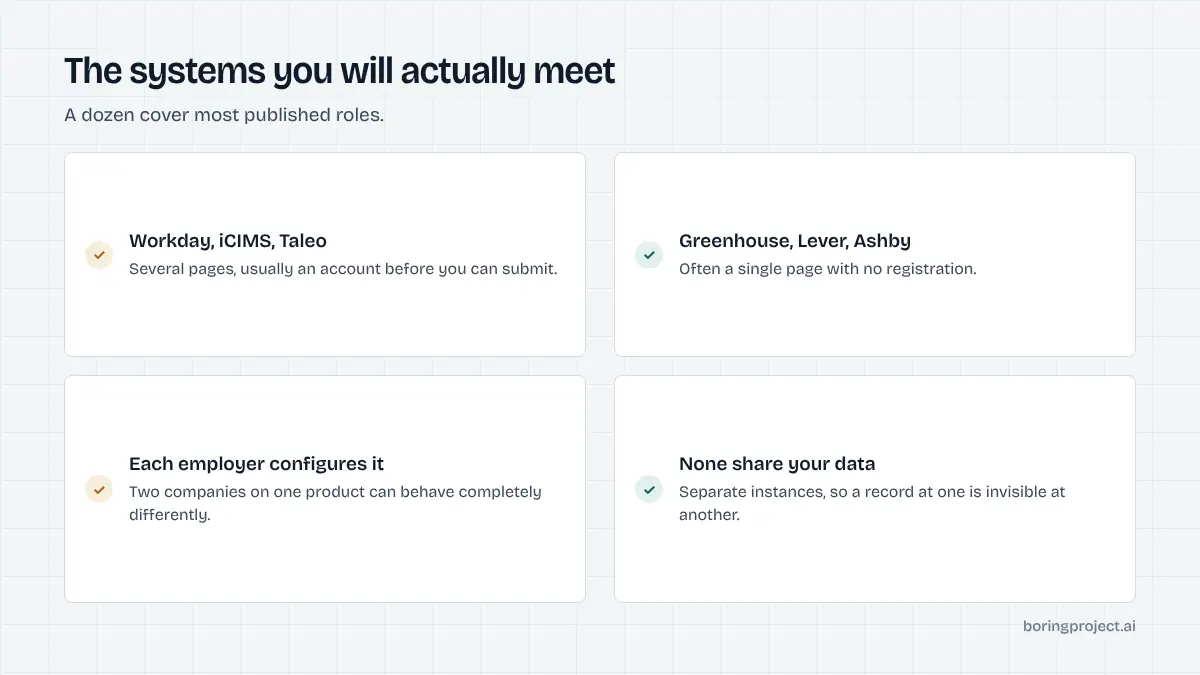
Knowing which you are in tells you what to expect. Greenhouse, Lever and Ashby are typically a single page with no account. Workday, iCIMS and Taleo tend to span several pages and often require registration before you can submit.
Each employer configures its own
Two companies using the same product can behave completely differently. One enables knockout questions aggressively, another has none. One sends rejection emails on a schedule, another never sends them.
This is why advice about "how the ATS works" is often contradictory: people are describing different configurations of the same software. The product sets what is possible; the employer decides what is switched on.
What it does not do
It does not score your resume against the job description and discard you below a threshold. It does not read your cover letter with AI and form an opinion. It does not share your record with other employers, even when they use the same vendor, because each runs an isolated instance.
Formatting still matters, but for retrieval rather than rejection: tables, columns and text in headers parse unreliably, so your record ends up with blank or misplaced fields and you become harder to find when a recruiter searches.
What this means for applying
Optimise for the human, with a parseable document
Since a person decides and a database stores, the two jobs are different and both easy. Make the document parse cleanly: single column, plain headings, no text inside headers or images, contact details in the body. Then write it for the recruiter who will skim it, using the actual language of the role rather than keyword stuffing.
Treat the form as the risky part
The resume affects whether someone is interested. The screening questions affect whether anyone ever looks. Those questions are the only automatic filter in the system, which makes them worth more care than most candidates give them. Our guide to how ATS screening questions work covers what they can and cannot ask.
If you are building on the other side
Every one of these systems exposes a different form, different field names and different submission behaviour, and they change without notice. Any product that applies on behalf of users has to maintain an adapter per system, forever. That is the work our job application API does: one schema across 40+ of them, with a receipt for every submission.
Frequently asked questions
What is an applicant tracking system in simple terms?
Software an employer uses to collect and manage job applications. It provides the careers site and application form, stores every applicant as a record in a database, and gives recruiters a workflow to move candidates through stages. It is primarily an organisational and record-keeping tool rather than a decision-making one.
How does an ATS work when I submit an application?
It parses your resume into structured fields so the record can be searched, evaluates any screening questions the employer configured, then attaches your record to that specific job and places it in a queue for review. Only the screening questions can end the application automatically.
Does an ATS score my resume?
Most do offer search and ranking tools that help a recruiter sort candidates, but that is ranking within a list rather than a pass or fail score that deletes applications. Recruiters who administer these systems consistently report never configuring content-based automatic rejection.
Which applicant tracking systems are most common?
Workday, Greenhouse, Lever, iCIMS, Taleo, SuccessFactors, SmartRecruiters, Ashby and Workable account for a large share of published roles. Workday is concentrated among large enterprises, while Greenhouse, Lever and Ashby are common in technology companies and usually involve shorter forms.
Do different companies share ATS data?
No. Each employer runs its own isolated instance with its own database, even when several use the same vendor. Your record at one company does not exist at another, which is also why you create a separate account for each employer on systems like Workday.
Does resume formatting matter for an ATS?
Yes, but for findability rather than rejection. Tables, multi-column layouts, text inside document headers and skills rendered as images parse unreliably, producing a record with missing or misplaced fields. The application is still submitted; you are simply harder to retrieve and your profile looks thin.
Next step
Find out which system you are applying through by looking at the URL when the application opens: myworkdayjobs.com, greenhouse.io, lever.co and ashbyhq.com are all visible in the address bar. That tells you how long the form will take before you start it.