 The Boring Project
Why Am I Not Hearing Back From Job Applications?
Why am I not hearing back from job applications? There are four distinct causes and they need different fixes; this helps you work out which one is producing your no response from job applications.
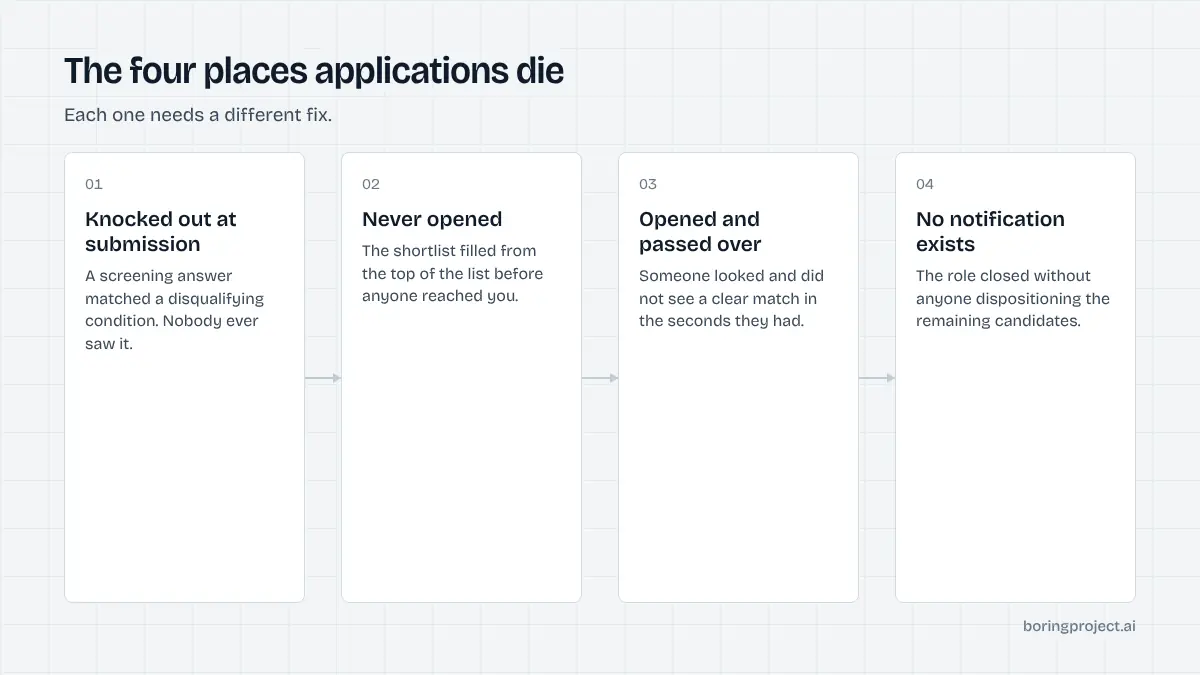
The four places applications die
Knocked out at submission
Ask why am i not hearing back from job applications and this is the cause nobody suspects: the fastest and least visible failure. If the employer configured a screening question with a disqualifying answer, the application closed the moment you submitted, before any person saw it. You often receive nothing at all, or a rejection within minutes.
This is the one people never suspect, because they are examining their resume when the cause was a yes or no field. The mechanism is covered in does ATS auto reject.
Never opened
On a role with several hundred applicants, a recruiter sorts the list, works from the top and stops once they have a shortlist. Applications below that point are not rejected on their merits, they are simply never reached.
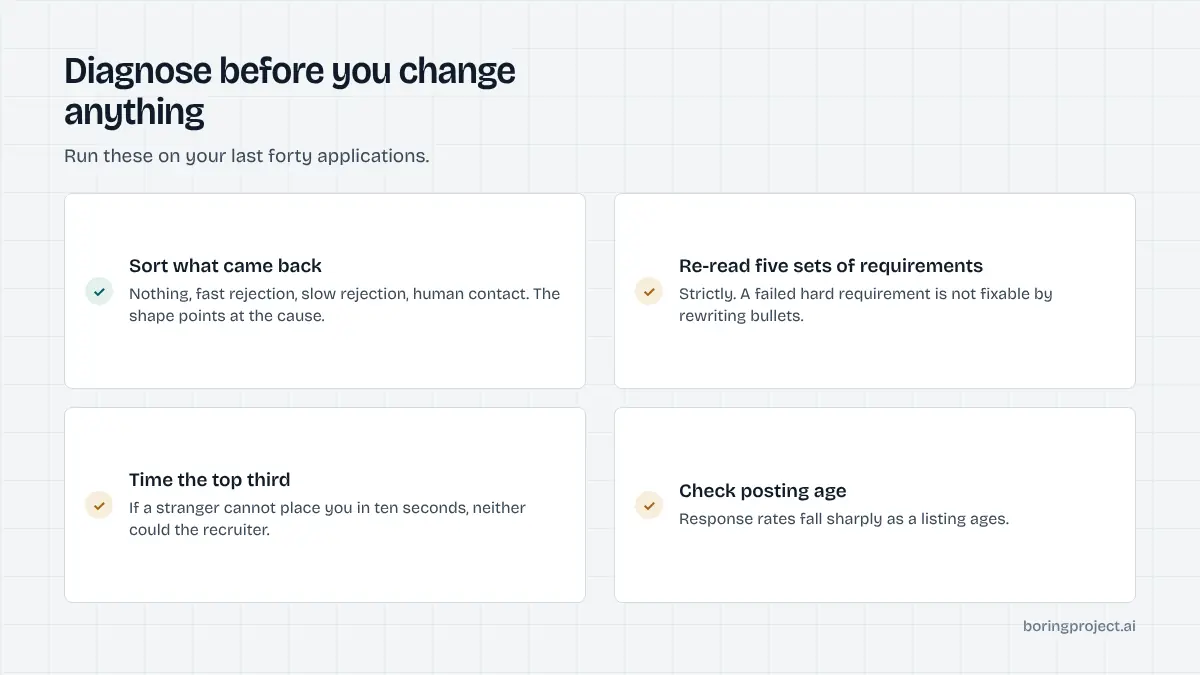
The signal here is timing: response rates drop as a posting ages, and applications sent in the first days do far better than the same application sent in week three.
Opened and passed over
The ordinary case. Someone looked, did not see a clear match, and moved on. If this is your failure point, the fix is upstream of applying: either the roles are not ones you fit, or your resume is not making the match visible in the top third of page one.
A large share of applications end with no notification at all. Teams close requisitions without dispositioning everyone, notification settings are off, and emails land in spam. Silence is often not a decision, it is the absence of a process. That is why a status can sit unchanged indefinitely, covered in why an application says in progress.
Working out which one is yours
Count, do not guess
Working out why am i not hearing back from job applications is a counting exercise rather than a guessing one. Take your last forty applications and sort them into four buckets: no response at all, fast rejection, slow rejection, and any human contact. The shape tells you a lot.
Mostly fast rejections points at screening answers. Mostly nothing at all, with some slow bulk rejections, points at volume and timing. A few human contacts that went nowhere points at fit or pitch rather than at the application itself.
Check the hard requirements honestly
Go back to five roles you heard nothing from and read the requirements again, strictly. Work authorisation, licences, years of experience, location, on-site expectations. If you failed a stated hard requirement on several of them, you have found your answer and it is not fixable by rewriting bullets.
Check what your resume shows in ten seconds
Look at the top third of page one. Current title, relevant employer, the main requirement of the roles you want. If a stranger could not tell in ten seconds that you are plausible for the role, neither could the recruiter.
What actually helps
Apply earlier rather than more
Since shortlists fill from the top of a sorted list, timing beats volume on high-competition roles. Searching for newly posted roles and applying in the first days is a larger effect than most resume edits.
Slow down on the questions, speed up on the form
The screening questions are the only step that rejects you outright, and they take thirty seconds to read properly. The rest of the form is transcription that adds nothing to your candidacy. Reversing the usual time allocation is free and it directly removes one of the four failure modes.
Accept the silence and keep moving
Treating an application as dead after a month is realistic. Follow up once, to a named person, around two weeks in. Beyond that, the effort is better spent on the next application. If you are building a product in this space, The Boring Project returns a receipt for every submission, because not knowing what happened is the normal state of this industry and it does not have to be.
Frequently asked questions
Why do I never hear back from job applications at all?
Usually one of four things: a screening answer knocked you out at submission, your application was never opened because the shortlist filled first, a recruiter looked and did not see a match, or the employer simply never sends notifications. Silence is frequently the absence of a process rather than a decision about you.
Is it normal to get no response from job applications?
Yes, and it is the majority experience on high-volume roles. Many employers do not disposition every candidate, and plenty of requisitions close without anyone sending a rejection. The absence of a reply carries much less information than it feels like it does.
How long should I wait before assuming rejection?
About a month is a realistic cut-off. Continue your search as though the application does not exist, and treat any later contact as a bonus. Checking whether the job is still posted is a better signal than waiting on a status field.
Does following up help?
Once, about two weeks after applying and ideally to a named recruiter rather than a generic inbox, is worth doing and occasionally surfaces an overlooked application. Repeated follow-up does not help, and the person reading it usually sees the same information you do.
Could my resume format be causing this?
Format rarely causes rejection, but it causes two real problems: it parses badly, so your record has missing fields and you are harder to find in a database search, and it slows the reader down so the relevant facts are not seen in the few seconds you get. Single column and plain headings fix both.
Should I apply to more jobs if nothing is coming back?
Not before diagnosing. If forty well-aimed applications produced nothing, four hundred more will reproduce the result. Check hard requirements first, then timing, then whether your resume makes the match visible immediately.
Next step
Take your last forty applications and sort them by what came back: nothing, fast rejection, slow rejection, human contact. The shape of that list points at which of the four causes is yours, and each one has a different fix.