 The Boring Project
Job Application Automation for Recruiters
A guide to candidate-side submission as one of the recruiter productivity tools worth adopting: when it fits, how contract staffing teams use it, and the compliance rules that keep it clean.
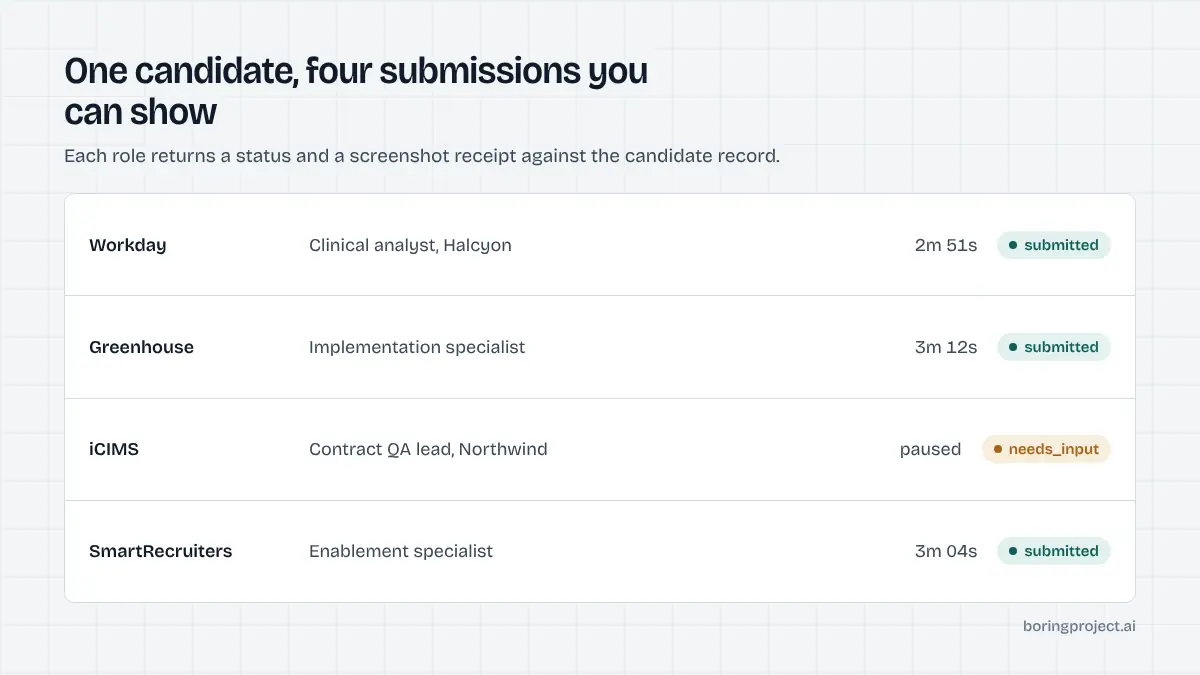
Most recruiter tooling points at the employer side of the funnel: sourcing, outreach, scheduling, ATS hygiene. Very little helps with a task agencies do every day, which is getting a candidate they represent into an employer's application pipeline.
That gap matters more than it used to. Bench talent in contract staffing, candidates in reverse-recruiting programs, and placed workers rolling off assignments all need to be submitted to roles the agency does not control. This article covers how automation handles that work and what a recruiting team should insist on before switching it on.
What candidate-side submission means for a recruiting team
Submitting into employers you do not control
When an agency owns the requisition, the candidate goes into the agency's ATS and the client sees a shortlist. When the agency does not own the requisition, the candidate has to apply through the employer's public careers page, usually on Workday, Greenhouse, iCIMS, Taleo, SuccessFactors or a similar system.
Candidate-side automation takes a job URL and the candidate's profile, fills that external form, submits it, and returns a status with a screenshot of the confirmation page. The recruiter's job shifts from typing into forms to choosing roles and reviewing receipts.
Where it fits in the stack
Treat it as a block that sits next to your CRM rather than a replacement for anything. Sourcing and outreach tools find and engage people. The CRM holds the relationship. The apply layer takes a candidate record plus a target role and comes back with evidence of submission.
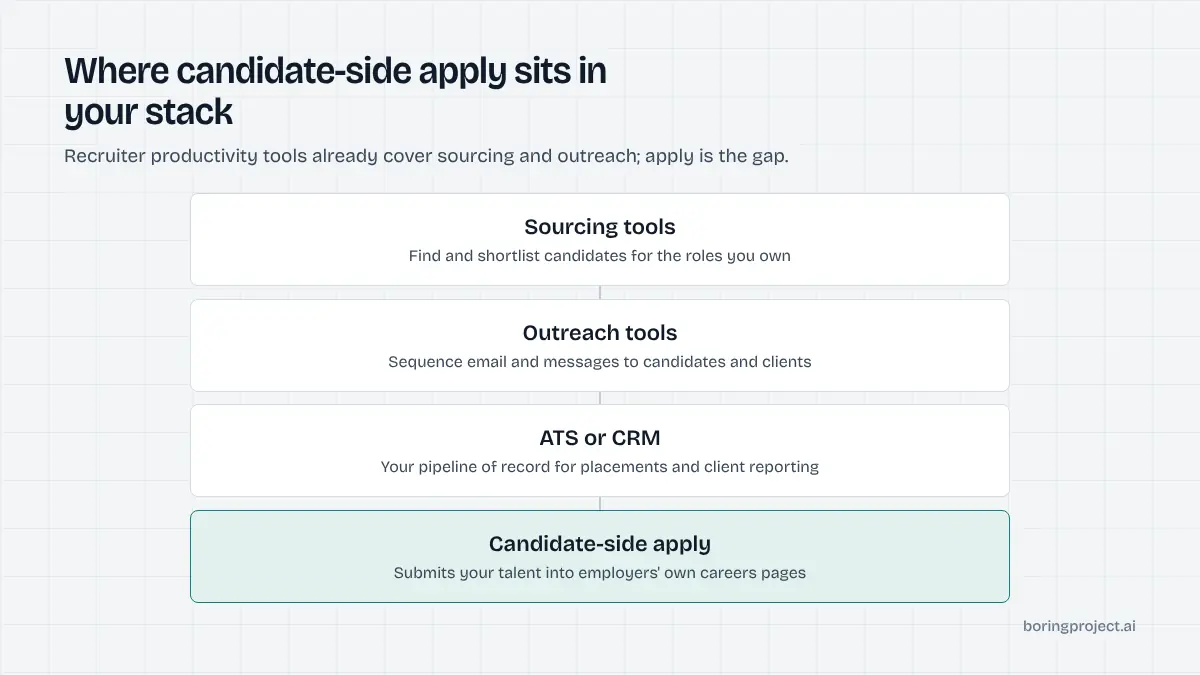
The webhook is the integration point. When an application resolves, your CRM receives the status and the receipt and attaches them to the candidate. Nothing else in your workflow needs to change.
Three use cases that pay off quickly
Contract staffing benches are the most obvious. A consultant rolling off a six-month engagement needs a next assignment, and the agency benefits from getting them in front of many employers quickly. Reverse-recruiting services, where the candidate pays the agency to run their search, are a second case; submission volume is the product.
The third is outplacement. Companies that pay an agency to support laid-off staff want to show those employees were actively put in front of opportunities, and a receipt per application is the cleanest proof.
Compliance rules that keep automation defensible
Consent per candidate, per role
The non-negotiable rule is that the candidate agreed to be submitted to that employer. Not "agreed to be represented" in general, but agreed to that role, or to a clearly described category of roles. Keep the record. If a candidate later asks why they were submitted somewhere, you should be able to show the approval.
Recruiters sometimes treat a signed representation agreement as blanket permission. For external applications it is not enough, because the employer is receiving the candidate's personal data directly. Our compliance checklist for automated job applications goes through the full set of controls.
Never fabricate screening answers
Employer forms ask about work authorisation, security clearance, relocation, salary expectations, and role-specific qualifications. Automation that guesses at those answers to get a submission through is a liability. The candidate can be disqualified later, and your agency's name is attached.
The correct behaviour is to pause. A needs_input status with a list of the specific missing fields lets the recruiter or candidate answer once, after which the submission completes. Build your process around that pause rather than trying to eliminate it.
Rate limits and employer relationships
Agencies live on employer relationships, which is why volume needs a ceiling. Submitting the same candidate to twelve roles at one company in an afternoon reads as spam to the hiring team. Per-employer rate limits, enforced by the tool rather than by recruiter discipline, keep that from happening.
A related point is targeting. Automation makes it cheap to apply broadly, but employers remember agencies whose candidates were obviously unqualified. Use the time you save on typing to be stricter about fit.
Choosing an approach: API or managed service
API integration for teams with engineering
If your agency has a product team or a technical ops person, integrating the apply API into your CRM is straightforward. A candidate record plus a job URL becomes a request; a webhook brings back the result. Recruiters never leave the CRM, and all reporting stays in one place.
This route suits agencies with steady volume and an appetite for building their own workflow around needs_input handling and receipt storage.
Managed service for everyone else
Plenty of agencies have no engineers and no desire to hire one for this. A managed service takes a spreadsheet of candidates, profiles and target roles and returns receipts. It is slower to iterate on but requires nothing beyond an exported list.
We describe the trade-offs in more detail in our piece on managed job application services for businesses. The short version: start managed if you are unsure about volume, move to the API when the spreadsheet becomes the bottleneck.
Comparing the two
| Consideration | API | Managed |
|---|---|---|
| Setup | Engineering sprint | Send a CSV |
| Reporting | Inside your CRM | Receipts returned to you |
| Best for | Ongoing volume | Pilots, seasonal pushes |
| Pricing basis | Per successful application | Per successful application |
Both are priced per successful application, so the decision is about workflow rather than cost structure. If you want a wider market view, our staffing-agency tool roundup compares the main options on the same criteria.
Frequently asked questions
Is it legitimate for a recruiter to submit applications on a candidate's behalf?
Yes, when the candidate has agreed to it and the submission uses the candidate's own accurate information. Recruiters have always helped candidates apply; automation just removes the typing. The line you must not cross is submitting without consent or inventing answers to screening questions. Keep a record of the candidate's approval for each role.
How is this different from the agency's own ATS?
Your ATS tracks candidates you are placing into roles you own. Candidate-side automation submits your talent into employers' external careers pages, which your ATS cannot reach. The two complement each other: the apply tool returns a status and receipt that you log against the candidate record in your system.
What happens when an employer's form asks something we do not have?
The application pauses with a needs_input status and a list of the missing fields. Your recruiter or the candidate fills the gap and the submission resumes. Automation should never guess at work authorisation, salary expectations, clearance status or similar fields, because a wrong answer damages the candidate and your agency's reputation with that employer.
Will employers penalise automated applications?
Employers care about relevance and accuracy, not the mechanism of submission. Applications arrive through their own careers page with real candidate data and a real resume. Problems come from volume that looks like spam, so apply per-employer rate limits and only target roles where the candidate is a plausible fit.
How should we report this to clients and candidates?
Each application returns a screenshot receipt and a status. Share receipts with candidates so they know exactly where they were submitted. Internally, track submitted versus needs_input versus failed by employer and ATS, and connect those to downstream interviews and placements in your CRM so you can judge whether the extra volume is paying off.
Do we need engineers to use this?
Not necessarily. Teams with a product or ops engineer can integrate an API directly into their CRM so submissions trigger from a candidate record. Teams without that capacity can use a managed service: send a spreadsheet of candidates and target roles, receive receipts back. Many agencies start managed and move to the API once volume justifies it.
Next step
If your team submits candidates into external careers pages every week, job application automation for recruiters removes most of that typing without changing your CRM. Talk to us about which route fits your volume and we will set up a short pilot.