 The Boring Project
Job Application Automation Compliance Checklist
Job application automation compliance in practice: the controls that matter for candidate consent automation, data accuracy, rate limiting, retention, employer terms and privacy law. This is general guidance, not legal advice.
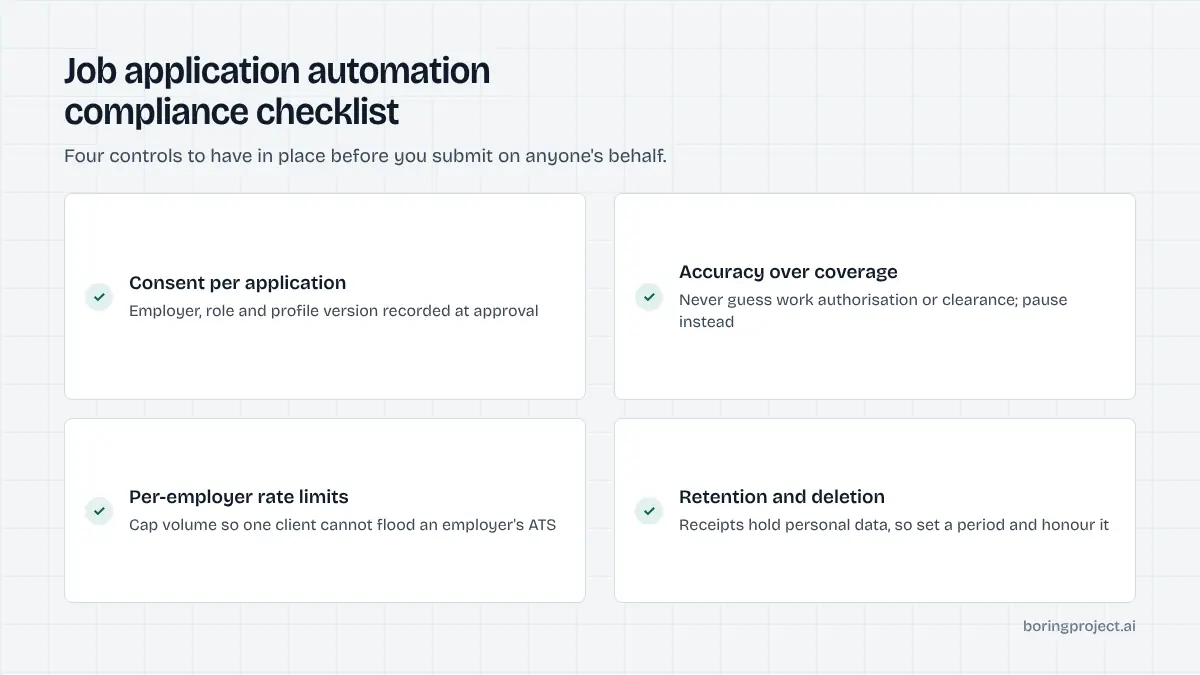
Job application automation compliance is unglamorous work, because automating applications touches personal data, third-party websites and the candidate's reputation with employers. None of that is new; recruiters and career advisors have submitted applications for people for decades. What changes with automation is scale, and scale turns small process gaps into systemic problems.
This checklist is written for product teams adding auto apply to their platform and for staffing or career-services teams buying it. Work through each section, write down your answer, and revisit it when your volume grows.
Consent and accuracy
Consent per application, recorded
The candidate should agree to be submitted to a specific employer and role, or to a clearly described set of roles, using a specific version of their profile. Record the timestamp, the scope and the profile snapshot. If the profile is edited later, earlier approvals should not silently extend to new content.
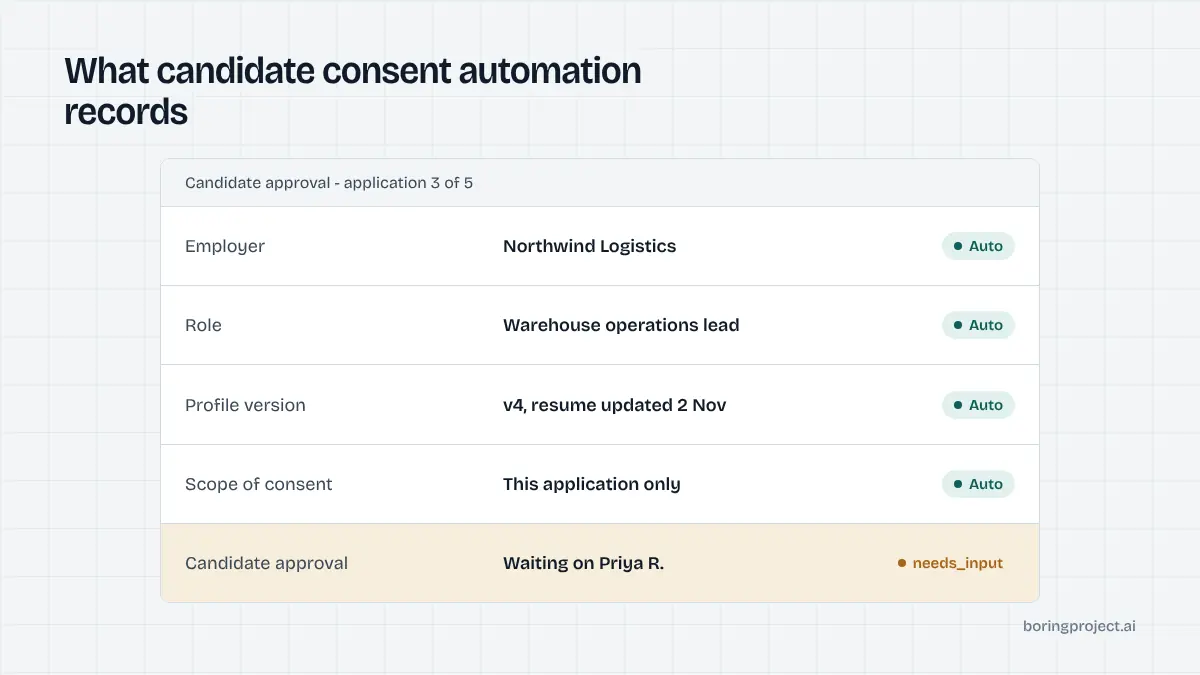
Consent must also be easy to withdraw. A withdrawal should cancel queued applications immediately and be logged just as carefully as the original approval. Teams that treat a signup checkbox as blanket permission tend to regret it the first time a candidate asks why they were submitted somewhere they did not expect.
Accuracy over completion
Employer forms ask questions the profile may not cover: work authorisation, clearance, relocation, salary expectations, licence numbers, role-specific skills. The temptation is to fill something plausible so the submission goes through. Resist it. A fabricated answer can disqualify the candidate later and may constitute misrepresentation.
The correct design is a pause. The application stops with a needs_input status and a list of the exact fields; the candidate answers; the submission resumes. We cover the design patterns in how automation should handle screening questions.
Transparency to the candidate
Every submission should produce evidence the candidate can see: which employer, which role, when, and a screenshot of the confirmation. Receipts close the loop and give the candidate a way to spot errors early. They also protect your business if a dispute arises about what was sent and when.
Volume, retention and third-party terms
Rate limits per employer
Automation makes it cheap to submit many applications, and that is exactly why you need a ceiling. Dozens of applications to one employer in an hour, from one platform, reads as spam to the hiring team and can get your candidates' applications discarded wholesale.
Enforce per-employer rate limits in the system rather than relying on user discipline. Apply them across all your users, not just per candidate, because the employer sees aggregate volume. Pair limits with relevance checks so that volume goes to roles where the candidate is a plausible fit.
Data retention and minimisation
Collect only the profile fields you need to complete applications. Store receipts and screenshots for a defined period that matches a documented purpose, then delete or anonymise them. Screenshots of confirmation pages contain personal data and belong under the same retention policy as the profile itself.
Write the retention schedule into your privacy notice and build the deletion job before you need it. Retroactively cleaning up years of screenshots is far more expensive than scheduling deletion from day one.
Employer and ATS terms of service
Careers sites and applicant tracking vendors publish terms, and some address automated access. Review the terms for the platforms and employers you target and keep notes on anything restrictive. Submitting a genuine application for a real, consenting candidate through the standard form is a different act from scraping or credential sharing, but the distinction is for your counsel to assess, not for your engineers to assume.
Privacy law and vendor due diligence
GDPR and CCPA basics
If any candidate is in the EU, the UK or California, assume the relevant data protection regime applies. The practical obligations are familiar: a lawful basis for processing, clear notice about what you do with the data, minimisation, retention limits, security measures, and a working process for access and deletion requests.
Decide who is the controller and who is the processor between you and any vendor. In a typical setup the platform that owns the candidate relationship is the controller and the application-submission vendor is a processor, which means you need a data processing agreement. Confirm the specifics with your legal team.
Questions for an automation vendor
Any vendor that submits applications on your behalf should be able to answer these in writing: Do you require candidate consent on every application? Do you ever fabricate screening answers? What are your per-employer rate limits? What do you retain, for how long, and where? Can you sign a data processing agreement? Do you provide a receipt per submission?
| Control | What good looks like |
|---|---|
| Consent | Per application, timestamped, revocable |
| Accuracy | Pause on unknown fields, never guess |
| Rate limits | Enforced per employer, platform-wide |
| Retention | Documented schedule, automated deletion |
| Receipts | Screenshot per confirmed submission |
| Contracts | DPA available, terms reviewed |
Building compliance into the integration
If you are integrating an API rather than running a managed workflow, the controls above map to concrete features: a consent flag required on each request, a needs_input status you must handle, rate limits enforced server-side, and a webhook carrying the receipt. The API documentation describes each of those surfaces. Staffing teams submitting on behalf of placed talent will find more operational detail in our guide to job application automation for recruiting teams.
Frequently asked questions
Is automated job application submission legal?
Submitting an application on someone's behalf, with their informed consent and accurate data, is a long-standing practice that recruiters and career services have always performed manually. Automation does not change the legal character of the act. What creates risk is submitting without consent, misrepresenting the candidate, or violating a specific site's terms. This article is general guidance, not legal advice.
What does valid candidate consent look like?
The candidate should know which employer, which role or category of roles, and which profile data will be sent, and should affirmatively agree. Record the time, the scope and the profile version. Consent should be revocable, and a revocation should stop any queued applications. A single checkbox at signup that covers all future submissions is a weak basis.
Do GDPR and CCPA apply to our automation?
If you process personal data of people in the EU, UK or California, the relevant regimes likely apply regardless of where your company sits. Core obligations include a lawful basis, transparency about processing, data minimisation, retention limits and honouring access and deletion requests. Map which party is controller and which is processor, and confirm with counsel for your situation.
Can automation answer screening questions for the candidate?
Only from data the candidate provided or explicitly approved. Fields such as work authorisation, security clearance, disability status and veteran status must never be guessed. The safe pattern is to pause with a needs_input status, collect the answer from the candidate, and resume. Any automation that fabricates answers to get past a form puts the candidate and your business at risk.
How long should we keep application receipts?
Long enough to serve the purpose you collected them for, and no longer. Candidates benefit from receipts while their search is active, and your business may need them for a dispute window. Set a retention period, document it in your privacy notice, and delete or anonymise on schedule. Screenshots contain personal data and should be treated as such.
What about employer website terms of service?
Many careers sites and ATS vendors publish terms that address automated access. Read them for the employers and platforms you target. Submitting a genuine application for a real, consenting candidate through the normal form is very different from scraping or credential abuse, but your legal team should review how specific terms apply to your use case.
Next step
The Apply API requires candidate consent on every request, never fabricates screening answers, enforces per-employer rate limits and returns a screenshot receipt for each submission. Start with the API documentation, or contact us if you would rather have the controls run for you under Managed Applies.