 The Boring Project
ATS Integration for Job Applications Across 40+ Systems
ATS integration for job applications is the layer that lets software submit a candidate's application into whatever system an employer uses, without a public API to call. This page explains how per-system adapters work, why applicant tracking system integration for applying is harder than it looks, which systems are covered, and how new ones get added.
Why there is no apply API to call
If you have integrated with an ATS before, it was probably from the employer side. Greenhouse, Lever, Workday and the rest expose APIs that let an employer's tools read candidates, post jobs and move people between stages. None of them let an outside party submit an application into an arbitrary employer's account.
The employer-side model
ATS APIs are authenticated per employer tenant and scoped to that employer's data. An integration partner (a sourcing tool, an HRIS, a background check vendor) is granted access by the employer.
A candidate, or a product acting for a candidate, has no tenant and no credentials. From the ATS vendor's point of view there is nothing to expose.
The form is the interface
The only sanctioned way in is the public application form on the employer's career site. That form is also where the employer's screening logic, consent language and EEO collection live, so bypassing it would be wrong even if it were possible.
Any product that applies on a candidate's behalf therefore drives the form, with real browser sessions, exactly as the candidate would. This is what we mean by a job application API: an API in front of forty form-driving adapters.
Why that is hard
Forms are built for people, not programs. They vary by vendor, by version, by employer configuration and sometimes by job.
They include account creation, email verification codes, multi-page wizards, conditional questions, file validation and bot detection. A reliable integration has to handle all of it and know when to stop and ask rather than guess.
How an adapter works
An adapter is a specialist for one ATS family, and it is the unit of applicant tracking system integration on the apply side. The apply service detects which system a posting uses and hands the work to the matching adapter.
Detection
Postings are identified by URL patterns, page markup and known hosting domains. A Greenhouse board, a Workday tenant subdomain, a Taleo career section and an employer's custom site fronting iCIMS all have signatures.
Detection also identifies the variant, since one employer's Workday flow may include steps another's does not. When detection is uncertain the service prefers to fail fast with an unsupported status rather than start a flow it may not be able to finish, because a half-completed application is worse for the candidate than no application.
Navigation and field mapping
The adapter knows the sequence of pages and the inputs on each. It maps the candidate profile onto those inputs: name, contact, address, authorisation, history, education, links, attachments.
Where the ATS runs its own resume parser and pre-fills fields badly, the adapter corrects them from the structured profile rather than trusting the parse. Screening questions are matched semantically against known answers; anything unmatched halts the application with a needs_input status rather than a default.
Verification, confirmation and receipts
Many systems require creating an account and verifying an email with a one-time code. Adapters handle the inbox round trip.
At the end, the adapter must positively recognise the confirmation page, not merely the absence of errors, before reporting submitted, and it captures a screenshot as the receipt. Failures are classified into reason codes so your product can tell a closed job from a blocked session.
Coverage and how it grows
Coverage is what you are really buying with ATS integration for job applications. The question to ask any vendor is not "do you support Workday" but "which Workday variants, and how do you know they still work this morning".
Systems covered today
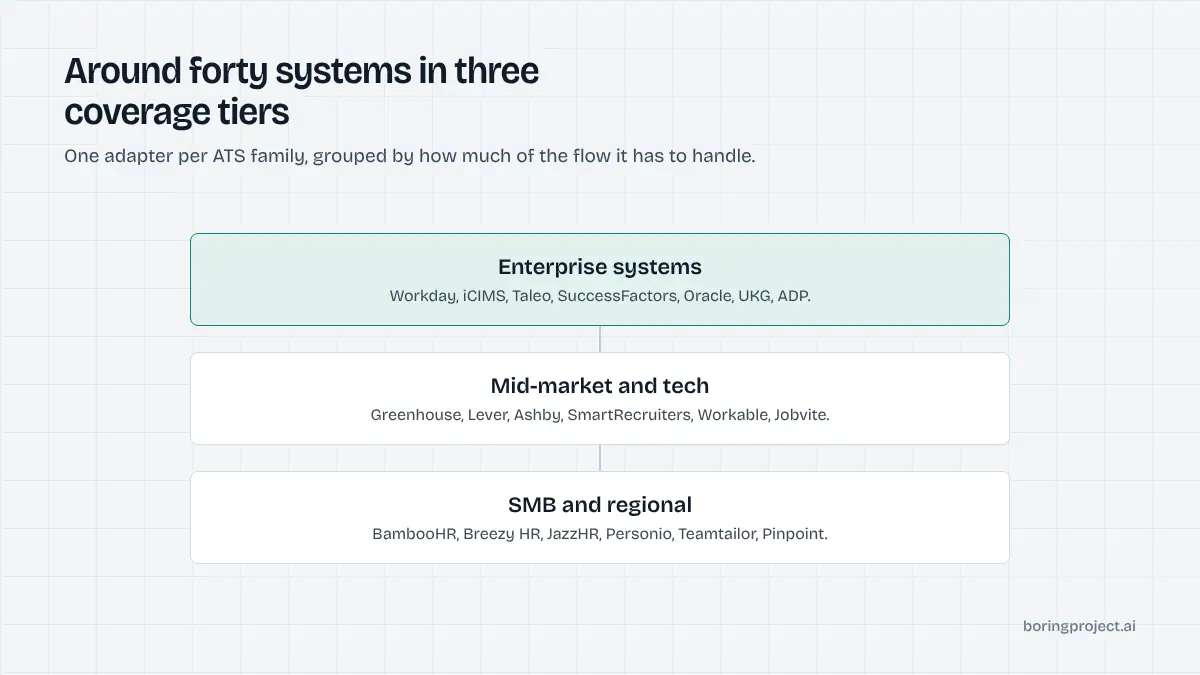
| Category | Systems |
|---|---|
| Enterprise | Workday, iCIMS, Taleo, SuccessFactors, Oracle Recruiting Cloud, UKG, ADP Workforce Now, Dayforce, Paylocity, Phenom, Eightfold |
| Mid-market and tech | Greenhouse, Lever, Ashby, SmartRecruiters, Workable, Jobvite, Rippling |
| SMB and regional | BambooHR, Breezy HR, JazzHR, Recruitee, Personio, Teamtailor, Pinpoint |
That is the core of around forty systems in total, plus employer career sites built on top of them. Enterprise systems account for a disproportionate share of engineering effort because of account creation, verification and multi-step wizards. They also account for a large share of the roles that agencies and reverse recruiters care about, which is why they are maintained first when something changes.
How new systems get added
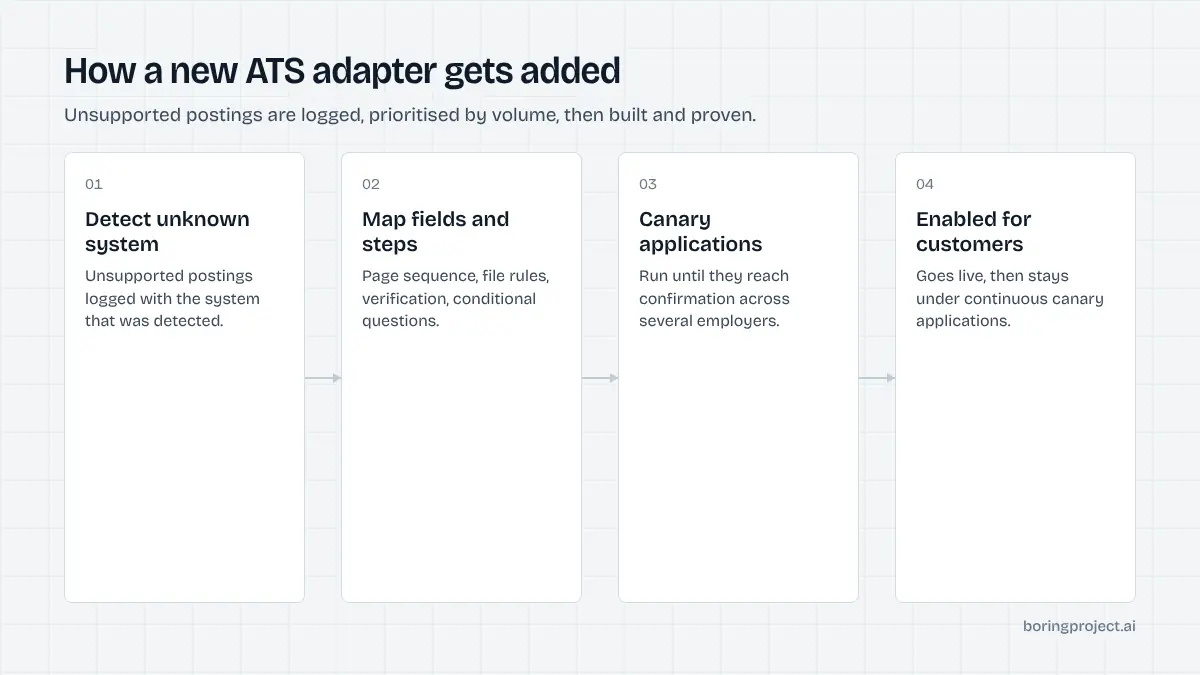
Unsupported postings are logged with the detected system and counted across all customers. Systems are prioritised by volume and by customer requests.
Building a new adapter means mapping the flow, handling its verification and file rules, writing the confirmation check, and then running canary applications until they pass consistently across several employers. Only then is it enabled for live traffic. The same process applies to a significant new variant of an existing system.
Customers see this as a changing coverage list and occasional notices that a previously unsupported system is now live. If you track unsupported-ATS failures on your side, you can re-queue those applications once the adapter ships rather than losing them.
Keeping it working
Every supported system has scheduled canary applications running continuously. A canary that fails to reach confirmation pauses the adapter, routes affected live applications to a holding state, and alerts an engineer.
Fixes are usually small; the value is in knowing within hours rather than hearing from customers days later. This standing cost is the main reason teams choose to buy rather than build, which we lay out in build vs buy for job application automation.
Frequently asked questions
Why is there no public API to submit a job application?
ATS vendors sell to employers, and their APIs serve employer needs: posting jobs, reading candidates, moving stages. Letting third parties push applications into any employer's account would bypass the employer's own form, screening logic and consent capture. So the only sanctioned entry point for a candidate is the public application form, which is what adapters drive.
What is an ATS adapter?
A piece of software that knows how one applicant tracking system's application flow works: how to detect it, navigate its pages, map profile fields to its inputs, upload files, handle account creation and verification, answer screening questions from provided data, and recognise the confirmation page. Each ATS family has its own adapter, with variants for employer customisations.
Which applicant tracking systems are covered?
Coverage includes Workday, Greenhouse, Lever, iCIMS, Taleo, SuccessFactors, SmartRecruiters, Ashby and Workable, plus others such as Jobvite, BambooHR, Rippling, Breezy HR, JazzHR, UKG, ADP, Paylocity, Dayforce, Oracle Recruiting, Phenom, Eightfold, Recruitee, Personio, Teamtailor and Pinpoint, around forty systems in total. The list grows as new systems reach meaningful volume.
What happens when a job is on an unsupported system?
The request returns a failed status with an unsupported-ATS reason code and no partial submission. Unsupported systems are logged and ranked by how often they appear across customers, which is how the roadmap for new adapters is set. If a system matters to you specifically, tell your vendor; volume from one customer can move it up the list.
How is breakage detected when an ATS changes its form?
Through continuous canary applications: scheduled test submissions against each supported system and major employer variants, checked against the expected confirmation. A failed canary pauses live traffic to that adapter and alerts an engineer. Customers see a short delay or a needs_input rather than a stream of silent failures.
Do employer customisations break integrations?
They can. Many ATSs let employers add custom questions, extra steps or branded career sites in front of the standard flow. Adapters are built to handle the common customisations and to pause with needs_input when they meet an unfamiliar question rather than guess. Tenant variants discovered in production are added to the adapter's test set.
Next step
The Apply API puts all of these adapters behind one request, with webhook statuses, screenshot receipts and per-application pricing; the API documentation shows the request and webhook shapes. If your users' jobs sit on a system not listed above, tell us which; coverage requests from real volume are how the list grows.