 The Boring Project
Job Application Automation for Career Changers
A career change job search has a targeting problem before it has a volume problem, so this guide covers picking adjacent titles, handling experience and screening questions honestly, and using automation to submit a well-chosen list rather than a wide one.
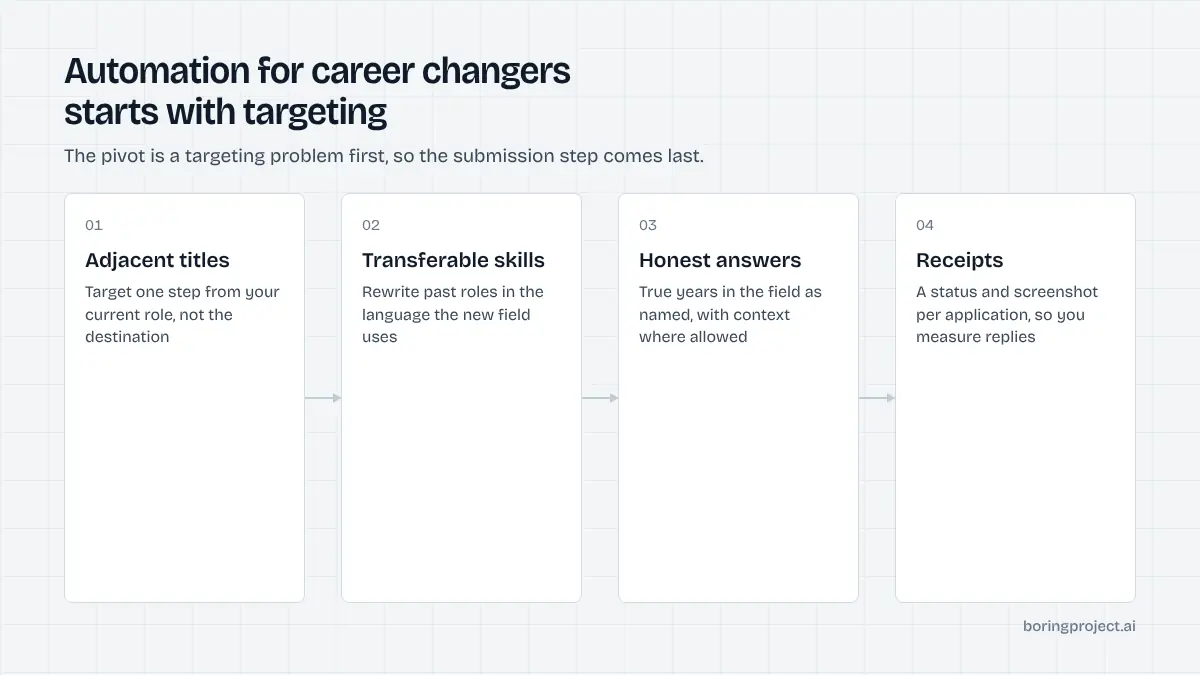
Career changers are the candidates auto-apply tools serve worst by default. The tool matches titles, the titles do not match your history, and the knockout questions ask for years of experience you do not have in the field as named. The result is a lot of submissions and very few replies, which feels like the market rejecting you when it is really the list.
This post is about using job application automation for career changers in a way that respects how screening actually works. The tool's job is to submit. Your job is targeting, framing and telling the truth in a way that still gets read.
Targeting: adjacent titles, not destination titles
Map the overlap, not the ambition
Start with two columns: what you have actually done, in plain verbs and nouns, and what postings in the new field require. The overlap is your target zone. A teacher has run groups, designed curricula, assessed outcomes and managed stakeholders; postings for instructional designers, enablement specialists and customer education roles ask for exactly those things under different names.
Destination titles (the role you want in three years) rarely sit in the overlap. Applying to them now produces rejections that teach you nothing. Adjacent titles sit in the overlap and lead to the destination.
Build two lists
The first list is small: roles where the posting's requirements are mostly in your overlap and where you will write a specific cover letter. The second list is wider: adjacent roles where your standard materials fit without a bespoke letter. Automation is for the second list; the first deserves your time.
| List | Size | Materials | Who submits |
|---|---|---|---|
| Core | Small | Tailored resume summary, specific cover letter | You, or the tool with your letter attached |
| Adjacent | Wider | Standard reframed resume, optional short letter | The tool, from a stored profile |
Exclude what will knock you out
Postings that require a licence, certification or clearance you do not hold are not targets, whatever the title. Nor are roles requiring a specific number of years in the field as named when your honest number is zero. These are hard filters and no framing gets past them. Remove them before the tool sees the list; the time saved is real and the rejections avoided are reputational.
Where a knockout is something you could acquire in weeks rather than years, such as a widely available certification or a tool you can learn, note it as a project rather than a reason to apply anyway. Removing one knockout often opens a whole title family.
Screening honesty: the part that cannot be automated away
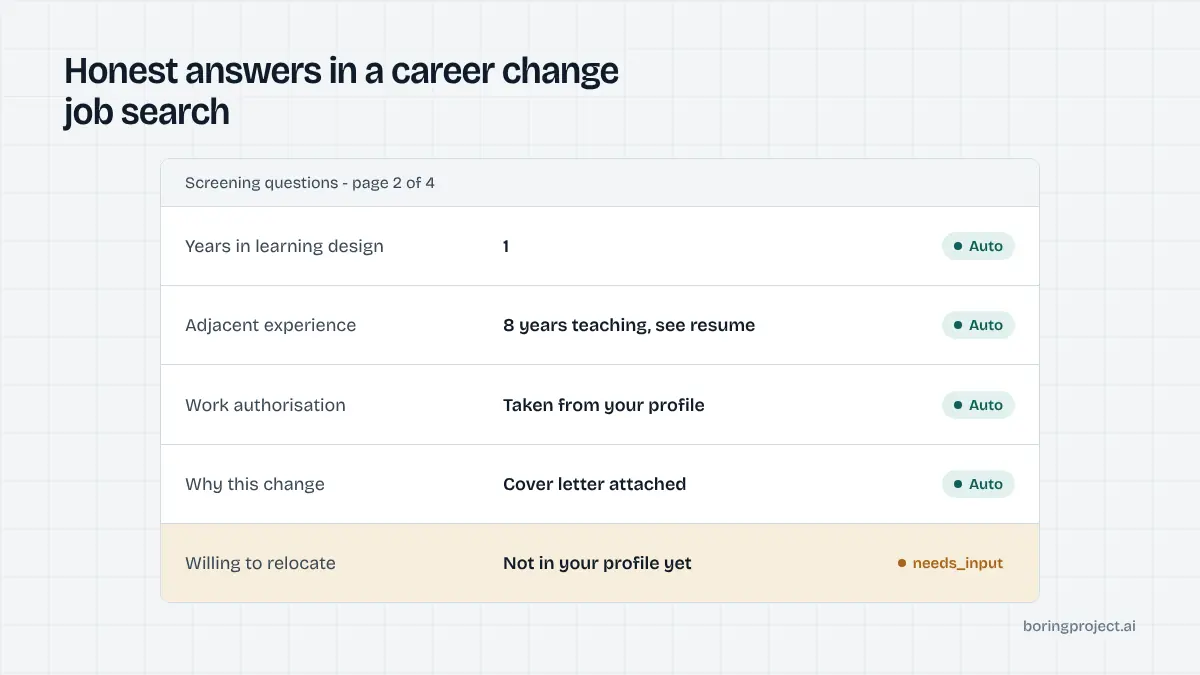
Years-of-experience questions
The commonest knockout for career changers is "How many years of experience do you have in X?" The correct answer is the true number for X as the form defines it. If you have eight years in an adjacent field and one in X, answer one, and use the resume and any free-text field to show the eight.
The temptation is to answer eight. That answer will pass the knockout and fail the first interview, and the interviewer will remember the discrepancy. Our guide to how screening questions are automated safely describes the rule we build to: the tool uses your stored answer or stops and asks; it never invents one.
Reframing is not fabrication
There is a wide space between lying and underselling. "Managed a classroom of 30" and "designed and delivered structured learning for groups of 30, tracking outcomes against defined objectives" describe the same work. The second is how the new field talks. Reframing your history in the new field's language is honest and expected. Claiming a title or tool you never used is not.
Do the reframing once, in the resume summary and bullets, and let the tool submit that version everywhere. A tool that rewrites your resume per application without showing you is a liability precisely because it can drift from reframing into invention.
Where to put the pivot explanation
Cover letter field if there is one; "additional information" field if not; a short summary at the top of the resume always. Two or three sentences: what you did, what you are moving toward, and the evidence that you can do it. Hiring managers are far more comfortable with a stated pivot than an unexplained one.
Running the automation and reading the results
Store a profile that tells the truth once
The profile the tool fills forms from should contain your true years per field, your reframed resume, your cover letter, and answers to the common questions (notice period, salary range, location, authorisation). Set it once, carefully. Every form then receives the same accurate information, which is both the ethical position and the one that survives reference checks.
Measure replies by list and by title
Track the core list and the adjacent list separately, and within the adjacent list, by title family. If instructional designer roles reply and enablement roles do not, the market is telling you where your framing lands. Shift the list toward what replies. If nothing replies after several weeks, revisit the resume summary and the title overlap before adding volume. The post on what to do when automated applications stop producing interviews is a reasonable checklist.
Use the time you save on the things a tool cannot do
A career change job search is won largely outside the form: a conversation with someone already in the role, a small project that proves the skill, a certification that removes a knockout. Automation's real value for career changers is giving you those hours back. Spend them there, not on a larger list.
Frequently asked questions
Does job application automation make sense for a career change, or does it just produce rejections?
It makes sense for the submission step, not the strategy. Career changers get filtered out mostly by knockout questions and by resumes that do not translate. Automation does nothing about either; a well-built target list of adjacent titles and honest, reframed answers does. Use the tool to remove form-filling from a list you have thought hard about, and measure replies rather than volume.
How do I answer "years of experience in X" when I am changing fields?
Give the true number for the field as named, and put the transferable experience where the form allows context: the resume, a cover note, or an additional-information field. Entering your total career length as experience in the new field is a fabrication that gets caught at interview. Many forms accept decimals or ranges, which helps when you have some adjacent exposure.
Which titles should a career changer target?
Titles one step from where you are, not the final destination. A nurse moving into health tech might target clinical analyst or implementation specialist before product manager; a teacher moving into corporate learning might target instructional designer or enablement specialist. Build the list from the overlap between what you have done and what the posting requires.
Should I hide my previous career on the resume?
No. Reframe it. Hiring managers notice gaps and unexplained pivots faster than they notice a different industry. Lead with a short summary that states the change and the transferable strengths, then present previous roles in terms the new field uses. Automation should submit this resume consistently, not generate a new, vaguer one per application.
Do career changers need a cover letter?
More than most candidates, where the form has a field for one. A cover letter is the one place to explain the pivot in two or three sentences and point at the evidence. Write one strong version, adapt a paragraph per role, and let the tool upload it where a slot exists. Do not let a tool invent a new letter for each application without your review.
How many applications should a career changer send per week?
Fewer than a same-field candidate at the same seniority, because each one needs a tailored framing. A manageable rhythm is a short list of carefully matched roles with a cover letter each, plus a slightly larger list of adjacent roles that your standard materials fit. If replies are zero after several weeks, change the targeting, not the volume.
Next step
If you want the adjacent list submitted from a profile that tells the truth once, Search + Apply fills each employer form from your stored answers, stops when it meets a question it cannot answer, and returns a receipt per application. It runs on the same job application API that career services platforms integrate; pricing is per successful application.