 The Boring Project
How Many Jobs Should I Apply to a Day?
How many jobs should I apply to a day? The useful answer depends on your level and field rather than a universal number; this covers what drives how many job applications per day make sense and where the quality argument is right.
Why there is no single number
The advice splits violently, and both sides are describing different searches
Ask how many jobs should i apply to a day anywhere and you get two confident answers. One says three a day, carefully tailored. The other says thirty, because the funnel is brutal and volume is the only lever. People argue about it endlessly.
They are not disagreeing about facts. They are describing different searches. A senior specialist in a narrow field may see three suitable roles in a week, so a target of thirty a day is arithmetically impossible without applying to things they do not want. A graduate in a large field has hundreds of plausible roles open at any moment, and applying to three a day leaves most of them untouched.
What actually sets your number
Two things. How many genuinely suitable roles exist in your field right now, and how much time each application takes on the systems your target employers use.
The second is more variable than people expect. A Greenhouse or Ashby application can take three minutes. The same role on Workday, with an account to create and parsed fields to correct, can take twenty. Someone applying to Workday-heavy employers physically cannot match the daily count of someone applying through simpler systems, regardless of effort.
The rough shape
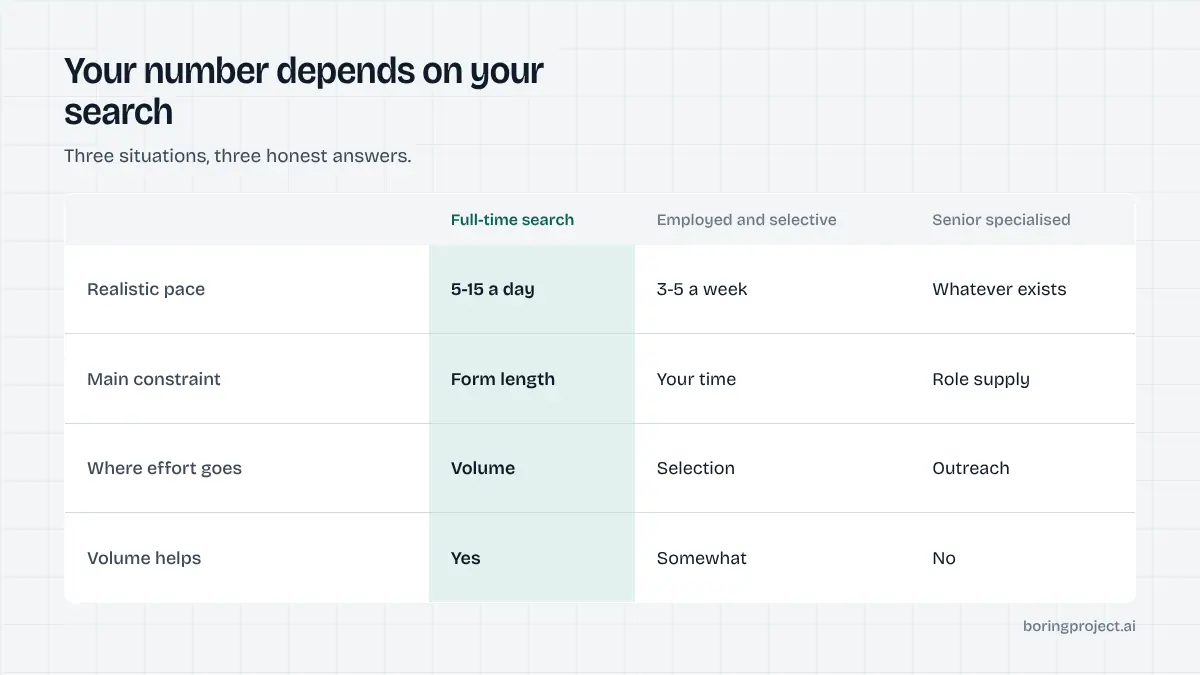
For a full-time search in a large field, something in the range of five to fifteen considered applications a day is sustainable and keeps quality intact. For someone employed and searching selectively, three to five a week is realistic and sufficient. For senior or specialised searches, the number is whatever the market has that week, often one or two, and the effort moves to tailoring and outreach instead.
Where the quality argument is right and wrong
Right: a bad application is not a lottery ticket
The strongest version of the quality argument is simply true. An application to a role you do not fit is not a small chance of success, it is no chance, and sending a hundred of them produces a hundred rejections and a worse mood.
Nothing about volume changes whether you meet a hard requirement. The screening questions on the form will dispose of you in seconds regardless of how many you sent.
Wrong: tailoring has sharply diminishing returns
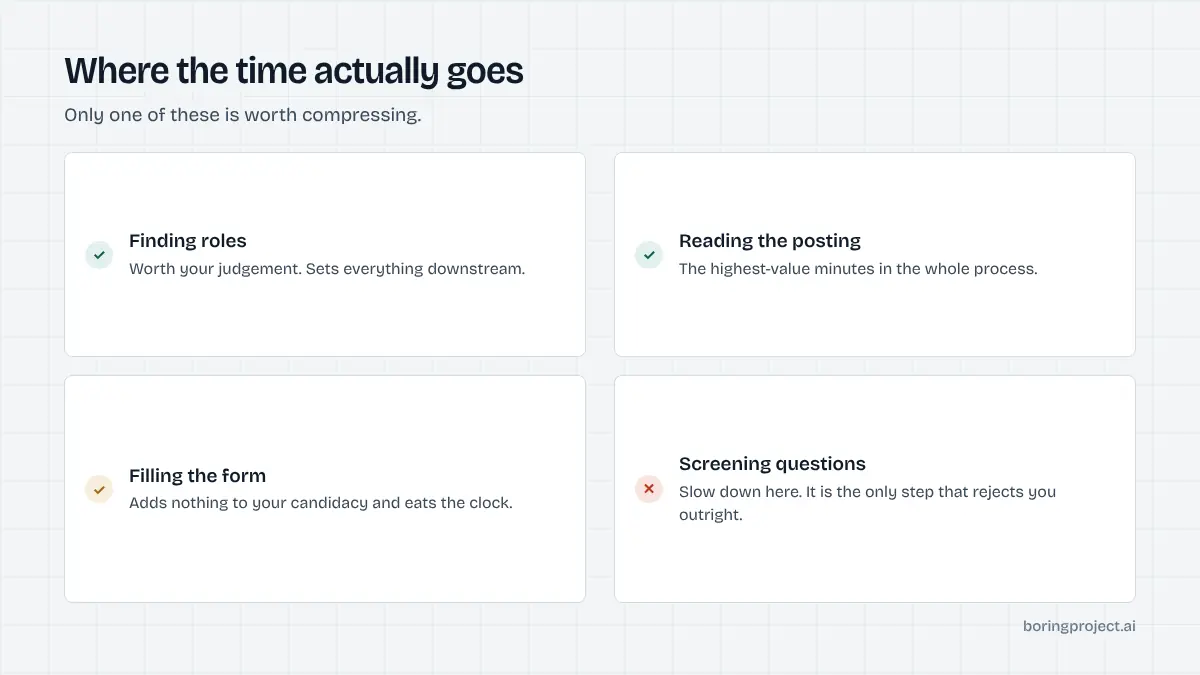
The weak version of the quality argument is that every application should be extensively customised. In practice the return on tailoring drops off fast. Making sure your resume reflects the actual requirements of the role matters. Rewriting it from scratch for each application generally does not.
The highest-value minutes are spent on reading the posting properly to decide whether to apply at all, and on answering the screening questions carefully, since those are the only part that rejects you automatically.
The part that is genuinely compressible
Form filling. Retyping your employment history into a system that already has your resume adds nothing to your candidacy and consumes most of the clock. That is the part worth removing, whether through a tool, a maintained master profile you copy from, or application infrastructure if you are applying for other people. Whether automating it helps is covered in does auto apply work.
A practical way to set your target
Count the roles, not the hours
Start from supply. Search your criteria and count how many genuinely suitable roles appeared this week. If it is sixty, a target of ten a day is reasonable. If it is four, your daily target is zero most days and your effort belongs in outreach and networking instead.
This inverts the usual approach, which is to pick a number and then find roles to fill it. That is how people end up applying to things they do not want.
Track responses, not applications
The number worth watching is the response rate. If you have sent forty applications and received no responses at all, sending four hundred more will not change the outcome, and that is the signal to re-examine targeting, level or resume rather than to increase volume. We cover that diagnosis in why auto apply is not getting interviews.
Protect the part that cannot be rushed
Whatever your number, keep the screening questions deliberate. They are the one place where speed costs you outright, because a mis-click on authorisation, notice period or location ends that application silently. If you are applying at volume, that is the step to slow down on, not the resume.
Frequently asked questions
How many jobs should I apply to a day if I am unemployed?
For a full-time search in a field with plenty of openings, five to fifteen considered applications a day is a sustainable pace. The constraint is usually the systems involved rather than your effort: a day of Workday applications yields far fewer submissions than a day of single-page forms.
Is applying to 100 jobs a day a good idea?
Only if a hundred suitable roles exist, which is rare. At that volume you are almost certainly applying to roles you do not fit, which produces rejections rather than chances. The count is also constrained by reality: most people cannot find that many genuinely matching openings in a day.
Does applying to more jobs increase your chances?
Within your suitable pool, yes, more applications mean more opportunities. Outside it, no, because a role whose hard requirements you fail is closed regardless of how many you send. Volume multiplies whatever your targeting produces, in either direction.
How many applications does it take to get a job?
There is no reliable universal figure, and precise ratios quoted online are usually invented. It varies enormously by field, seniority and market conditions. The more useful measure is your response rate on the applications you have already sent, which tells you whether to increase volume or fix targeting.
Should I tailor my resume for every application?
Tailor it to reflect the actual requirements where they differ meaningfully from your default. Rewriting from scratch each time has poor returns. The minutes are better spent deciding whether to apply at all, and answering the screening questions accurately.
What is the best daily target if I already have a job?
Three to five a week is realistic and does not burn you out. Searching while employed means your scarce resource is time rather than opportunity, so being selective is not a compromise, it is the correct strategy.
Next step
Before setting a daily number, search your criteria and count the genuinely suitable roles posted in the last seven days. That number, divided across the week, is your target. If it comes out low, the work is in outreach rather than applications.