 The Boring Project
Does Auto Apply Work for Job Seekers?
Does auto apply work? It reliably removes typing and reliably fails to fix targeting; this sets out what the tools actually do, whether does ai auto apply work differently, and the conditions that decide the outcome.
What these tools genuinely do
They remove typing, not judgement
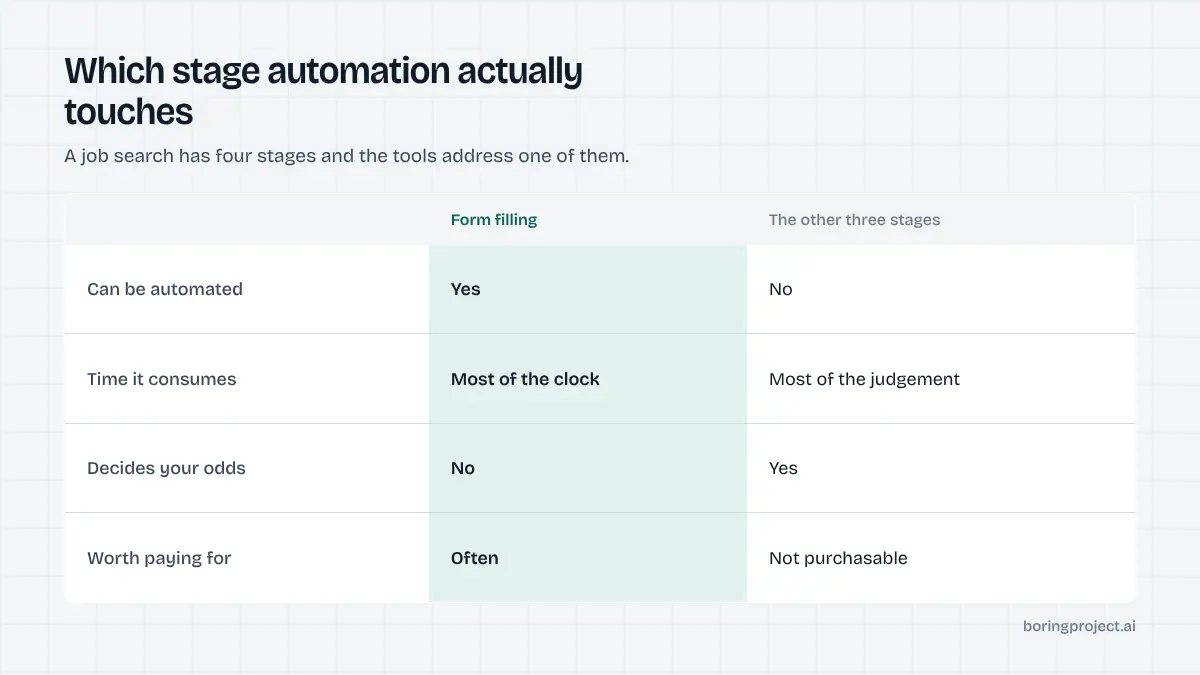
Asking does auto apply work is really asking which part of a job search it touches. A job search has four distinct stages: deciding what to target, finding roles that match, completing the application, and interviewing. Auto-apply tools address exactly one of them. They complete forms.
That is a real saving. Candidates routinely report twenty minutes per application on systems like Workday, and a tool that reduces that to seconds across fifty applications has returned several working days. The mistake is expecting the saving to arrive as interviews. Removing typing from a well-aimed search makes it faster. Removing typing from a badly aimed search makes it faster at being wrong.
Where the success stories and the failures diverge
The accounts people post about these tools split cleanly. One camp reports hundreds of applications and no interviews, sometimes after spending several hundred dollars. The other reports modest volumes landing interviews at normal rates.
The variable is almost never the tool. It is whether the roles being applied to were ones the person could plausibly get. A tool firing applications at everything matching a loose keyword produces a rejection pipeline. The same tool pointed at forty genuinely suitable roles behaves like a faster version of applying by hand.
Does AI auto apply work any differently
The AI framing mostly describes two features: generating a cover letter per role, and answering open-text screening questions. Both are useful and neither changes the economics.
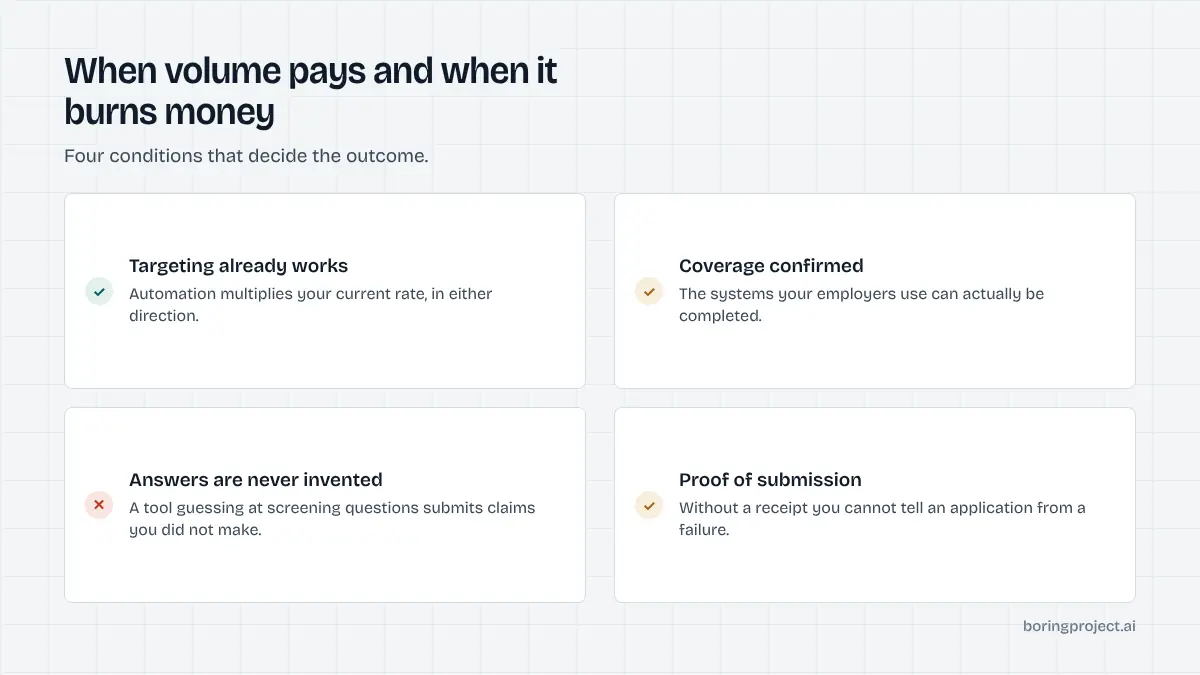
What does matter is whether the tool invents answers. A system that writes a plausible response to "how many years of Kubernetes experience do you have" without the answer being true has submitted a false application on your behalf. Tools that pause and ask on anything not derivable from your profile are the ones worth paying for.
When it helps and when it does not
The conditions where it pays
Volume helps when your targeting is already sound, when your profile genuinely matches a large pool of roles, and when the systems your target employers use are ones the tool can actually complete. Junior and mid-level roles in large fields benefit most, because the pool is big and the applications are formulaic.
It also helps when the alternative is not applying. Someone employed full time who manages four applications a week is not choosing between careful applications and automated ones; they are choosing between forty automated applications and four careful ones.
The conditions where it wastes money
Senior and specialised searches are the clearest failure case. At that level roles are few, each application benefits from being tailored, and the hiring process often starts with a conversation rather than a form. Volume adds nothing and the per-application cost adds up.
It also fails when coverage is wrong. If the tool cannot complete the applicant tracking systems your target employers use, a large quota buys applications you never actually made. That is the specification almost nobody publishes, and the one worth asking support about before paying. Our guide to the best auto apply tools explains why.
What recruiters on the other side report
Recruiters are increasingly vocal that mass-applied applications are identifiable and unwelcome, and some state plainly that they discard them. That is worth weighing honestly rather than dismissing as vendor-unfriendly noise.
The identifiable part is usually the mismatch: an application from someone whose background has no relationship to the role, arriving alongside many others like it. An automated application to a role you genuinely fit, with accurate answers, is not distinguishable from a manual one, because it is the same form filled with the same facts.
How to decide
Test before you commit
Nearly every tool in this category offers a free allowance or a cheap entry plan. Use it on real roles and then check two things: whether the submissions actually completed on the employers you care about, and whether the applications are ones you would have sent yourself.
That test takes a week and answers the question better than any review. The failure modes show up immediately.
Fix targeting first
If you are not getting interviews from manual applications, automation will not change the outcome, it will only change the speed. The honest sequence is to get a handful of applications producing responses, then automate the volume once the aim is right.
Know which product you are buying
Autofill tools fill the form and leave the submit click to you. Cloud agents submit on your behalf while you are elsewhere. Human services put a person on it. These suit different searches and the distinction is set out in auto apply versus autofill. If you are building applying into a product rather than running your own search, The Boring Project provides it as infrastructure with a receipt for every submission.
Frequently asked questions
Does auto apply actually get you interviews?
It gets applications submitted, which is necessary but not sufficient. Interviews come from applying to roles you plausibly fit with accurate information. Automation changes the speed of that process, not its quality, so it amplifies whatever your targeting already produces, in either direction.
Does AI auto apply work better than ordinary autofill?
The AI features mostly generate cover letters and answer open-text screening questions, which saves time but does not change whether you are a credible candidate for the role. What matters more is whether the tool invents answers it cannot derive from your profile, because that submits applications containing claims you did not make.
How many applications should I expect to send?
There is no reliable published figure, and anyone quoting a precise conversion rate is guessing. What the volume question actually turns on is role level and field: junior roles in large fields need many more applications than senior specialised ones, where volume is the wrong strategy entirely.
Can recruiters tell if you used an auto apply tool?
They often can, but what they are detecting is usually a mismatch rather than the automation itself. An application from a candidate with no relationship to the role, arriving in a cluster of similar ones, stands out. An automated application to a role you genuinely fit, with accurate answers, looks like any other application.
Is auto apply safe to use?
Applying through an employer's own careers site with accurate information and your consent is ordinary job seeking with the typing automated. The risk sits in tools that drive a job board account on your behalf, invent answers to screening questions, or apply far outside the criteria you set.
What should I check before paying for one?
Which applicant tracking systems it can complete end to end, whether submission happens in your browser or on the vendor's servers, whether it shows proof that an application was actually submitted, and what it does when a screening question cannot be answered from your profile. Those four answers predict the experience better than any feature list.
Next step
Before paying for anything, send ten applications by hand to roles you genuinely fit and see what comes back. If the response rate is reasonable, automation will multiply it. If it is zero, the problem is upstream of applying and no tool will fix it.