 The Boring Project
How Many Applications to Get a Job?
How many applications to get a job? There is no honest universal number, and the ones circulating are usually invented; this explains what drives the count and how to measure your own job application success rate.
Why the numbers you have read are unreliable
Most quoted ratios have no source
Search how many applications to get a job and the figures come back confident and unsourced. Claims like "one interview per ten applications" or "one offer per hundred" circulate constantly without attribution. When traced, they usually come from a vendor blog, a survey with a small self-selected sample, or another article repeating the same unsourced figure.
They also average across situations that have nothing in common. A graduate applying to large retail employers and a principal engineer applying to four companies are both counted, and their rates differ by an order of magnitude. An average across them describes nobody.
Self-reported numbers skew hard
The accounts people post publicly are skewed in both directions. Someone who applied to 1,200 roles over eight months posts about it because the number is shocking. Someone who applied to nine and took the third offer rarely writes a post.
Treat any single account as one data point from a situation you probably do not share.
What actually moves the number
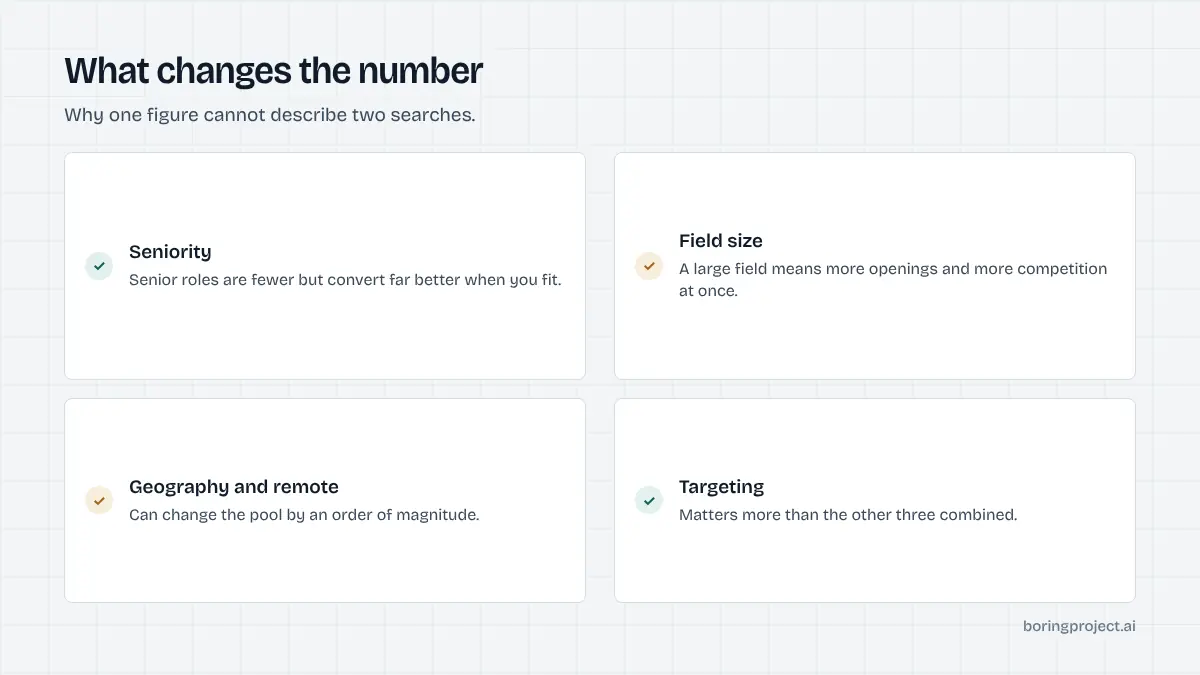
Four things dominate. Seniority, because senior roles are fewer but convert far better when you fit. Field size, because a large field has more openings and more competition at once. Geography and remote eligibility, which can change the pool by an order of magnitude. And whether your applications are aimed at roles you plausibly fit, which matters more than all the rest combined.
Measure your own rate instead
The only number that helps is yours
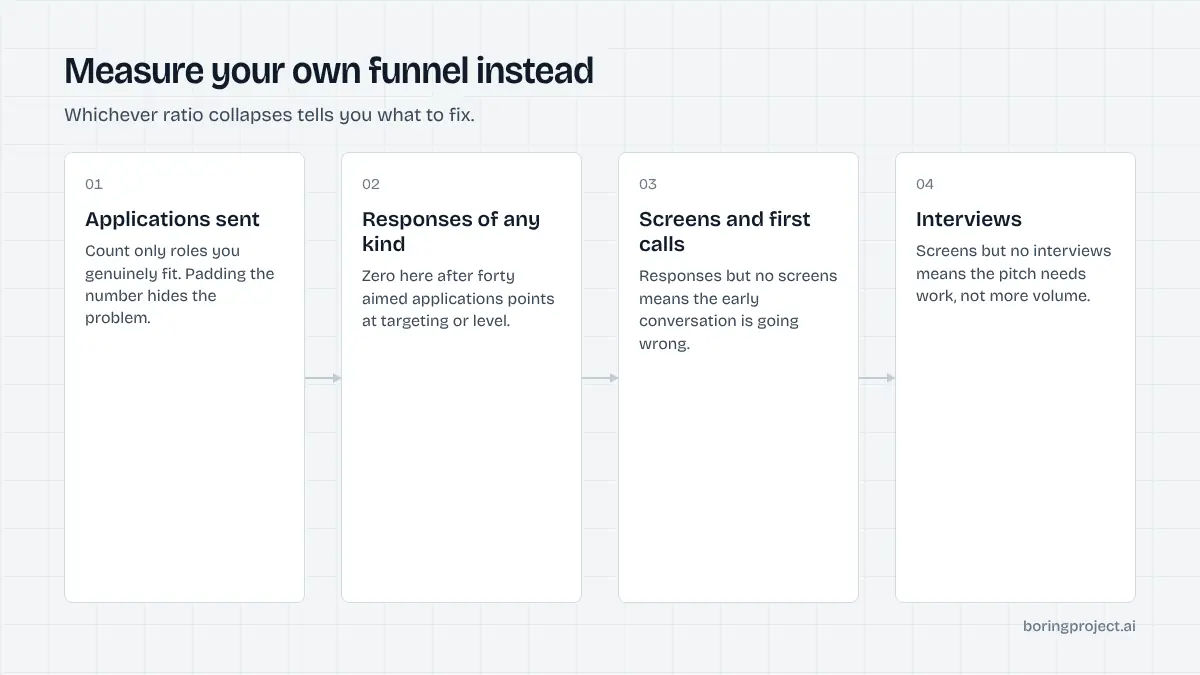
Rather than searching for a universal figure, track four counts: applications sent, responses of any kind, screens or first conversations, and interviews. The ratios between those tell you where your search is actually failing, which no external statistic can.
The funnel is diagnostic. Plenty of applications and no responses means targeting, level or resume. Responses but no screens means the conversation is going wrong early. Screens but no interviews means the pitch needs work. Each failure points somewhere different.
What a reasonable rate looks like
Rather than a target number of applications, watch whether anything moves at all. If forty well-aimed applications have produced no response of any kind, something upstream is wrong and sending four hundred more will reproduce the result. That is the signal to change the approach rather than the volume, which we cover in how many jobs to apply to a day.
Count only real applications
A surprising share of the large numbers people quote include applications to roles they did not fit, duplicates to the same company, and roles that were never genuinely open. Counting those inflates the denominator and makes the search look more hopeless than it is.
If you are using automated applying, this distinction matters more, since volume is cheap and the temptation to widen criteria is strong. Our note on job application automation success rates covers what changes when applications become cheap to send.
Using the number sensibly
Volume is a multiplier, not a strategy
More applications within your suitable pool means more chances. More applications outside it means more rejections. Volume multiplies whatever your targeting produces, so it is worth getting the aim right on a small number before scaling.
Expect the market to move the number
Application counts in a tight market and a loose one are not comparable, and neither are two fields in the same month. A number that was true for a friend last year carries little information about your search now.
Where the count is genuinely useful
As a planning tool. If you know roughly what your response rate is, you can work out how much searching a week actually requires and budget your time honestly, rather than discovering after two months that you have been applying at a tenth of the rate your situation needs. If you are building applying into a product, The Boring Project reports what happened to every submission, which is the only way to compute a real rate rather than an estimated one.
Frequently asked questions
How many applications does it take to get a job on average?
There is no reliable average, and figures circulating online are usually unsourced or averaged across situations with nothing in common. Seniority, field size, geography and targeting change the number by an order of magnitude, so a single figure cannot describe both a graduate search and a senior specialised one.
Is 100 applications a lot?
It depends entirely on the field and level. For a junior role in a large competitive field it is unremarkable. For a senior specialised search it would mean applying far outside your criteria, since that many genuinely suitable roles rarely exist at once.
What is a good job application success rate?
The useful measure is your own funnel rather than a benchmark: applications to responses, responses to screens, screens to interviews. Watching which ratio collapses tells you what to fix. No response at all after forty well-aimed applications points at targeting, level or resume rather than at volume.
Should I apply to more jobs if I am not hearing back?
Not first. If well-aimed applications are producing nothing, more of the same reproduces the result. Check whether you meet the hard requirements of the roles, whether your resume surfaces the relevant facts early, and whether screening answers are knocking you out before anyone reads.
Do automated applications count the same?
Only if they are applications you would have made yourself. Automation makes volume cheap, which tempts people to widen criteria, and applications to roles you do not fit inflate the count without improving the odds. Count only submissions to roles you genuinely want.
How long should a job search take?
Long enough that you should plan for months rather than weeks, and variable enough that averages are unhelpful. The more actionable question is whether your funnel is moving at all: a search producing screens is working slowly, while a search producing nothing needs a change of approach rather than more time.
Next step
Count your last forty applications and sort them into responses, screens and interviews. Whichever ratio is closest to zero is the thing to fix, and it is almost never the number of applications.