 The Boring Project
Does Easy Apply Work on LinkedIn?
Does Easy Apply work? It submits a real application, but a thinner one into a much larger pile; this covers what actually gets sent, what drives the linkedin easy apply response rate, and when to use it.
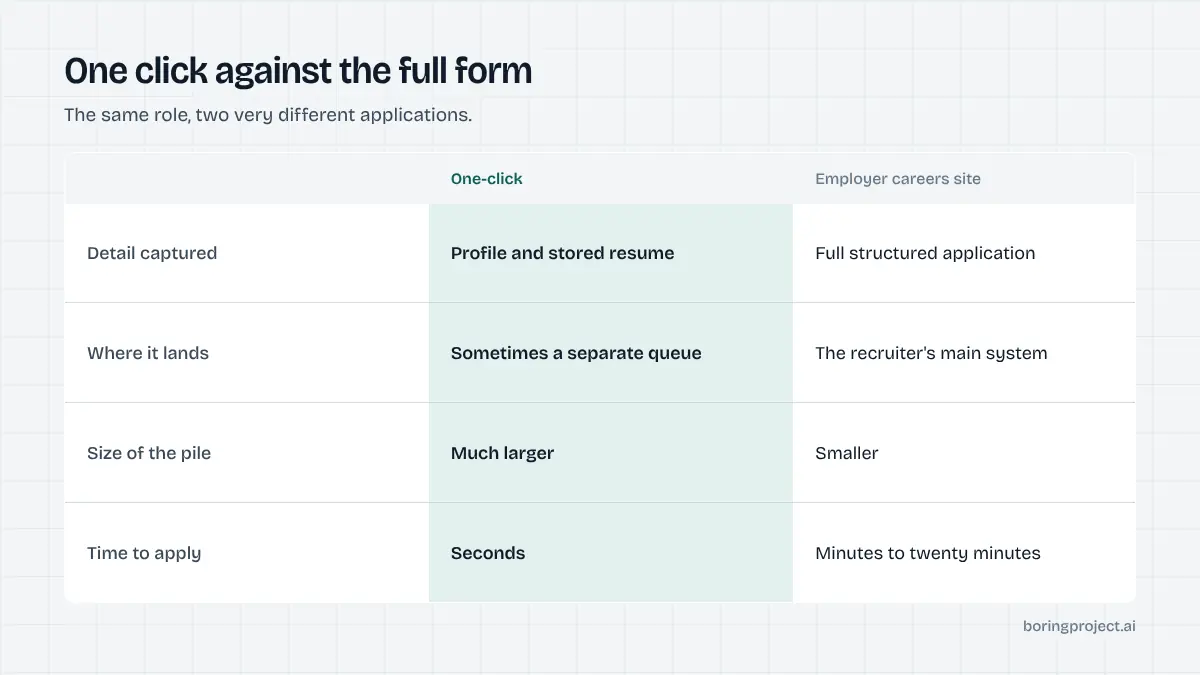
What a one-click application actually sends
It is a real application, with less in it
The honest answer to does easy apply work is that it works as a submission and underperforms as a strategy. Pressing Easy Apply does submit you. The employer receives a record and it lands in their hiring workflow. The scepticism people express about whether it goes anywhere is misplaced.
What differs is content. A one-click application typically sends your profile, a stored resume, and answers to a handful of questions. An application on the employer's own careers site usually captures far more structured detail, and often a cover letter field. The employer sees two candidates described at different resolutions, and the thinner description competes badly.
Where it lands depends on the employer
Some employers pipe one-click applications straight into their applicant tracking system, where they sit alongside everything else. Others receive them in a separate inbox that a recruiter reviews less often, or not at all if the role is being worked from the careers site.
You cannot tell which from the outside, and this is the main reason reported experiences differ so wildly. Two candidates pressing the same button at two companies are having completely different experiences.
The volume problem is the real one
The button exists to reduce friction, and it succeeds, which is precisely the problem. A role that would attract eighty applications through a twenty-minute form attracts many hundreds through one click.
Your application is not worse than it was. It is competing against far more applications, many from people who applied in two seconds without reading the posting. Recruiters know this, and some treat the one-click pile with less attention as a result.
When to use it and when not to
Use it when the alternative is not applying
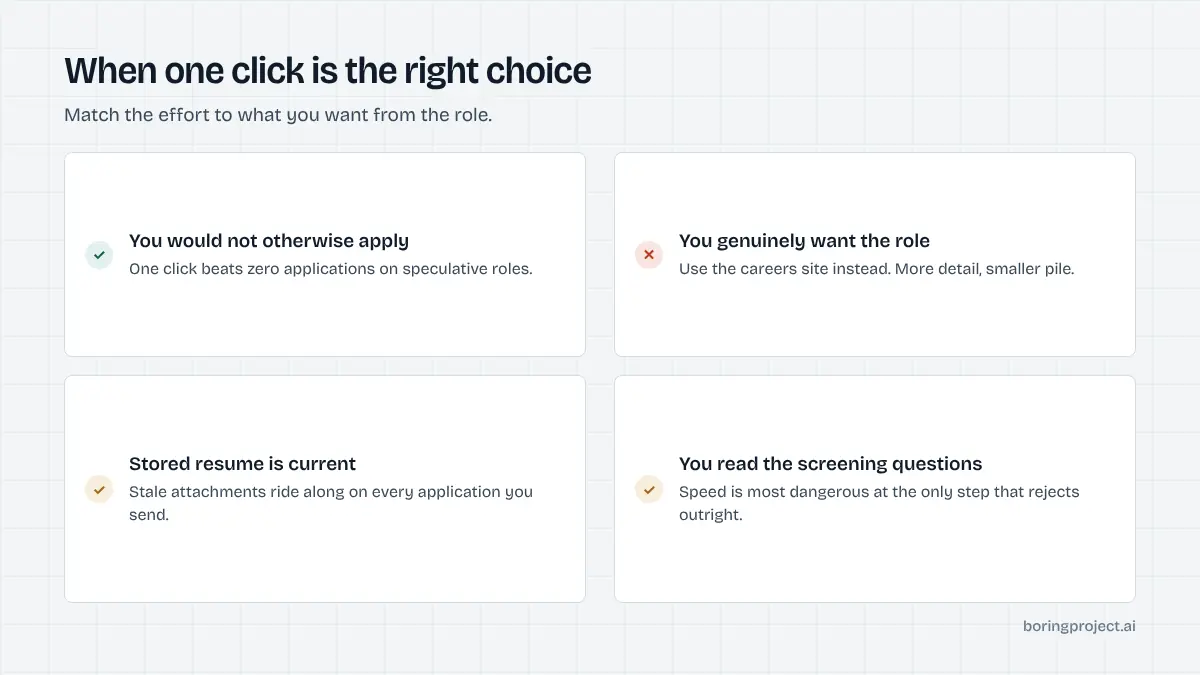
If you would not otherwise apply, one click beats zero applications. For speculative applications to roles you are mildly interested in, it is exactly the right tool and the low effort matches the low expected value.
Take the longer route when you actually want the role
If the job is one you genuinely want, apply on the employer's careers site instead. You will give more detail, you will land in the system the recruiter is actually working from, and you will be in the smaller pile. That is worth twenty minutes.
Check the company's own careers page even when a one-click option exists. The same role is almost always posted there, and the application you submit is a fuller one.
Fix what the button sends
Whatever route you take, the stored profile and resume attached to one-click applications are often stale. People set them up once and forget them for years. If you are going to use it, spend ten minutes making sure the attached resume is current and the headline describes the role you want now.
What actually drives the response rate
Fit, as always
The dominant variable is whether you plausibly match the role, and no application route changes that. A well-matched one-click application beats a poorly matched careers-site one every time.
Timing
Because shortlists fill from the top of a sorted list, applying in the first days of a posting matters more than most people expect, and it matters more on high-volume roles, which is exactly what one-click postings become.
Screening answers
Even short application flows carry screening questions, and those are the one mechanism that rejects automatically, as covered in does ATS auto reject. Clicking through them quickly is how people knock themselves out of roles without knowing. The speed the button offers is most dangerous at exactly this step. If you want the underlying model of where the application goes, see what an applicant tracking system is.
The interesting thing about one-click applying is that it proved candidates will trade detail for speed. The problem it created is that the detail is what employers needed. Infrastructure that fills the full employer form automatically gets both, which is what The Boring Project does across 40+ systems.
Frequently asked questions
Does Easy Apply actually send my application to the company?
Yes. A real record reaches the employer and enters their hiring process. What varies is where it lands: some employers route these applications into their main applicant tracking system, while others receive them in a separate queue that gets reviewed less often.
Why is the LinkedIn Easy Apply response rate so low?
Mostly volume. Removing friction means a role attracts many times more applications, including many from people who applied without reading the posting. Your application is not weaker than before, but it is competing in a much larger pile, and it carries less detail than a full careers-site application.
Should I apply on the company website instead?
For roles you genuinely want, yes. The careers-site application captures more structured information, usually lands in the system the recruiter is actively working from, and sits in a smaller pile. For speculative applications, one click is a reasonable match of effort to expected value.
Does applying both ways help?
It rarely helps and can create duplicate records that look careless. Pick the fuller route for roles you care about. If you have already applied one way and then find the careers-site posting, applying again is unlikely to improve your position.
Do recruiters ignore one-click applications?
Some weight them less, because the pile is larger and the applications carry less detail. It is not a universal policy and it varies by employer and role. The practical response is to use the fuller route when the role matters rather than to assume the button is useless.
What should I check before using it?
That the stored resume attached to your profile is current, that your headline describes the role you want now, and that you have actually read the screening questions rather than clicking through them. Stale attachments and rushed screening answers are the two self-inflicted failures here.
Next step
Open the profile and resume attached to your one-click applications and check when you last updated them. If the answer is more than six months ago, that is the fix with the highest return, because every application you send is carrying it.