 The Boring Project
Does Applying Early Matter for Job Applications?
Does applying early matter? More than almost any edit you can make to a resume, and for a structural reason; this explains the mechanism and what the best time to apply for a job actually looks like.
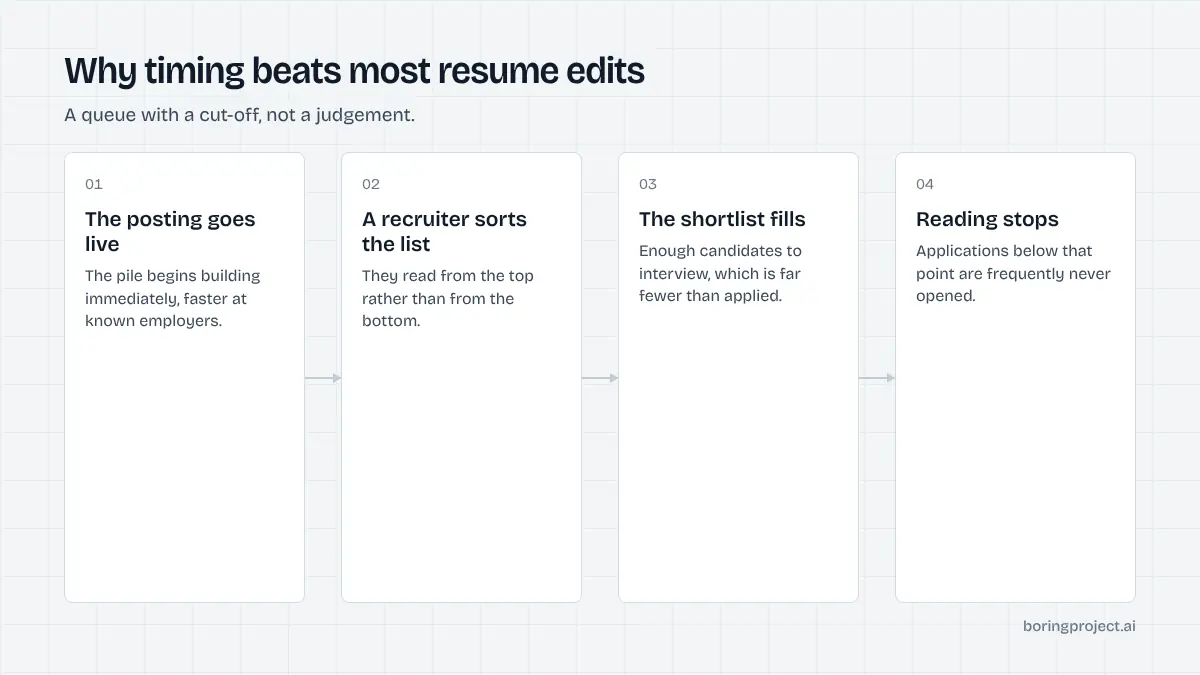
Why timing beats most other levers
Shortlists fill from the top and then stop
The mechanism is simple and rarely explained. A recruiter working a role opens a sorted list of applicants, reads from the top, and builds a shortlist. Once they have enough people to interview, they stop. Applications below that point are frequently never opened at all.
That is not a judgement about those candidates. It is a queue with a cut-off, and the cut-off arrives faster on popular roles. So does applying early matter has a structural answer rather than a motivational one: early applications are read in a context where reading is still happening.
The pile grows faster than you think
A role at a recognisable employer can collect several hundred applications in its first few days, and one-click applying has made that worse. The difference between applying on day one and day ten is often the difference between being among the first fifty and being among the first six hundred.
Interviews often start before the posting closes
Teams rarely wait for a closing date. They begin interviewing as soon as they have a credible shortlist, and a strong early candidate can be at offer stage while the listing is still accepting applications. By the time a late application is read, the decision may be effectively made.
How early is early enough
The first few days
There is no precise threshold, and anyone quoting one is guessing. The practical target is the first two or three days of a posting, which usually puts you ahead of the bulk of applications without requiring you to refresh job boards hourly.
Freshness beats weekday folklore, and compounds on crowded roles
Advice about applying on particular days of the week is largely folklore. What matters is the age of the posting rather than the day you press submit. A Tuesday application to a three-week-old listing is worse than a Saturday application to a listing posted that morning.
The advantage is largest exactly where competition is worst. On a quiet role with twelve applicants, everyone gets read and timing barely matters. On a role collecting four hundred applications in a week, the cut-off arrives long before the last application lands, so being early is the difference between being considered and being invisible.
That inverts the usual instinct, which is to deprioritise crowded roles. The crowded ones are where speed pays most, provided you actually meet the requirements.
Early does not rescue a poor fit
Timing amplifies, it does not substitute. An early application to a role whose hard requirements you fail is still knocked out by the screening questions. The sequence that works is to apply early to roles you genuinely fit, not to apply early to everything.
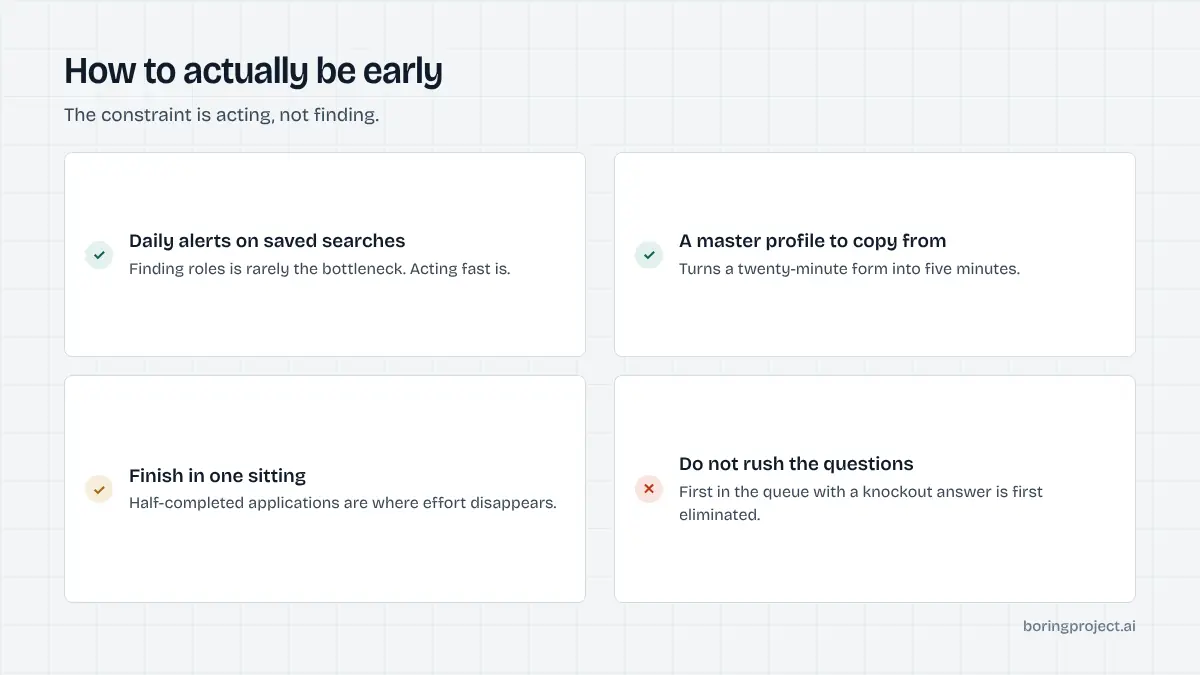
How to actually be early
Set up alerts and act on them the same day
Saved searches with daily alerts on the boards and company careers pages you care about are the whole technique. The constraint is rarely finding roles, it is acting before the pile builds.
Keep the application cost low
Being early only works if you can finish the application promptly, and the thing that stops people is the twenty-minute form. A maintained master profile with employers, exact dates, titles and addresses in one copyable document turns that into a few minutes. This is the same reason application volume varies so much between systems, covered in how many jobs to apply to a day.
Do not sacrifice the screening questions for speed
The one part not to rush is the set of yes or no questions, since those are the only step that rejects you outright. Being first in the queue with a knockout answer is being first to be eliminated.
Early gets you read; the top of page one decides what happens next, as covered in do recruiters actually read resumes. If you are building applying into a product, speed to submission is the measurable advantage infrastructure provides, which is what The Boring Project is built around.
Frequently asked questions
Does applying early actually improve your chances?
Yes, and the mechanism is structural rather than psychological. Recruiters build shortlists from the top of a sorted applicant list and stop once they have enough candidates, so later applications are often never opened. Timing is one of the few levers that changes whether you are read at all.
How soon after a job is posted should I apply?
The first two or three days is a sensible target. That usually places you ahead of the bulk of applications without requiring constant monitoring. On roles at well-known employers the pile can build within a day, so same-day applying is better where you can manage it.
Is there a best time to apply for a job, like a specific day?
Advice about particular weekdays is largely folklore. What matters is the age of the posting, not the day of the week. A Saturday application to a listing posted that morning beats a Tuesday application to a three-week-old one.
Do companies interview before the closing date?
Frequently. Teams start interviewing as soon as they have a credible shortlist rather than waiting for a posting to close, so a strong early candidate can reach offer stage while the listing still accepts applications.
Is it pointless to apply to an old posting?
Not pointless, but the odds are worse and you should weight your effort accordingly. Searches do fail and roles do get reposted. Treat older listings as lower-probability applications rather than skipping them entirely.
Does applying early help if I am underqualified?
No. Timing changes whether you are read, not whether you meet the requirements, and screening questions will still disqualify you on hard criteria regardless of when you submit. Apply early to roles you actually fit.
Next step
Set a daily alert for the two or three searches that matter most to you, and build the master profile that lets you finish an application in five minutes. Together those are worth more than another round of resume edits.