 The Boring Project
Auto Apply Jobs UK: What Works in 2026
UK job application automation has to deal with a market split between job-board applies that send your CV to a recruiter and employer ATS forms with right-to-work, sponsorship and notice-period questions; this guide covers both and where automation fits.
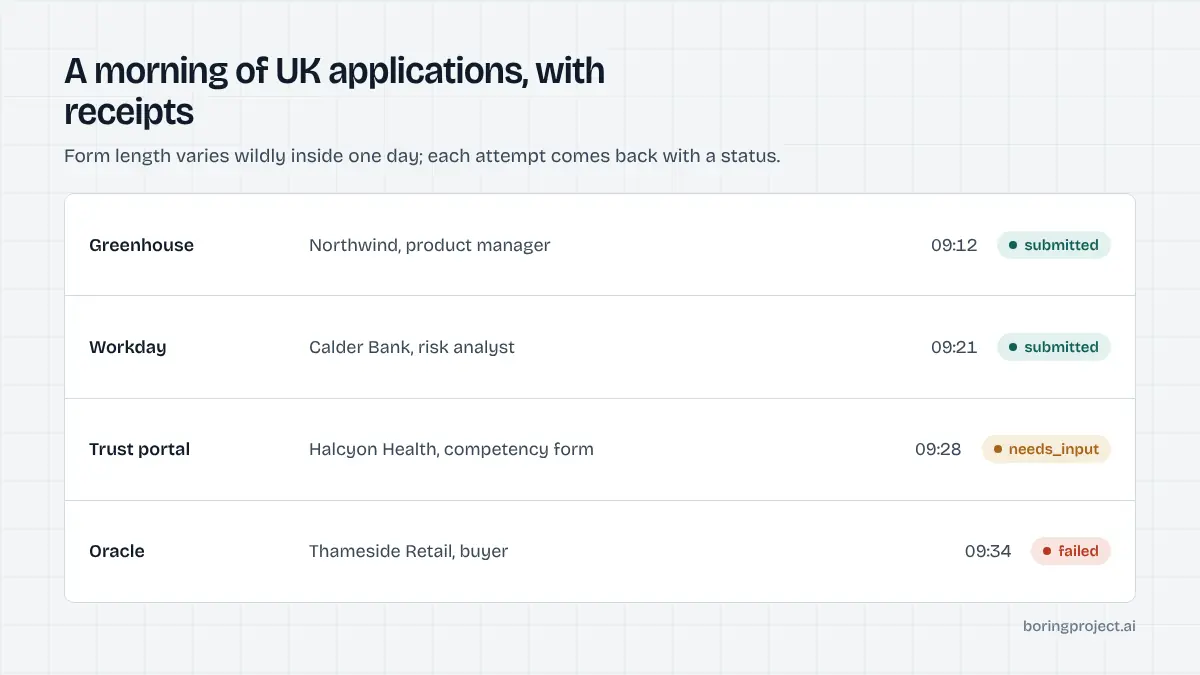
The UK job market is heavily intermediated. Recruitment agencies advertise a large share of private-sector roles on boards like Reed, Totaljobs, CV-Library and Indeed, and applying there means sending a CV to the advertiser rather than filling a form. Employers that hire directly, especially large ones and the public sector, route you to their own system.
If you want to auto apply jobs uk style, the useful question is not "which tool clicks fastest" but "which of these two paths am I on, and what will the form ask". This post answers that.
Two paths: board applies and employer forms
Board applies send your CV to a recruiter
On the major UK boards, a one-click apply sends your stored CV, sometimes with a short cover message, to whoever posted the ad. Often that is an agency, not the employer. There is no ATS form to fill, so automation adds little beyond what the board already does.
What matters on this path is CV quality, a specific cover message where there is a field for one, and not applying to the same role through three different agencies. Indeed's own apply flow in the UK works similarly; our post on how Indeed's apply flow behaves covers the details and the cases where it redirects to an employer site.
Employer forms are where the time goes
Many UK employers, and almost all large ones, redirect board applicants to their own careers site. That site runs an ATS, and the form can range from a resume upload with four questions to a multi-page competency application. This path is where UK job application automation earns its place.
The split by employer type looks roughly like this, based on what is visible on careers sites:
| Employer type | Commonly seen systems | Typical form |
|---|---|---|
| FTSE and large financial services | Workday, SuccessFactors, Oracle Recruiting Cloud, iCIMS | Long, account required |
| Tech and scale-ups | Greenhouse, Lever, Workable, Teamtailor, Pinpoint, Ashby | Short, single page |
| Public sector, NHS trusts, universities | Dedicated public-sector recruitment systems | Long, competency statements |
| Retail and hospitality chains | Various, often mobile-first | Short, with availability questions |
Agencies and duplicates
If a role is advertised directly and through agencies, apply directly once. Duplicate submissions through multiple routes are a common cause of silent rejection, because the employer has to resolve who introduced you. The post on why automated applications get rejected lists duplicates among the most avoidable causes.
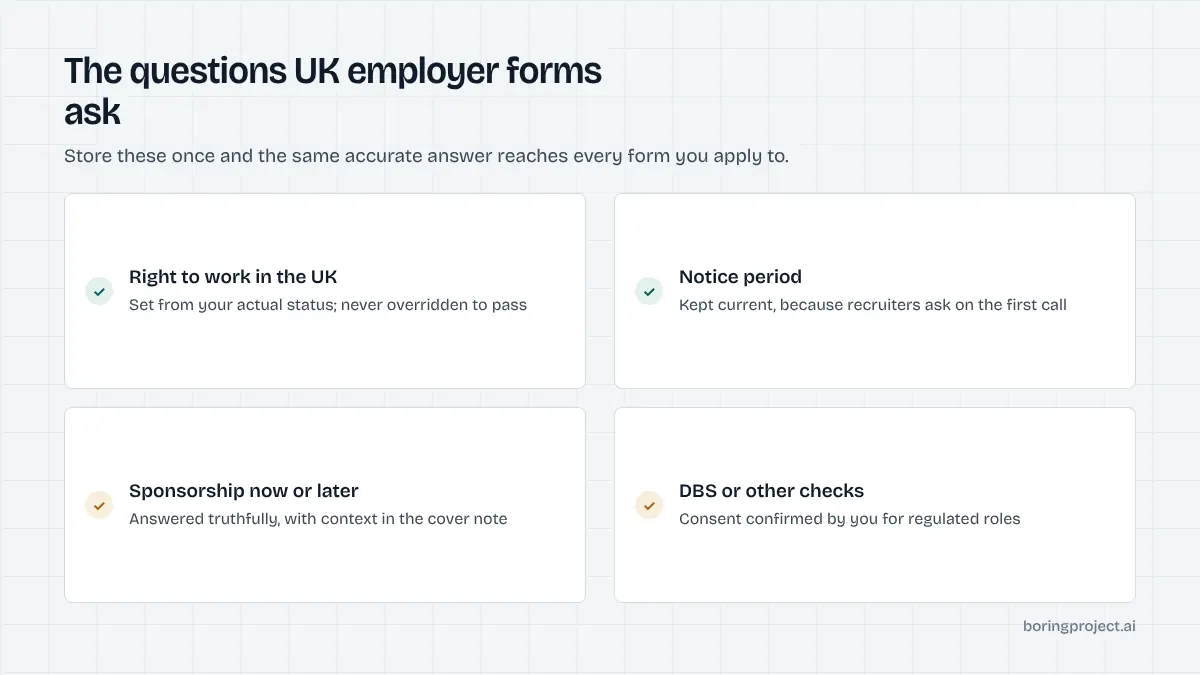
The questions UK forms ask
Right to work and sponsorship
Nearly every UK employer form asks some version of "Do you have the right to work in the UK?" and, often, "Will you require sponsorship now or in the future?" Employers ask because sponsoring a visa is only possible for certain roles and salary levels, and because they must check right to work before employment starts.
Answer from your actual status. If you are on a Graduate visa, a Skilled Worker visa, or have settled status, the correct answers differ, and university careers services publish guidance on how to phrase context. Store the answers in your profile once and use a tool that will never change them to pass a knockout. A yes that turns out to be wrong wastes everyone's time and can be treated as misrepresentation.
Notice period, salary and checks
UK forms frequently ask for notice period, current or expected salary in GBP, and whether you consent to pre-employment checks. Regulated roles (education, healthcare, financial services, security) add DBS or equivalent background checks and sometimes a declaration of unspent convictions. These are factual fields; keep them current.
Diversity monitoring sections are common and optional. They are separated from the scored application by design, and how you answer them is your choice; just be consistent.
CV and cover letter conventions
UK CVs are typically two pages, without a photo or date of birth, and without a signature. A short, role-specific cover letter is still read by many employers, particularly in the public sector, charities and professional services, and some forms have a dedicated upload or text field for it.
Where that field exists, a prepared letter you can adapt in a minute is worth having. Where it does not, do not force one into a free-text question. And do not let a tool invent a letter per application without you seeing it; generic letters are easy to spot and do more harm than an empty optional field.
Running automation sensibly in the UK
Store once, submit consistently
The practical setup when you auto apply jobs uk at any volume is a single profile holding your CV, right-to-work and sponsorship answers, notice period, salary range, and two or three short competency examples. The tool fills each employer form from that profile, stops and asks when it meets a question it cannot answer from stored data, and returns a receipt per application.
Expect public-sector forms to need you
Competency-based public-sector applications ask for written statements against each essential criterion. No tool should write those for you, and most will correctly stop with a "needs input" status. Budget your own time for these and let automation handle the private-sector forms around them.
Judge by replies, not sends
UK recruiters and in-house teams reply slowly compared with some markets, and agencies reply only when there is a match. Track reply rate per path (board apply versus employer form) and per sector rather than looking at a single total. That tells you where to spend the next week's effort.
A simple weekly review works: count applications submitted, needs-input items you resolved, acknowledgements received, and screening calls booked, split by path. If employer-form applications are producing calls and board applies are not, shift the list toward direct employers. If neither is, the problem is the CV or the targeting, and more volume will not fix it.
Frequently asked questions
Do UK job boards have an auto apply feature?
The main UK boards offer one-click applies that send your stored CV and a short profile to the advertiser, which is fast but not targeted automation. Many postings, particularly from larger employers and public bodies, redirect to the employer's own application system instead. The one-click path needs no automation; the redirect path is where a tool that fills ATS forms saves real time.
How should an auto-apply tool answer the right-to-work question?
From your stored profile, truthfully, every time. UK forms commonly ask whether you have the right to work in the UK and whether you will need sponsorship now or in future. Set these once based on your actual status and visa route, and use a tool that will not override them. If your situation needs a sentence of context, put it in the cover note field.
Should I include a cover letter on UK applications?
Where the form has a dedicated cover letter field or upload, yes, keep a short one ready. Many UK employers, especially in public sector, charities and professional services, still read them. Where the field is optional and the role is high-volume, a tailored CV matters more. Never let a tool generate a new letter per application without your review.
Which ATS platforms are common in the UK?
Large employers and financial services often use Workday, SuccessFactors, Oracle Recruiting Cloud or iCIMS. Tech and scale-ups lean on Greenhouse, Lever, Workable, Teamtailor and Pinpoint. The public sector, NHS trusts and universities frequently use their own recruitment systems with long competency-based forms. Expect wide variation in form length within a single day's applications.
Are there UK-specific fields I should prepare in advance?
Notice period, salary expectation in GBP, right to work and sponsorship status, and willingness to undergo DBS or other checks for regulated roles are the usual ones. Some employers add a diversity monitoring section, which is optional and separate from the scored application. Store accurate answers once so every form receives the same information.
Is it better to apply directly to the employer or via a recruitment agency?
For roles advertised both ways, apply directly once and let the agency know if they contact you. Applying through two routes creates a duplicate, which some employers handle by discarding both or by triggering a fee dispute. Agencies are useful for contract and interim work and for roles not advertised publicly, less so for duplicating an application you could make yourself.
Next step
If you have a list of UK employer postings and would rather get receipts back than fill each form, Managed Applies takes a CSV of roles and a profile and returns a status and screenshot per application, with consent required and no fabricated answers. Talk to us about managed applies; pricing is per successful application.