 The Boring Project
Auto Apply Jobs India: Tools and Realities
Searching for naukri auto apply usually means one of three different things, so this guide separates portal one-click applies from LinkedIn Easy Apply and from employer ATS forms, and explains where automation actually helps in the Indian market.
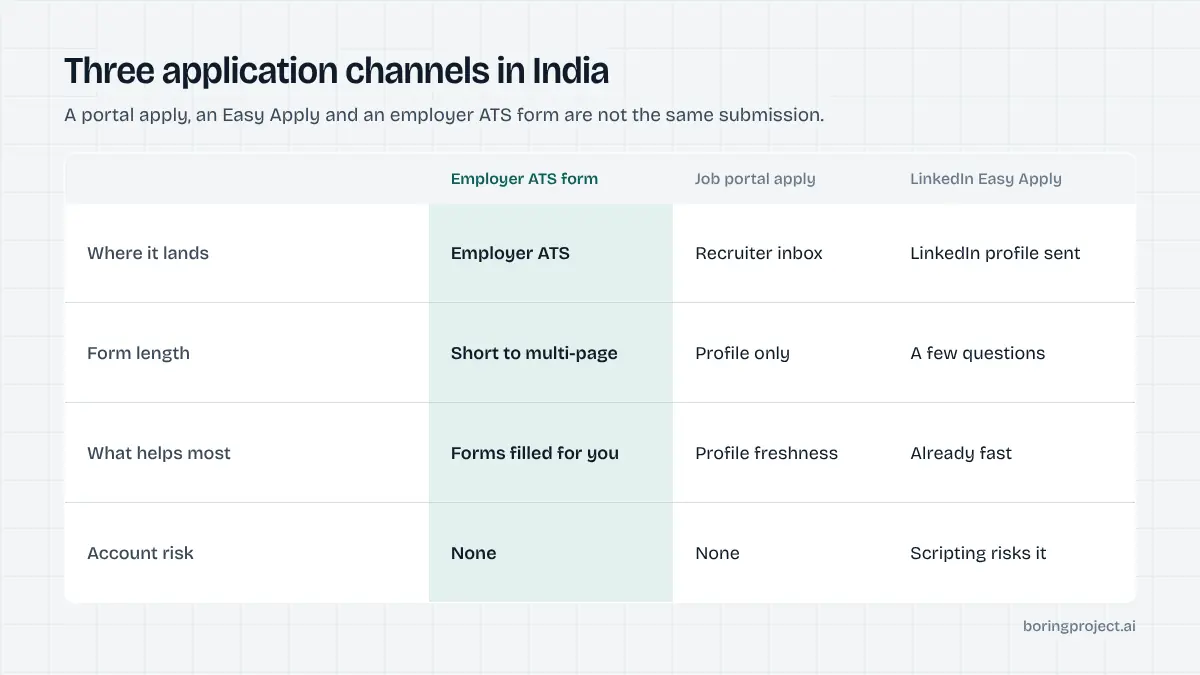
India's job market runs on portals to a degree that surprises people used to the US or UK. For a large share of roles, the application is your portal profile landing in a recruiter's inbox, not a form on the employer's site. That changes what "auto apply" means and what is worth automating.
This post covers the three channels you will meet when you auto apply jobs india, which ATSs sit behind employer career sites, the fields that are specific to Indian hiring, and how to avoid the account problems that come with the wrong kind of tool.
The three application channels in India
Portal applies: your profile is the application
On the major Indian job portals, clicking Apply on most listings sends your saved profile and resume to the recruiter who posted the role. There is no separate form. Speed here comes from keeping the profile complete and current, not from a bot clicking Apply.
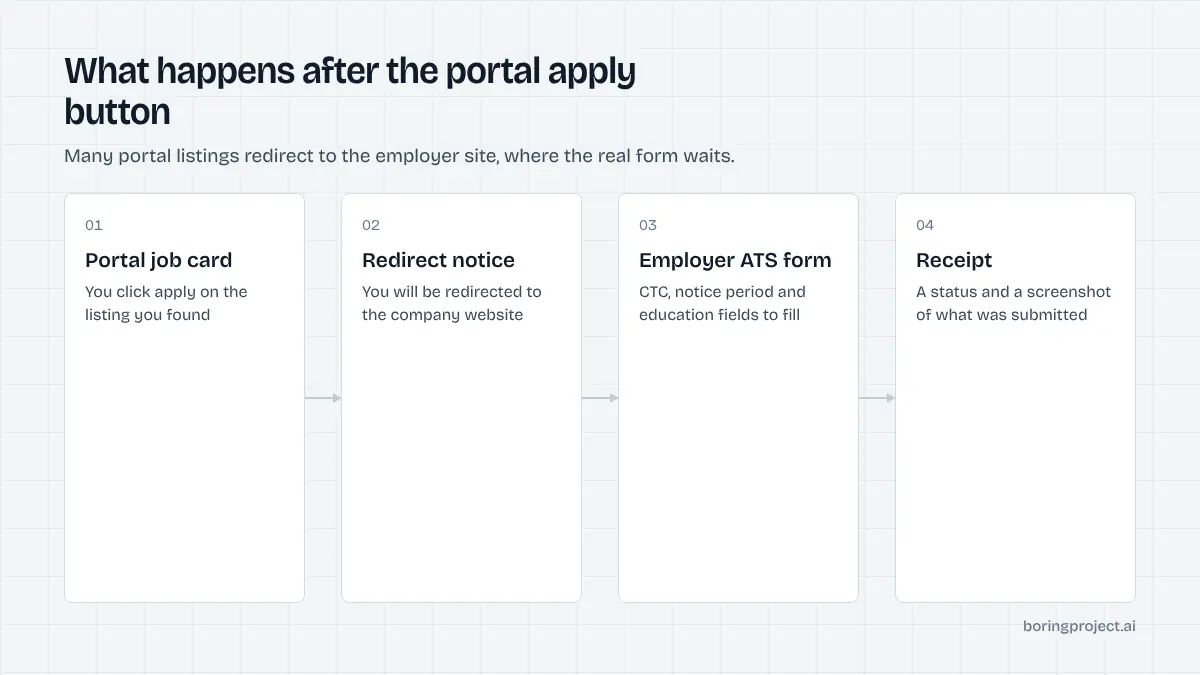
Recruiters on these portals also search the resume database directly, so profile freshness (recent update, correct notice period, accurate CTC fields) often matters more than application count. Some postings instead redirect to the company's own careers site; those are a different channel entirely.
LinkedIn Easy Apply: short, but not universal
LinkedIn is widely used for product, tech and multinational roles in India. Easy Apply postings submit your LinkedIn profile plus a few questions in a couple of clicks. Many postings, especially from larger employers, instead link out to the employer's ATS.
The pattern and its limits are covered in detail in our guide to LinkedIn Easy Apply automation. The short version: Easy Apply is already fast, and tools that script it against LinkedIn's interface risk your account.
Employer career sites: where the real forms live
When a portal or LinkedIn posting redirects to the company site, you are on an ATS. This is the channel where applying takes 10 to 30 minutes per role by hand, and almost all of the time you save when you auto apply jobs india comes from here rather than from the portals. It is also where Indian employers vary the most, from a two-field Greenhouse form at a startup to a multi-page Workday flow at an IT services major.
Which ATSs Indian employers use, and what their forms ask
The platform mix
Based on what is visible on employer career sites, the landscape splits roughly like this:
| Employer type | Commonly seen platforms | Form length |
|---|---|---|
| Large IT services, banks, multinationals | Workday, SuccessFactors, Taleo, iCIMS, Oracle Recruiting | Long, account required |
| Funded startups and product companies | Greenhouse, Lever, Ashby, Workable | Short, single page |
| Mid-sized Indian companies | Darwinbox, Keka, Zoho Recruit, or plain email | Varies widely |
| Government and PSUs | Custom portals | Long, often document-heavy |
Adoption shifts over time and many companies run more than one system, so treat the table as a starting point rather than a rule. The practical takeaway is that the same resume meets very different forms depending on employer size.
Fields specific to Indian hiring
Indian employer forms and portal profiles commonly ask for current CTC, expected CTC, notice period, and sometimes last working day or whether you are serving notice. Many multinational forms add a question on willingness to relocate and on preferred work location among listed cities.
These fields should be stored once, accurately, in whatever profile your tool uses. An automation tool that leaves notice period blank or enters a default is creating a bad first call for you. Education fields often expect degree, university and year of passing as separate entries, which is where resume parsing on Workday and SuccessFactors tends to need correction.
Documents and identity details
Most Indian ATS forms at the application stage ask for a resume and little else. Document-heavy requests (PAN, Aadhaar, previous relieving letters, payslips) usually come after an offer, not at application. If an application form demands identity documents up front, be cautious; a legitimate employer rarely needs them before an interview.
Making automation work without losing your accounts
Automate the forms, not the portal
The safe division of labour is simple. Keep your portal and LinkedIn profiles complete and apply there yourself, since those are one-click anyway. Use automation for the employer ATS forms that redirects send you to, where the work is repetitive and the risk to your portal account is nil because the tool never touches the portal.
Browser extensions that script portal interfaces are the main source of restricted or flagged accounts. Our post on whether auto apply is safe goes through the distinction between tools that act on your accounts and tools that submit to employer forms directly.
Set expectations by ATS
A startup Greenhouse form will submit in a few minutes. A Workday application at a large IT services company will take longer, require account creation, and may stop for input on a question your profile does not cover. A tool that reports submitted, needs input, or failed per application, with a screenshot, lets you see which of the day's applications actually went through.
Keep the volume sane
Indian recruiters at large employers see very high application counts per posting. Standing out is a matter of relevance and a current profile, not of applying to every opening a company has. One application per role, no duplicates across channels, and accurate CTC and notice period fields will do more than any amount of volume.
A workable daily routine looks like this: refresh the portal profile if anything changed, apply by hand to the one-click postings that fit, and hand the redirect-to-careers-site postings to the tool as a list. Review the receipts in the evening, answer anything marked needs input, and remove employers that have already rejected you from tomorrow's list. It is unglamorous, which is the point.
Frequently asked questions
Is there a built-in naukri auto apply feature?
Job portals in India let you apply with a saved profile in one click, which is fast but not automation in the sense of targeting and submitting on your behalf. Third-party tools that claim to automate portal applies typically drive the browser against the portal's interface, which can conflict with the portal's terms and leads to account restrictions in some cases. Treat such claims cautiously.
What happens when a portal posting redirects to the company website?
Your portal profile is no longer the application. You land on the employer's careers site, usually run by an ATS, and must complete that form from scratch. This is where most of the time goes and where a proper application tool helps, because it fills the employer's form directly from your profile rather than relying on the portal.
Which ATS platforms do Indian employers use?
Large IT services companies and multinationals commonly run Workday, SuccessFactors, Taleo or iCIMS. Startups and product companies often use Greenhouse, Lever, or Indian HR suites with recruiting modules such as Darwinbox, Keka or Zoho Recruit. Many mid-sized companies still accept applications by email or through a portal-only flow with no ATS form at all.
Do Indian application forms ask for notice period and current CTC?
Very often, yes. Notice period, current CTC, expected CTC and sometimes last working day are standard fields on portal profiles and on many employer forms. Keep these accurate and current in whatever profile your tool uses. An out-of-date notice period is one of the most common reasons a recruiter call goes badly.
Can I use an auto-apply tool for jobs abroad from India?
You can, as long as the tool answers work-authorisation questions truthfully. Forms in the UK, Canada, Australia and the US will ask whether you are authorised to work there and whether you need sponsorship. A tool that answers those from your stored profile is fine; one that guesses "yes" to get past the knockout is a problem for you, not for the tool.
Are auto-apply tools priced in rupees?
Pricing varies by vendor and most consumer tools price in US dollars with monthly plans; some add regional pricing. Rather than quote figures that change, check the vendor's site directly. For per-application pricing on a business or platform basis, which is a different model from consumer subscriptions, the sales team can share current terms.
Next step
If the employer-site forms are the part of your search you want off your plate, Search + Apply submits them from a profile you control and returns a receipt per application. It is built on a job application API that covers the Workday, SuccessFactors, Greenhouse and Lever forms Indian employers use, with per-application pricing.