 The Boring Project
Auto Apply Jobs Germany: An English Guide
Germany job application automation has to respect a document-heavy application culture and a split between short Personio-style forms and long corporate SuccessFactors flows; this English-language guide covers the boards, the ATSs, the document pack, and the fields to prepare once.
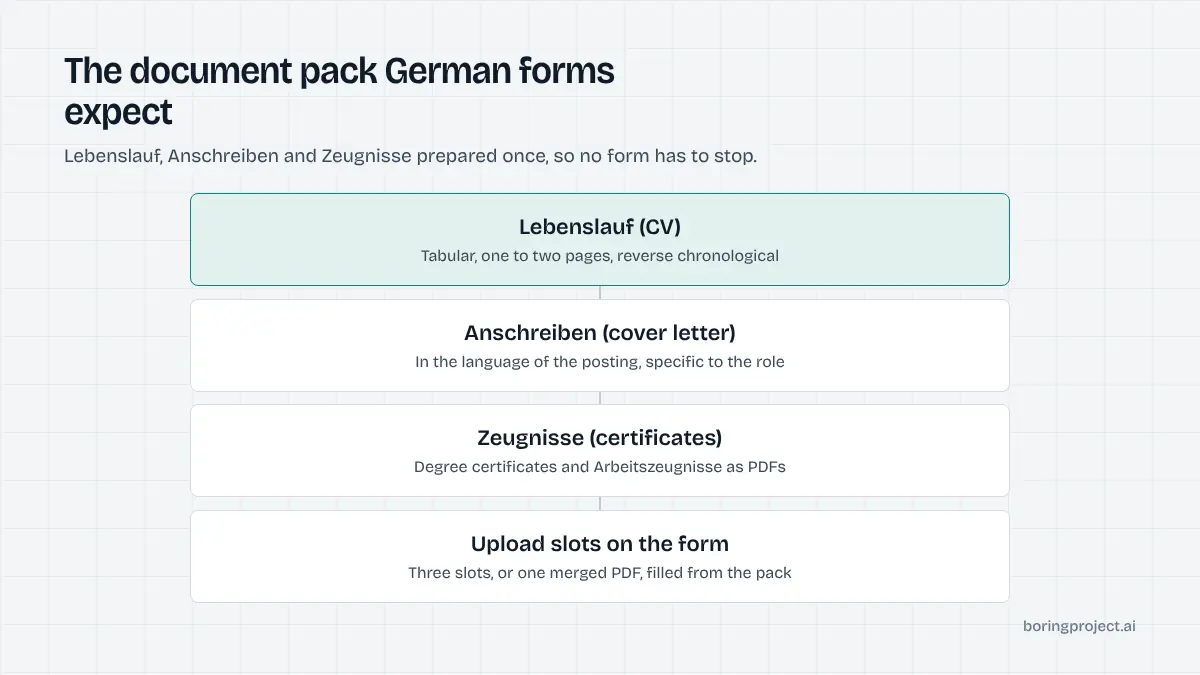
Germany is one of the more formal application markets. A complete application (Bewerbungsunterlagen) has traditionally meant a CV, a cover letter and a set of certificates, and many employer forms still have a slot for each. At the same time, startups and international companies in the major cities have moved toward a CV-only application in English.
If you plan to auto apply jobs germany wide, the two things to get right are the language and the documents. The forms themselves are manageable once those are sorted.
Where German jobs are posted and how applying works
The boards
StepStone and Indeed carry a large share of German postings, LinkedIn is strong for English-language and international roles, and XING remains relevant for German-speaking professionals. The Federal Employment Agency's job board (Jobbörse) lists a very wide range of roles, including many outside tech. Specialist boards cover engineering, healthcare and academia.
Most postings on these boards link to the employer's own application form. Some boards offer a profile-based quick apply, but for mid-sized and large employers the application happens on the company's careers page.
The ATS mix
The German market has its own ATS landscape alongside the global platforms:
| Employer type | Commonly seen systems | What to expect |
|---|---|---|
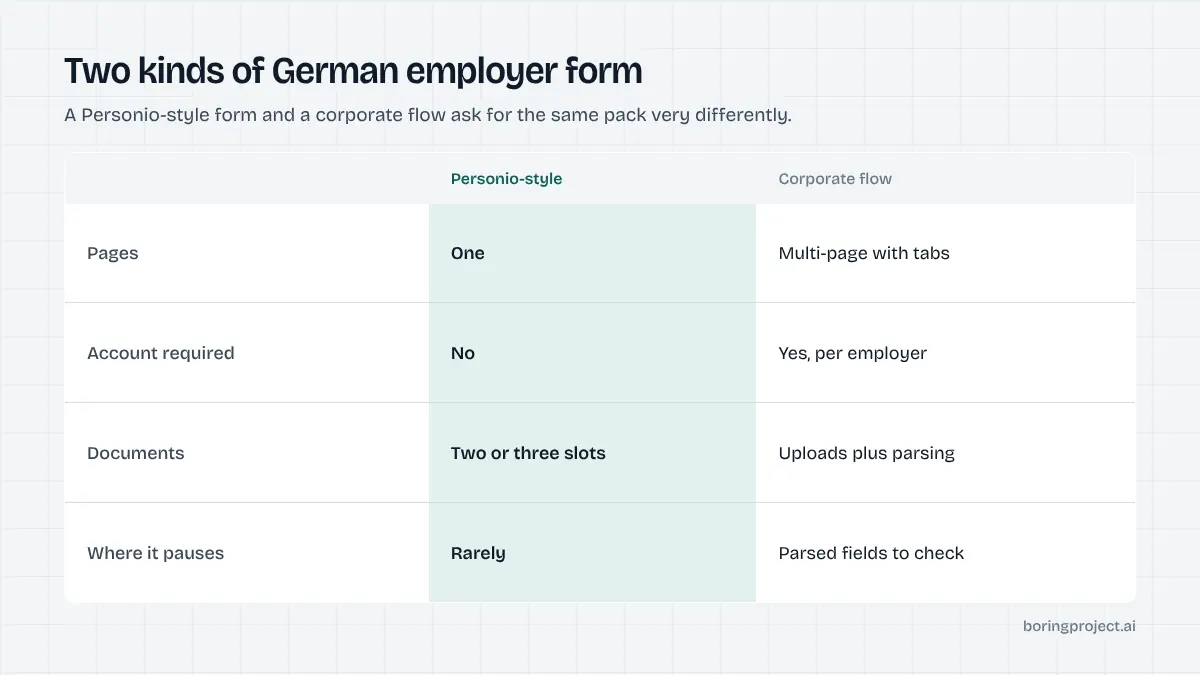
| Startups and SMEs (Mittelstand) | Personio, Recruitee, Teamtailor, Softgarden | Short form, two or three upload slots |
| International tech companies | Greenhouse, Lever, Ashby, Workable | Short form, English, CV-first |
| Large corporates and DAX companies | SAP SuccessFactors, Workday, Umantis, own portals | Account required, multi-page, document uploads |
| Public sector and universities | Interamt and institution-specific portals | Long, formal, strict document requirements |
Personio forms are quick and often ask for CV, cover letter and certificates as separate files. SuccessFactors flows require registration and parse your CV into structured fields that need checking. Our guides to applying on Personio and applying on SuccessFactors cover the specifics of each.
Language is the first filter
A posting written in German generally expects a German-speaking candidate and German documents. A posting in English usually accepts English documents. Mixed postings exist, but the safe rule is to match the posting's language and to skip German-only postings if your German is not at a working level. This filter removes more unsuitable roles than any title or location rule.
The document pack and the fields German forms ask for
Lebenslauf, Anschreiben, Zeugnisse
The German CV (Lebenslauf) is usually tabular, one to two pages, in reverse chronological order. A photo and date of birth were traditional; the equal treatment law means they cannot be required, and many employers now ask you to leave them out. The cover letter (Anschreiben) is still expected by many employers, particularly outside tech, and should be specific to the role.
Certificates (Zeugnisse) are the part that surprises people from other markets. German employers commonly expect degree certificates and reference letters from previous employers (Arbeitszeugnisse), either merged into one PDF or uploaded separately. Prepare that pack once, in both languages if you are applying to both kinds of posting, so no form has to stop for a missing file.
Permit, salary and start date
Forms frequently ask whether you hold a valid work permit for Germany or need visa support, your earliest possible start date (frühestmöglicher Eintrittstermin), and a gross annual salary expectation (Gehaltsvorstellung) in EUR. The salary expectation is asked more directly in Germany than in some markets and a blank is sometimes read as evasive.
Set each of these once in your profile. EU and EEA citizens need no permit; others should answer from their actual status (Blue Card, Opportunity Card, student permit with work allowance, and so on). A tool that changes a permit answer to pass a knockout is doing you harm.
Formal details
Some forms, especially in the public sector, ask for a full address, nationality and details of qualifications in a structured way. These are factual fields and are fine to store. Optional fields about religion or marital status are increasingly rare and can be left blank.
Qualification fields can be fiddly for candidates educated outside Germany. Forms may ask for the German equivalent of your degree or for a recognition status (Anerkennung) for regulated professions such as medicine, nursing, teaching or engineering. Enter what you actually hold; if a recognition process is in progress, say so in the cover letter rather than selecting a status you do not yet have.
Making germany job application automation work
Split the list by language and by form type
Run two lists: English-language postings with a CV-first pack, and German-language postings with the full German pack. Within each, note the ATS. Short Personio or Greenhouse forms can be batched; SuccessFactors and Workday forms need more time and more attention to parsed fields.
Let the tool handle uploads and stop for the rest
Most of the repetitive work when you auto apply jobs germany wide is uploading the same three documents into slightly different slots and re-typing the same start date and salary expectation. That is exactly what a form-filling tool should do. Anything it cannot answer from the stored profile, such as a role-specific motivation question, should return a "needs input" status for you to answer once.
Judge by acknowledgements and interviews
German employers tend to acknowledge receipt (Eingangsbestätigung) and then take their time. Track acknowledgements, then interview invitations, per list. If the German-language list produces nothing, the issue is usually language level or document completeness, not volume.
Rejections in Germany are often explicit, if slow, and many employers send a short decline rather than silence. Treat a decline as useful data: remove that employer from the active list for a few months, and look at whether the pattern of declines clusters around a form type, a sector or a language. That tells you whether to fix the pack, the list or the German.
Frequently asked questions
Can I auto apply for jobs in Germany if I do not speak German?
For English-language postings, yes, and there are many in tech, research, and international companies in Berlin, Munich, Hamburg and Frankfurt. For postings written in German, assume the role requires German unless it says otherwise, and do not apply with an English-only pack. A tool cannot fix a language mismatch; filtering the list by posting language is your job.
What documents do German application forms expect?
Typically a CV, a cover letter, and certificates (Zeugnisse) such as degree certificates and previous employer references, often as one PDF or in separate upload slots. Startups and international companies increasingly accept a CV alone. Have the full pack ready as PDFs so whichever form you meet can be completed without stopping.
Which ATSs are common among German employers?
Personio is widespread among small and mid-sized companies and startups. Large corporates frequently use SAP SuccessFactors, Workday, or Umantis and similar systems; some run their own portals. Recruitee, Teamtailor, Greenhouse and Lever appear at tech companies. Expect a Personio or Greenhouse form to be short and a SuccessFactors form to require an account and several pages.
Should the cover letter be in German?
Match the language of the posting. A German posting expects a German Anschreiben; an English posting accepts English. A machine-translated letter in either direction is usually obvious and hurts more than a well-written letter in the posting's language. Keep one strong version per language and adapt a paragraph per role rather than generating a new letter each time.
Do German forms ask about work permits?
Many do, in the form of a question about whether you hold a valid work permit for Germany or the EU, or whether you need visa support. EU and EEA citizens do not need a permit; others should answer based on their current status, including Blue Card or Opportunity Card holders. Store the answer once and never let a tool change it.
Is it normal to include a photo and date of birth on a German CV?
It has been common historically, and some candidates still include a photo. The General Equal Treatment Act means employers cannot require one, and many international and larger German companies now explicitly say not to include a photo, date of birth or marital status. Follow the posting's instruction where given; otherwise either choice is acceptable in 2026.
Next step
If you have a filtered list of German employer postings and a complete document pack, Managed Applies will submit each one, upload the right files to the right slots, and return a status and screenshot per application. Talk to us about managed applies to see how it fits a German job search; pricing is per successful application.