 The Boring Project
How to Auto Apply for Sales Jobs
Sales job search automation only pays off when the targeting is as disciplined as a real pipeline, so this guide covers which roles to include, how to handle quota and compensation questions, and what to expect from the ATSs sales teams use.
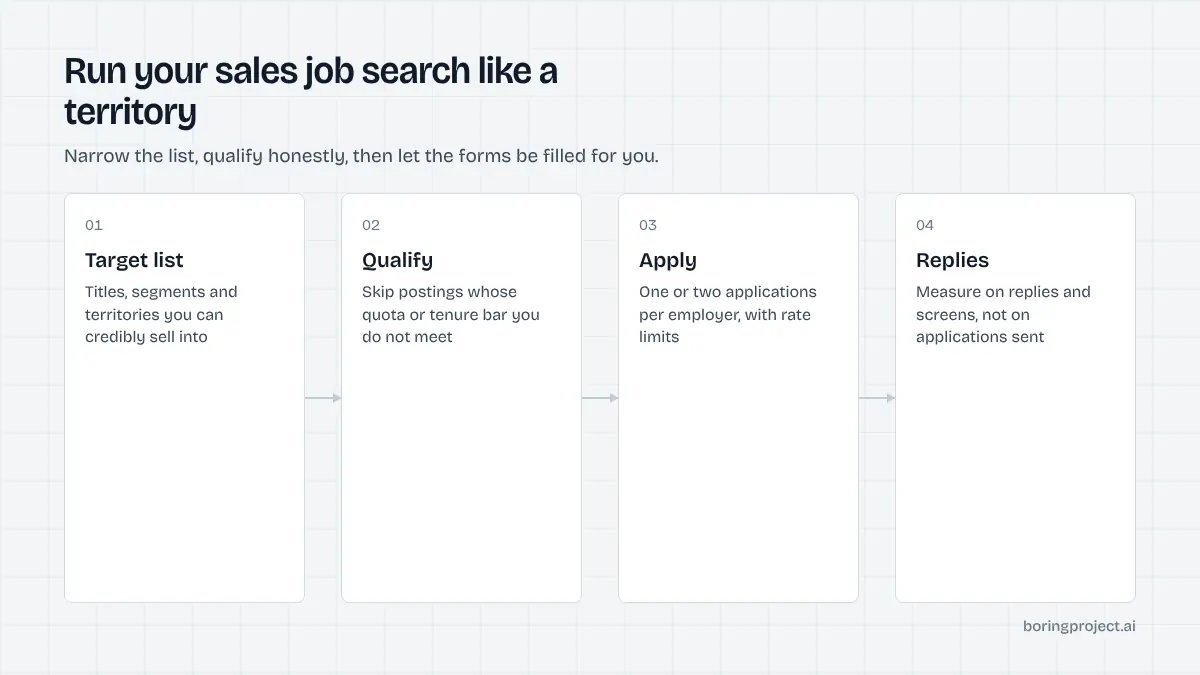
Sales candidates are, in theory, the people best placed to auto apply for sales jobs well. You already think in pipelines, conversion rates and follow-ups. The problem is that the same instincts that make a good outbound sequence make a bad job search: volume feels productive, and it is easy to confuse applications sent with meetings booked.
This post is about running sales job search automation the way you would run a territory. Narrow list, honest qualification, fast execution, and measurement on replies rather than sends.
Why sales postings punish lazy auto apply
The titles mean different things at different companies
An "Account Executive" at a 30-person startup may own prospecting, demos and closing with a modest OTE. The same title at a large vendor may be an enterprise closer with a seven-figure quota and a dedicated SDR team. A keyword filter on "account executive" puts both in your queue.
Filter on segment (SMB, mid-market, enterprise), motion (inbound, outbound, channel), and deal size where the posting states it. If a tool only supports title matching, build the list manually and feed it the URLs instead.
Hiring managers remember names
Sales hiring is unusually relationship-driven. VPs of Sales talk to each other, recruiters specialise in a region or vertical, and many companies use the same two or three agencies. Sending the same resume to six openings at one company in a week is noticed and stored.
Set a hard cap of one or two applications per employer per month, and skip roles where you clearly do not meet the stated quota or tenure bar. Tools with per-employer rate limits do this for you; others need a manual check.
Volume without relevance gets filtered early
Most sales teams screen on a handful of concrete fields: years of closing experience, quota attainment, average contract value, and sometimes a named CRM or vertical. These are often knockout questions in the ATS. Applying to roles where your honest answers fail the knockout is pure waste.
If your application count is high and your reply rate is near zero, the cause is almost always the list, not the form. The post on why automated applications stop producing interviews walks through diagnosing that.
Building a target list that does not spam
Start with three segments, not thirty keywords
Pick the segment you have actually sold in, one adjacent segment up, and one adjacent segment sideways (a new vertical with the same deal size, for example). Write a one-line pitch for each. If you cannot write the pitch, remove the segment.
Within each segment, favour postings that state the comp structure and quota. Those postings tend to come from teams that know what they want, which means fewer wasted interviews.
Set the exclusion rules before the inclusion rules
Exclusions do more work than inclusions in sales. Common ones:
| Exclusion | Why |
|---|---|
| Commission-only or 100% variable | Different job, different risk profile |
| "Entry level" with 5+ years required | Posting is mislabelled or a numbers game |
| Reposted more than twice in 90 days | High churn or unrealistic bar |
| Agency duplicates of a direct posting | Apply once, directly |
| Territories you cannot legally work in | Instant rejection on the work-authorisation field |
Most auto-apply tools can filter on title, location and remote status. Few can detect reposts or agency duplicates, so budget a few minutes a day to prune the queue by hand.
Decide what "one application" includes
A sales application often has three parts: the ATS form, a resume with a visible numbers section, and sometimes a short written answer about a deal you closed. Prepare all three once. The resume should show attainment per year, not just job titles; the written answer should be a real deal with a real outcome.
Automation should submit exactly those materials to each role. If a tool rewrites your resume per application without showing you the output, turn that feature off.
Handling quota, comp and screening questions
Pre-write the five questions you will always get
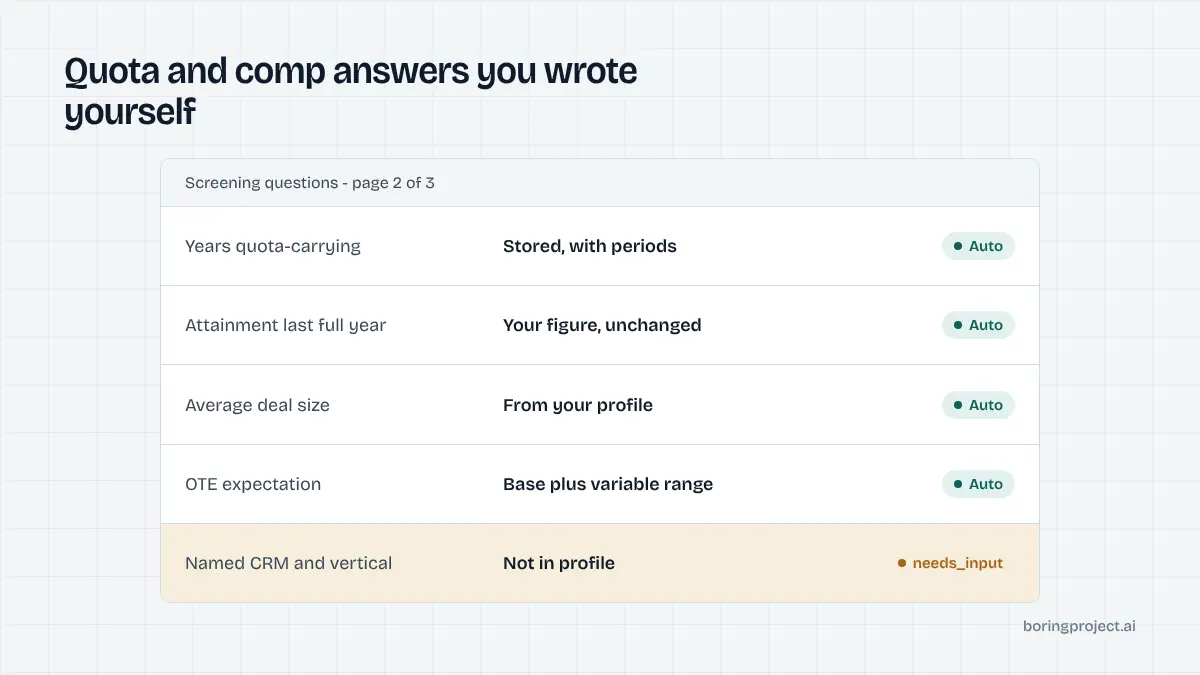
Nearly every sales ATS form includes some version of: years of quota-carrying experience, attainment in the last full year, average deal size, OTE expectation, and whether you have sold into a specific buyer or vertical. Write accurate answers once, with units and time periods, and store them in the tool's profile.
For OTE, check a market reference before you commit a number. A published salary dataset for your role and city is a reasonable starting point for a range, and it is easier to defend on a screen than a figure from memory.
Never let the tool invent an answer
The temptation in sales automation is to let a model fill in "118%" because that is what good candidates write. Do not. Attainment figures get verified in references and sometimes in offer letters, and a single inflated number can end an offer process late.
A trustworthy tool either uses the answer you gave or stops and asks you. Our guide to how screening questions are automated safely explains the "needs input" pattern: the application pauses, you answer the new question once, and the tool continues.
Measure replies and follow up like a seller
Treat each application as an opportunity with a stage. The numbers that matter are reply rate per segment and screen-to-interview rate. If one segment produces replies and another does not, cut the second one rather than doubling its volume.
Expect speed to vary by ATS. Greenhouse, Lever and Ashby forms are short; Workday and iCIMS need an account per employer and add compliance pages, so a 50-application day on startup postings is realistic and the same day on enterprise postings is not.
Automation gets you into the ATS. It does not send the two-line note to the hiring manager on LinkedIn, and it should not. That note, sent within a day of applying and referencing something specific about the team or product, is where sales candidates have an edge over every other function. Use the time the tool saves you for exactly that.
Frequently asked questions
Is it a good idea to auto apply for sales jobs?
It works when you treat it like a pipeline rather than a blast. Narrow the target list to titles, segments and territories you can credibly sell into, pre-write honest answers to quota and compensation questions, and let the tool handle form filling. Applying to every posting with the word "sales" in it produces rejections and burns bridges with recruiters who remember names.
How do auto-apply tools handle quota attainment questions?
The better ones ask you for the number once, store it in your profile, and reuse it wherever a form asks. A tool that guesses or leaves the field blank is a liability. Give a real figure with the period and context, for example "112% of a $900K quota in FY2025", and refuse any tool that offers to "optimise" it upward.
Which ATS platforms do sales teams hire through most?
SaaS and tech companies lean heavily on Greenhouse, Lever and Ashby, which are quick to apply through. Larger enterprises, telecoms, insurance and medical device companies more often run Workday, iCIMS or SuccessFactors, which involve account creation and longer forms. A good automation tool should handle both without you noticing the difference.
Should I include an OTE expectation when a form asks for salary?
Yes, and give a range that reflects base plus variable at target. Sales recruiters read a blank or a lowball as a lack of market awareness. If a form only offers a single number field, enter the midpoint of your OTE range and keep base versus variable for the recruiter screen. Check a salary reference first so the figure is grounded.
Will recruiters notice that my application was automated?
They will notice if the content is generic, not if the submission method was. An application with a tailored resume, accurate answers and a sensible cover note looks identical whether a person or a tool clicked submit. What gives automation away is volume without relevance: 40 applications to the same company in one week, or SDR applications from a 10-year enterprise AE.
Can I auto apply to recruiter and agency postings too?
You can, but keep them in a separate list. Agency postings are often duplicates of the same employer role, so applying to each one inflates your count without adding new opportunities. Many sales candidates get better results by applying directly to the employer and sending a short note to one or two specialist sales recruiters.
Next step
If you want the form filling handled while you keep control of the list and the answers, Search + Apply does exactly that: you approve each role, it submits the application and returns a receipt. It is built on the same job application API used by staffing and career platforms, and pricing is per successful application.