 The Boring Project
Auto Apply for Job Boards Without Building It
Auto apply for job boards means the seeker completes the application on your board and it is submitted into the employer's ATS on their behalf. This article explains why the external redirect costs boards so much, how a job board apply integration works, and what to decide before launch.
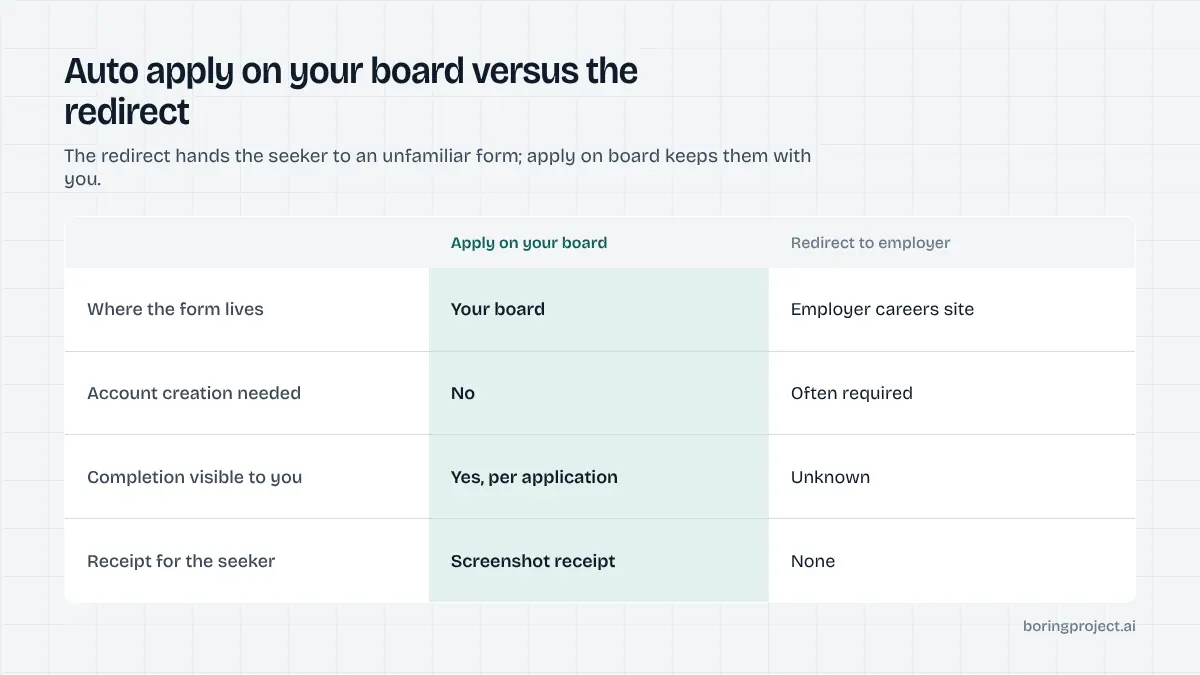
The redirect problem
Most boards do the hard part well: they attract seekers and match them to listings. Then, at the moment of highest intent, they send the seeker somewhere else and hope.
What happens after the click
The seeker lands on an employer career site built on Workday, Taleo, iCIMS or similar. They are asked to create an account, verify an email, upload a resume, then re-type the same resume into fields the parser got wrong, then answer screening questions, then confirm.
On a phone this is miserable. Many people stop partway.
The board never finds out. It counted a click; the employer counted an abandoned session. Neither number is the one that matters, which is completed applications.
What it costs the board
Three things leak at the redirect. Conversion: a share of motivated seekers never finish.
Data: the board cannot report true applications to employers, which weakens the case for paid listings. Relationship: the seeker's next step happens off-board, so the board has nothing to show them afterwards, no status, no follow-up, no reason to come back.
Why boards have not fixed it
Native apply exists for employers who integrate directly, but the long tail of backfilled jobs cannot be integrated one by one. Building browser automation for dozens of ATS families is a product in itself, and keeping it working is a permanent engineering cost.
Most boards correctly decide it is not their core business. The result is a decade-old compromise: great discovery, then a hand-off at the moment that matters most.
How an embedded apply flow works
Auto apply for job boards works the other way round: the seeker stays on the board, and the application is submitted for them through a job application API. The board owns the experience; the API owns the ATS plumbing.
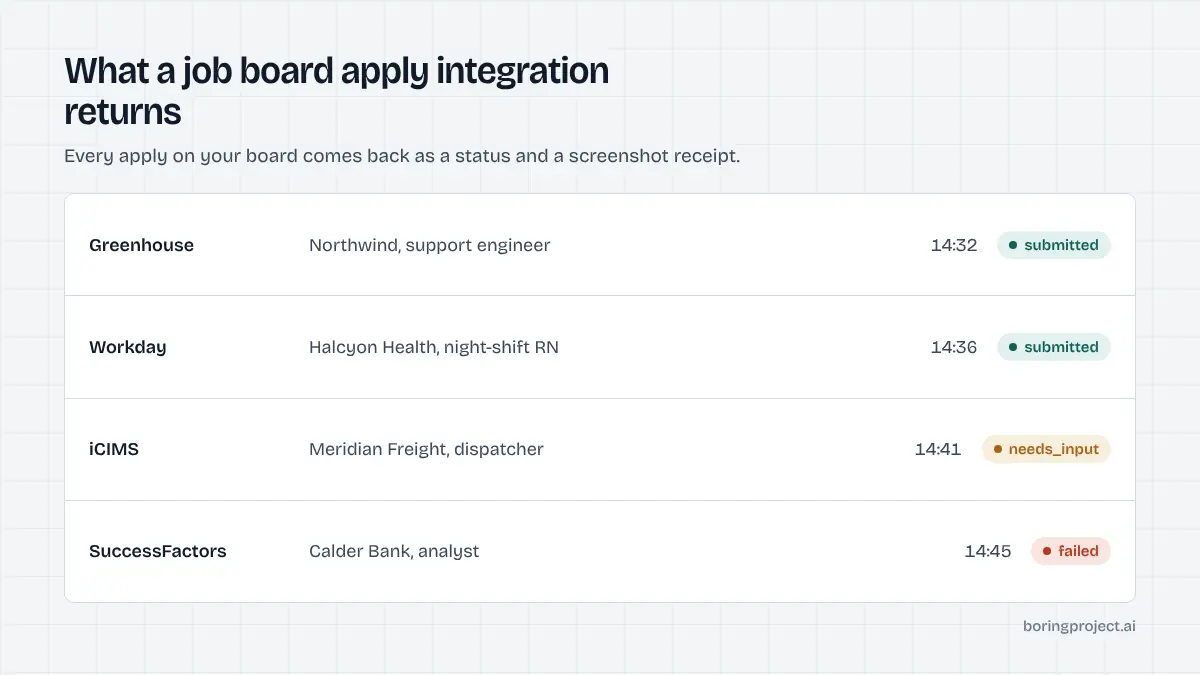
The seeker's side
The seeker clicks Apply on your listing. If they have a profile on the board, it is prefilled; if not, they complete a short form once.
They confirm consent for this application. They see a status: queued, then submitted with a receipt, or a short list of extra questions the employer asked. The whole thing happens in your UI, on your domain.
Your side
Your server calls the apply API with the job URL, the seeker's profile, the consent record and a callback. The service identifies the employer's ATS, fills and submits the form, handles any email verification, and sends a webhook with the result and a screenshot of the confirmation page.
Your handler updates the application record and notifies the seeker. The status model and payloads are covered in our guide to job application webhooks.
Nothing about the listing itself changes. Backfilled jobs that point at an external ATS are precisely the ones this is for.
What you can now report
Every application has a timestamp, an employer, a status and proof. You can show seekers a real tracker.
You can show employers completed applications rather than clicks. You can see which listings convert and which employer forms generate the most needs_input friction, which is useful signal for your own product.
This also changes the conversation with employers. A board that can say "we delivered this many completed applications to your form last month, here are the receipts" is selling outcomes, not traffic. That is a stronger position for pricing paid listings and for keeping the employer's budget when the market softens.
Decisions to make before launch
The job board apply integration itself is small. The product decisions around it deserve more thought.
Consent and profile depth
Decide how you capture consent: per application, per session, or as a standing authorisation the seeker can revoke. Per application is the clearest.
Decide how much profile you collect upfront versus on demand. Richer profiles mean fewer follow-up questions; longer forms mean more drop-off at signup. Most boards collect the basics at signup and let needs_input prompts fill the rest over time.
Whatever you choose, write the consent language plainly: which jobs, on whose behalf, and how to withdraw. Seekers are more willing to let a product apply for them when they can see exactly what will be sent and can review the receipt afterwards.
Branding and data ownership
The API has no seeker-facing surface, so the experience is yours by default: button, forms, emails, receipts. Confirm in writing that application data and receipts belong to you and the seeker, and that the vendor does not reuse candidate data for other customers. If you plan to offer the flow to partner boards or employers under their brand, read our guide to white label auto apply for the API versus embed trade-offs.
Volume, pacing and pricing
Per-employer rate limits are built into a serious apply service and protect you from looking like a bot farm to employers who receive many applications from your seekers. Pricing is typically per successful application, so failed and closed jobs do not cost you. Model it against your current click volume and a realistic completion rate, then compare with what you earn per completed application from employers.
Frequently asked questions
Why do job boards lose candidates at the external redirect?
Because the redirect hands the candidate to an unfamiliar site that often demands account creation, resume re-entry and a multi-page form. Each step loses a share of people, especially on mobile. The board also loses visibility: it cannot tell whether the candidate finished, so it cannot report completed applications to the employer or the seeker.
What does a job board apply integration involve technically?
A front-end apply flow that collects or reuses the seeker's profile and consent, a server-side call to an apply API with the job URL and profile, and a webhook handler that updates the application status and stores the receipt. Most boards already have the profile; the new work is the API call and the status UI.
Can this work for backfilled listings we do not have a direct relationship with?
Yes, and that is the main use case. Backfilled jobs point to the employer's own ATS, which is exactly what the apply service drives. The candidate applies from your board, the application lands in the employer's system through their normal form, and you receive confirmation. No employer integration is needed.
Will employers object to applications coming through a board?
The application arrives through the employer's own form with the candidate's real details and consent, the same as if they had clicked through. Rate limits per employer keep volume natural. Boards that already send traffic to those forms are simply completing more of the journeys they start.
Can we brand the apply experience as our own?
Yes. The API is invisible to the seeker; the apply button, profile form, status page and notifications are all yours. Receipts and screenshots can be shown under your brand. White-label is the default posture for an API product, since there is no vendor UI for the seeker to encounter.
What happens when an employer's form asks something our profile does not cover?
The application returns a needs_input status with the specific questions. Your board shows them to the seeker, collects the answers, and resubmits. This happens most on first applications to a new employer and declines as the profile fills in. It is far better than a default answer that disqualifies the candidate.
Next step
Search + Apply is built for boards: your feed stays the source of jobs, the apply step runs through the job application API, and receipts come back under your brand with per-application pricing. Bring your monthly click volume and we can model the numbers with you.