 The Boring Project
Auto Apply API Pricing: Models Compared
A neutral comparison of the three ways auto apply APIs bill, with a close look at per application pricing and the definitions that decide what you actually pay.
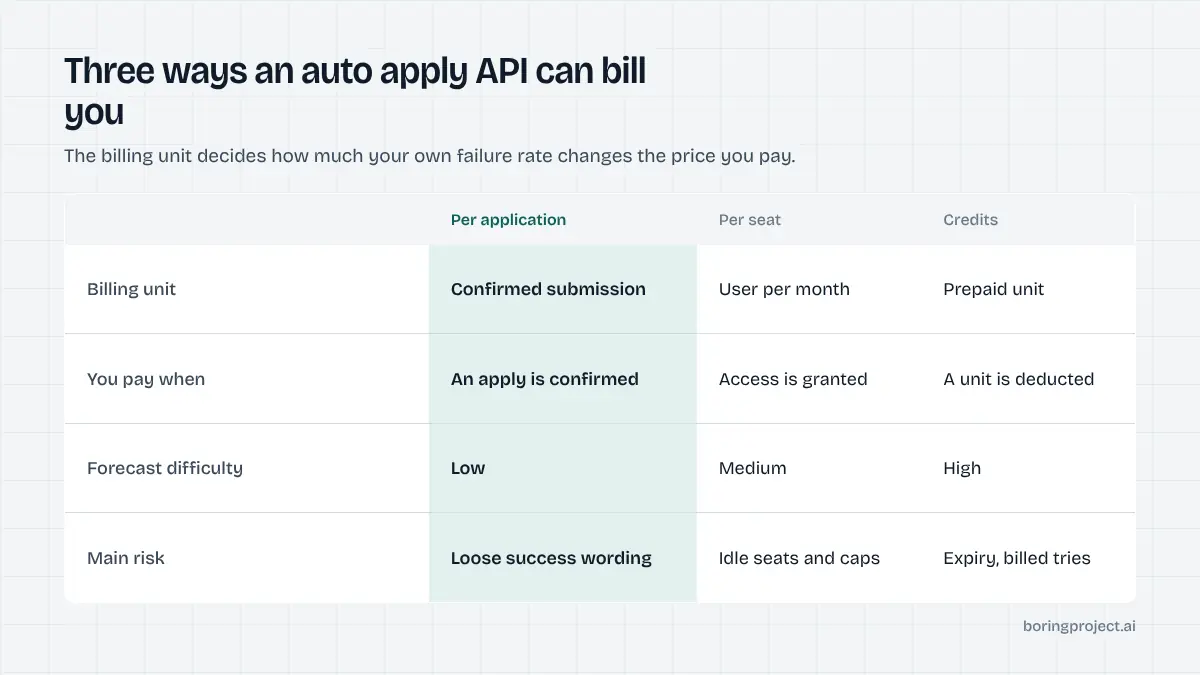
Pricing for application automation looks simple on a vendor page and gets complicated the moment you try to forecast a quarter. The reason is that the billing unit, the definition of success, and your own failure rate interact in ways a rate card does not show.
This article compares the three common models, explains what "successful application" should mean, and gives a method for turning a quote into a monthly number you can defend. It does not quote specific vendor prices, which change often; it covers the structures.
The three billing models
Per application
The vendor charges for each application that reaches a defined end state, usually a confirmed submission. Nothing is charged for attempts that pause or fail. Cost scales with outcomes, which makes it the easiest model to forecast once you know your success rate.
The risk is on the definition. If the vendor counts "submitted" loosely, you pay for applications that never landed. If they count it strictly and give you a screenshot receipt per billed application, the model is close to ideal for a buyer.
Per seat
Per-seat pricing charges a monthly fee per user with access to the product. It is inherited from recruiter software, where a human sits in front of a dashboard. For an API, a seat is an awkward unit: a single credential can submit thousands of applications, and a large team might submit very few.
Vendors sometimes pair seats with a usage cap, which turns the model into a disguised bundle. Read the cap carefully, and ask what happens when you exceed it mid-month.
Credits
Credit systems sell a bundle of units up front and deduct them as you use the product. The important question is what consumes a credit. If every attempt costs one, your effective cost per successful application rises with your failure rate. If only confirmed submissions cost a credit, the model behaves like prepaid per application pricing with a commitment attached.
Credits also expire in many plans. Unused balance at period end is revenue for the vendor and waste for you, so size bundles against measured volume rather than targets.
What counts as success, and why it dominates the math
Defining the billable event
The single most important line in any auto apply API pricing agreement is the definition of a billable application. Three outcomes are possible for every attempt: submitted, needs input, and failed. Only the first should be billable, and it should come with evidence, typically a screenshot of the ATS confirmation page.
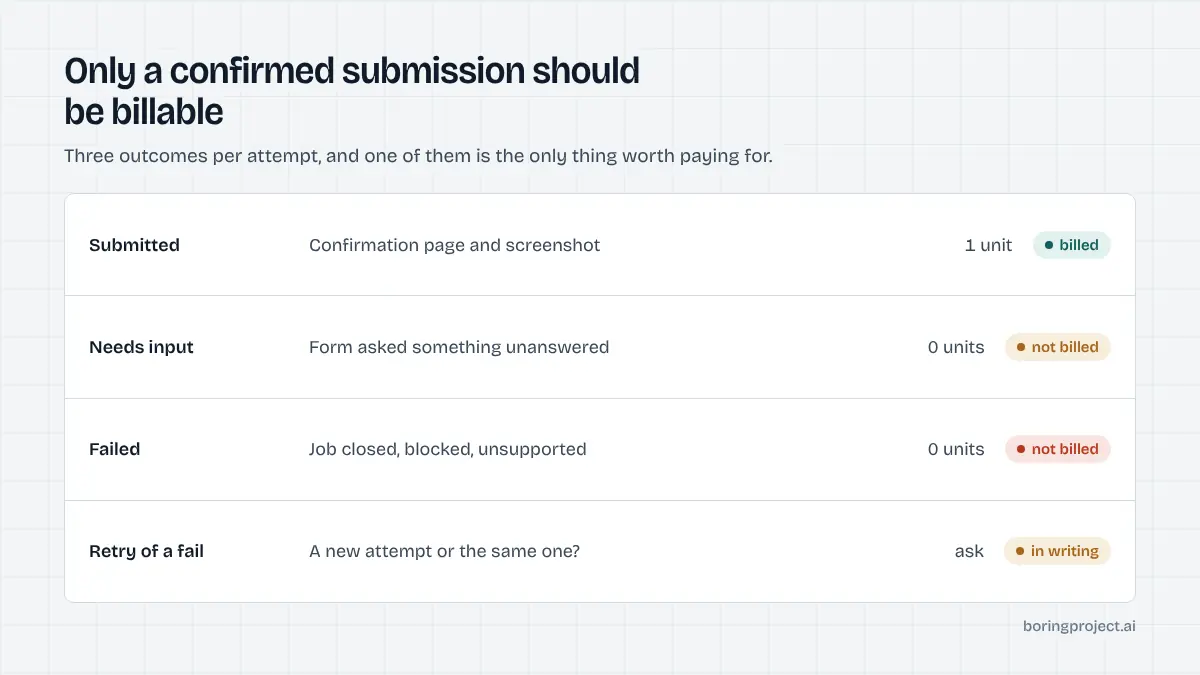
Needs input means the form asked something the candidate profile did not cover. A vendor that bills at that point is charging you for half an application. Failed means the posting closed, the page errored, or the ATS rejected the attempt; billing for that is simply billing for nothing.
How failure rates change the effective price
Suppose two vendors quote the same number, but one bills per attempt and the other per confirmed submission. If a quarter of attempts pause or fail on your job mix, the per-attempt vendor costs a third more per successful application than their rate card suggests.
Your failure rate depends on which ATSs your jobs sit on, how complete your candidate profiles are, and how fresh your job feed is. We discuss realistic ranges and the reasons behind them in our article on automated job application success rates. Measure yours in a pilot before signing anything with a minimum.
Hidden multipliers to ask about
Three line items often sit outside the headline rate. Platform or integration fees charged monthly regardless of usage. Surcharges for specific ATSs, usually the harder ones. And retry policy: if an application fails and the vendor retries, is the retry a new attempt or part of the original? Get answers in writing for all three.
Modelling your cost before you commit
A simple forecast
Start with the number of applications you intend to submit per month. Multiply by the success rate you observed, or a conservative estimate if you have not run a pilot. That gives expected successful applications. Multiply by the per-application rate and add fixed fees. For credit plans, divide your bundle by expected consumption per application to find the real unit cost.
| Model | Billing unit | Forecast difficulty | Main risk |
|---|---|---|---|
| Per application | Confirmed submission | Low | Loose success definition |
| Per seat | User per month | Medium | Usage caps, idle seats |
| Credits | Prepaid unit | High | Expiry, charged on attempts |
Comparing against building it yourself
Any vendor quote should be weighed against the cost of running your own automation: engineers, browser infrastructure, proxies, and the maintenance load of ATS changes. Those costs are mostly fixed and continue whether you submit ten applications or ten thousand. Our build vs buy analysis for job application automation walks through that comparison in detail.
Questions to put in the RFP
Ask each vendor to define the billable event, state whether needs input and failed attempts are charged, list any per-ATS surcharges, describe retry handling, and confirm whether receipts are included. Then ask for a pilot sized to a few hundred applications on your own job list. The answers will separate vendors faster than the rate card does.
Frequently asked questions
What should count as a successful application?
A submission the employer's ATS confirmed, with evidence. In practice that means the confirmation page was reached and captured as a screenshot. Attempts that paused for missing information or failed because the posting closed should not be billed. Ask any vendor to define success in writing before you compare prices, because the definition changes the effective rate more than the headline number.
Why do some vendors charge per seat?
Per-seat pricing comes from recruiter software, where the user is the unit of value. It is predictable for the vendor and simple to invoice. For an API that submits applications, seats are a poor proxy for usage: one integration can submit thousands of applications with a single credential. Seats make sense when humans operate a dashboard, less so for a programmatic product.
Are credit systems cheaper?
Sometimes, but it depends on what consumes a credit. If a credit is spent on every attempt, including failures and pauses, the effective price per successful application can be much higher than the credit price suggests. Model your expected failure and needs_input rates before assuming a credit bundle is a discount.
How do I estimate monthly cost for per application pricing?
Multiply expected successful submissions by the per-application rate, then add any platform fee. Expected successes come from your target volume times the success rate you observe in a pilot. Because you are not charged for failures, your cost tracks your actual outcome rather than your ambition, which makes the forecast easier to defend internally.
Does pricing change by ATS?
It can. Some vendors price harder systems such as Workday differently from simpler forms, and some charge a flat rate across all supported ATSs. Flat per-application pricing is easier to model. If a vendor varies by ATS, ask for the mix of systems in your target job list and compute a blended rate before comparing.
Is there a minimum commitment?
Vendors differ. Some require an annual contract or a monthly minimum; others let you start with a small pilot and scale. For a new integration, prefer a structure that lets you run a few hundred applications first, measure the success rate on your actual job mix, and then commit. Per-application pricing usually makes that easier.
Next step
The Apply API bills per successful application, confirmed by a screenshot receipt, with no charge for paused or failed attempts. Talk to sales about per-application pricing for your expected volume and job mix.