 The Boring Project
Build vs Buy Job Application Automation
This is a build vs buy job application automation guide for teams deciding whether to write their own ATS submission layer or use an API. It covers the engineering cost per ATS family, the maintenance load that dominates after launch, how canary testing works, and a framework for estimating job application automation cost over two years.
What you are actually building
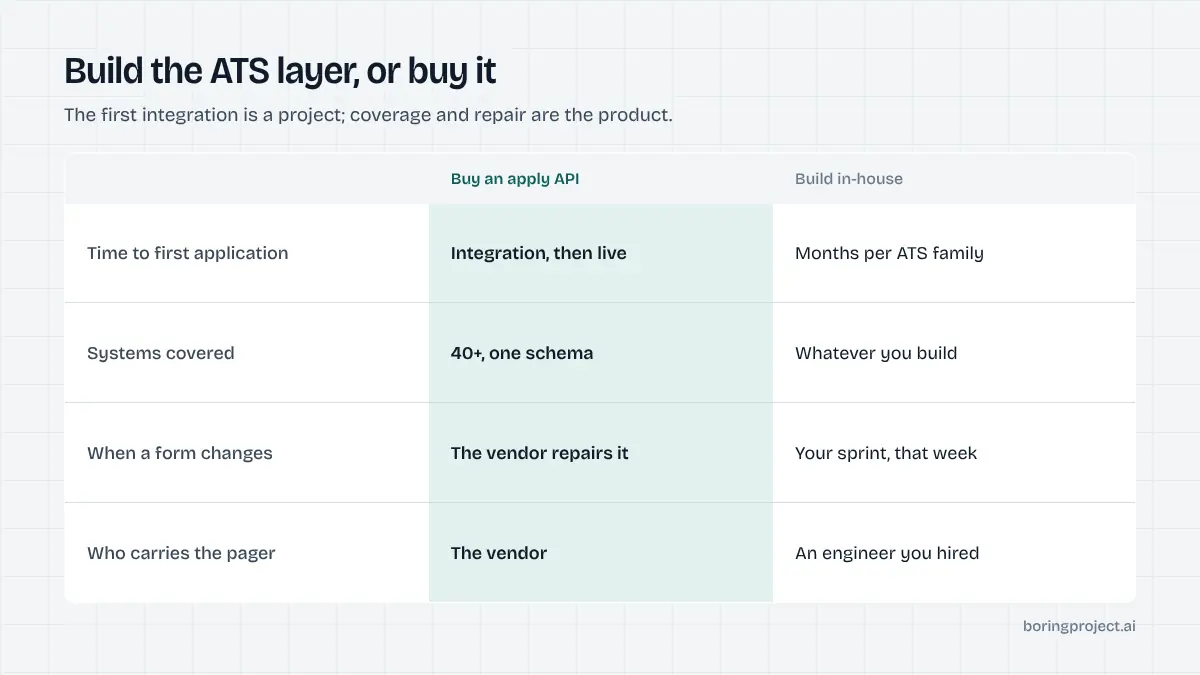
Teams usually enter the build vs buy job application automation decision believing the work is just form filling. That is true for one form. The product is the coverage, and the coverage is what costs money.
One ATS is a project, forty is a product
Greenhouse and Lever expose relatively simple, single-page forms. Workday requires account creation, email verification, a multi-step wizard with its own resume parser, and markup that varies by tenant configuration.
iCIMS, Taleo and SuccessFactors each have their own versions of the same complexity. Then there are employers with custom career sites in front of those systems.
Each family needs its own adapter: detection, navigation, field mapping, file upload, screening question handling, confirmation detection, and error classification. Expect the enterprise systems to take several times longer than the simple ones, and expect to discover tenant-specific variants after you thought you were done. We describe how adapters are structured in our guide to ATS integration for submitting job applications.
The infrastructure around it
Browser automation at volume needs a fleet of headless browsers, session isolation per candidate, inbox handling for OTP verification emails, file storage for resumes and screenshots, a queue with per-employer pacing, retries, and a webhook or callback system to report results. None of it is exotic. All of it has to exist before the first customer application goes through.
Budget for bot detection as well. Several enterprise career sites actively challenge automated sessions, and keeping a fleet healthy against those defences is an ongoing task rather than a one-time configuration. It is also the part most likely to be underestimated by a team whose experience is with conventional web scraping.
Guardrails that are not optional
Consent logging per application, duplicate detection, rate limits per employer, and a strict rule against guessing screening answers. These protect candidates and your domain reputation.
They also take design time, because the easy implementation (fill every field with something) is the wrong one. Expect to revisit them as you add systems, since each ATS exposes screening questions differently and the matching logic that worked for one will produce confident wrong answers on another.
The maintenance problem
Launch is the cheap part. ATS vendors and employers change their forms without telling anyone, and each change silently breaks every application into that system.
Breakage is continuous
A field renamed, a step added, a new consent checkbox, a bot-detection change. Across forty families and their tenant variants, something is broken most weeks. The question is not whether, but how quickly you know and how quickly you fix it.
Canary testing
The working answer is continuous canary applications: a scheduled set of test submissions across every supported ATS and the most important employer variants, run around the clock, with alerts on any deviation from the expected confirmation. When a canary fails, the adapter is flagged, live traffic to that system is paused or routed to needs_input, and an engineer repairs it.
This is how a provider keeps coverage honest. An in-house team has to build and staff the same thing for its own, much smaller volume.
Who carries the pager
Someone has to own this permanently. In a product company that someone is usually an engineer you hired to build features, now spending a significant share of their week on repairs for a component users never see unless it fails. Attrition makes it worse: adapter knowledge is detailed and specific, and it leaves with the person.
There is a quieter cost too. Every planning cycle, the maintenance backlog competes with roadmap work, and the roadmap usually loses, because a broken Workday adapter is an outage while a new feature is only a delay. Teams that build end up with a permanent tax on their velocity that does not show on any invoice.
A total cost framework
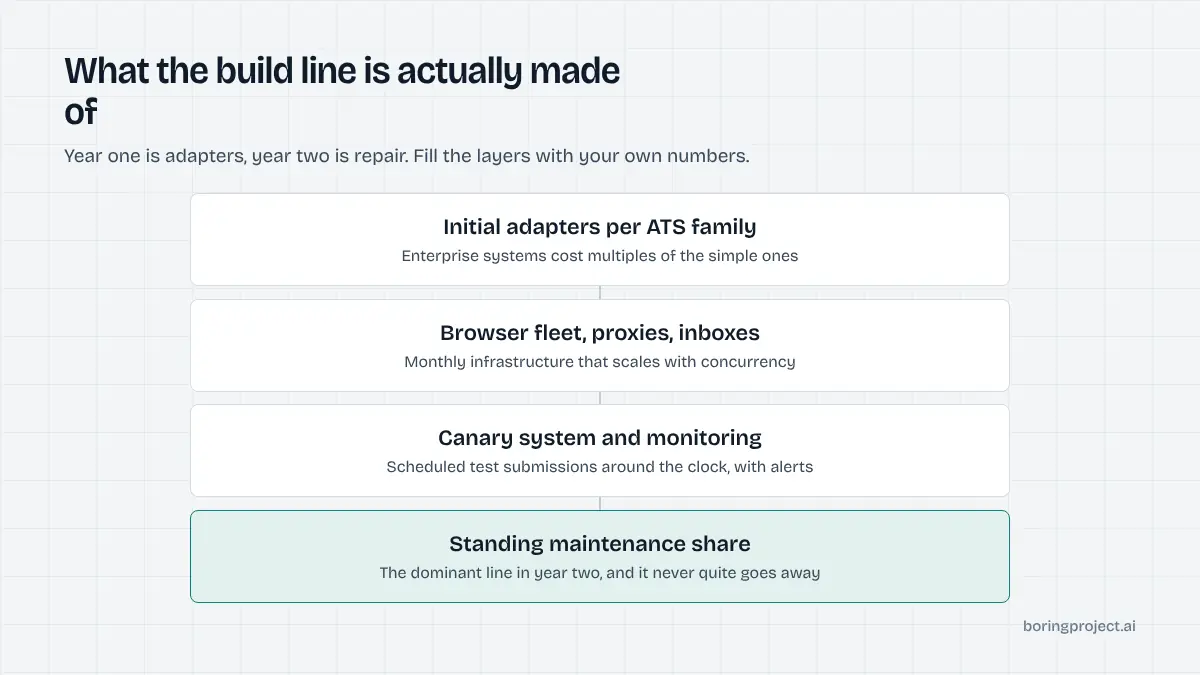
The argument usually stalls on one headline comparison: engineer salary versus per-application fee. Replace it with a two-year view of job application automation cost. The figures below are planning assumptions to fill with your own numbers, not benchmarks.
Cost lines for building
| Line item | Nature | Notes |
|---|---|---|
| Initial adapters | One-off per ATS family | Enterprise systems cost multiples of simple ones |
| Tenant and employer variants | Ongoing discovery | Found after launch, not before |
| Browser fleet, proxies, inboxes | Monthly infrastructure | Scales with concurrency |
| Canary system and monitoring | Build plus monthly | Required, not optional |
| Maintenance allocation | Standing engineering share | Dominant cost in year two |
| Failed applications during outages | Indirect | Lost placements and user trust |
| Opportunity cost | Indirect | Features not shipped |
Cost lines for buying
| Line item | Nature | Notes |
|---|---|---|
| Integration | One-off, small | Request, webhook handler, status UI |
| Per-application fees | Variable with volume | Successful applications only |
| Vendor evaluation and contract | One-off | Data ownership, consent, SLAs |
| Dependency risk | Indirect | Mitigate with exportable records and receipts |
Per-application pricing moves with usage, so the buy line is low at pilot volume and grows with revenue. The build line is front-loaded and then never quite goes away.
When you fill the tables in, be honest about the maintenance allocation. A common pattern is to budget a fraction of one engineer and then discover that two people are touching adapters every week. Ask anyone who has run browser automation against third-party sites for a year what their real number was.
When each answer is right
Build when submission is the product itself, you need only a couple of ATS families, and you have a team prepared to own browser automation for years. Buy when application submission is a feature inside a larger product, your users' jobs span many systems, and your engineers are better spent on matching, coaching, sourcing or whatever you actually sell. If the decision is close, buy first and revisit with real volume data; the conceptual overview of what a job application API does covers what you would be integrating.
Frequently asked questions
How hard is it to build job application automation in-house?
The first one or two ATS integrations are a reasonable engineering project. The difficulty is coverage and maintenance: dozens of ATS families, each with account creation, email verification, multi-page wizards and screening logic, all changing without notice. Teams routinely underestimate the second year, when the work is almost entirely repair rather than features.
What is the biggest hidden cost in building it yourself?
Detection and repair of breakage. When an ATS changes its form, every application into that system fails until someone notices and ships a fix. Without continuous canary applications you find out from customers. The engineering time is real, but the larger cost is failed applications and lost trust during the gap.
When does building make sense?
When application submission is your core product and differentiator, you only need one or two ATS families, you have a team willing to own browser automation indefinitely, and the volume is high enough that per-application fees exceed that team's cost. For most job platforms, agencies and tools, none of those hold at the same time.
How should I compare job application automation cost between options?
Use total cost over at least two years. For build: initial engineering per ATS family, infrastructure, proxies and browser fleet, monitoring, and a standing maintenance allocation. For buy: per-application fees at your projected volume plus a small integration effort. Then weigh time to market and the opportunity cost of engineers not working on your product.
Does buying mean losing control over the candidate experience?
No. With an API the candidate-facing experience, consent flow and reporting are entirely yours. What you give up is control over the submission mechanics, which is the part you did not want to own. Ensure the vendor gives you statuses, reason codes and screenshots so you can still explain every outcome to a user.
Can we start by buying and build later?
Yes, and it is the lowest-risk sequence. Buying first gets you to market, shows which ATS families matter for your users, and produces real volume figures. If building later still looks attractive you will be making that decision with data. In practice, most teams find the maintenance burden makes the switch unattractive.
Next step
Build vs buy job application automation is easier to settle with real figures, so talk to sales and bring your projected monthly applications and ATS mix. We will share current coverage, how canary testing works on our side, and per-application pricing so the buy column of your table has real figures in it.