 The Boring Project
Should I Apply to a Job With 100+ Applicants?
Should I apply to a job with over 100 applicants? Usually yes, because the number measures clicks rather than competitors; this explains what a 100 applicants on linkedin job counter is really counting.
What the number actually measures
Clicks, not candidates
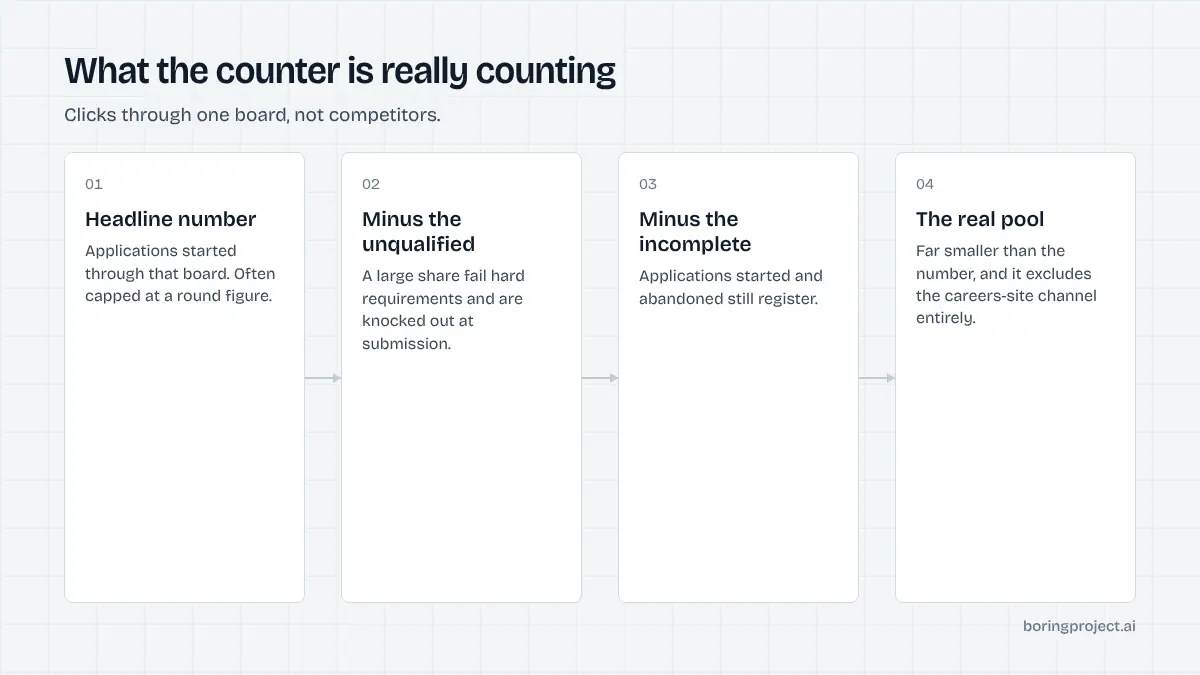
So when you ask should i apply to a job with over 100 applicants, the first thing to settle is what that number is. The counter on a job board generally reflects how many people started or submitted an application through that board. It does not measure qualified candidates, completed applications, or people the recruiter will seriously consider.
A substantial share of any large count is people who applied in two seconds without reading the posting, people who do not meet hard requirements, and people whose applications are incomplete. The number that matters to you is how many plausible candidates applied, and that is always far smaller.
It only counts one route
The counter sees applications through that board. It does not see applications made directly on the employer's careers site, which for many roles is the larger channel. So the number is simultaneously inflated as a measure of competition and incomplete as a measure of volume.
It is often capped
Many boards stop counting at a round number and display something like 100+ indefinitely. A role showing that may have 103 applicants or 2,000. Treating a capped display as precise information is reading more into it than it contains.
When to apply anyway
When you genuinely fit
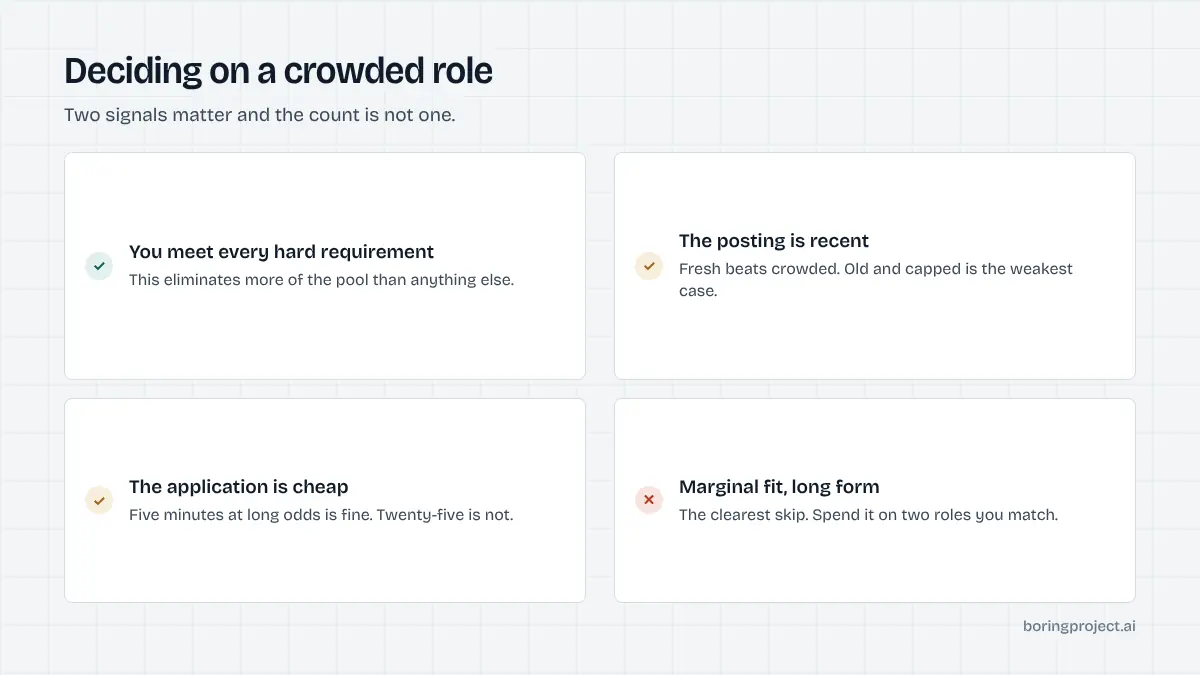
The strongest argument for should i apply to a job with over 100 applicants being yes is simple. Hard requirements eliminate a large share of any applicant pool automatically, through the screening questions, before anyone reads anything. If you meet the stated requirements and many applicants do not, your real position is far better than the headline count suggests.
When you can be early relative to the role, not the count
A high count on a role posted yesterday means the pile is building fast and speed matters. A high count on a role posted a month ago means the shortlist is probably already formed. The age of the posting tells you more than the number, which is covered in does applying early matter.
When the application is cheap
If the application takes five minutes and you fit the role, the expected value is positive even at long odds. The calculation changes when the application takes twenty-five minutes on a system that requires an account, which is where being selective genuinely pays.
When to skip it
When you fail a hard requirement
A high count plus a requirement you do not meet is the clearest skip. You will be knocked out at submission by the screening questions and the count makes a borderline case worse, because the recruiter has no shortage of candidates who do meet it.
When the role is old and the count is capped
A listing that has been up for over a month showing a capped count is the lowest-probability application you can make, unless something suggests the search failed and it was recently refreshed.
When the application cost is high and the fit is marginal
Spending twenty-five minutes on a Workday application for a role you are a stretch for, against a large pool, is where candidate effort is most often wasted. That time buys more applying to two roles you fit well.
Not the number. Whether you meet the requirements, how fresh the posting is, and whether your resume makes the match visible in seconds, which is covered in do recruiters actually read resumes. If you are building applying into a product, the cost per application is the variable that makes crowded roles worth entering at all, which is what The Boring Project is designed around.
Frequently asked questions
Should I apply to a job with over 100 applicants?
Usually yes, if you meet the requirements and the posting is recent. The counter measures applications started through one job board, not qualified competitors, and a large share of any pool fails hard requirements or never completes the form. Your real competition is much smaller than the number implies.
What does the applicant count on a job posting actually measure?
Generally how many people started or submitted an application through that specific board. It excludes applications made directly on the employer's careers site, and it includes people who applied without reading the posting or who do not meet the requirements.
Is 100+ applicants on a LinkedIn job a real number?
It is usually a cap rather than a count. Many boards stop displaying precise figures at a round number, so a role showing 100+ could have slightly over a hundred applicants or many times that. It is not precise enough to make a decision on.
Does a high applicant count mean I will not be read?
Not necessarily, but it does mean timing matters more. Shortlists are built from the top of a sorted list and recruiters stop once they have enough candidates, so applying while the posting is fresh is the lever that affects whether you are reached.
When should I skip a high-competition role?
When you fail a stated hard requirement, when the posting is old and the count is capped, or when the application takes twenty-five minutes and your fit is marginal. In that last case the same time is better spent on two roles you match well.
Does applying to crowded roles hurt my chances elsewhere?
No, applications are independent. The only real cost is your time, which is why the application length matters: a cheap application to a long-odds role is reasonable, while an expensive one to a marginal fit usually is not.
Next step
Next time a counter puts you off, check two things instead: whether you meet every stated hard requirement, and when the role was posted. Those two answers decide it, and the applicant number does not.