 The Boring Project
How Long Does an Automated Job Application Take?
Application submission time depends far more on which ATS the employer runs than on the tool submitting it; this post gives the median we see, explains why Workday and iCIMS take longer than Greenhouse and Lever, and lists the things that make an application stall.
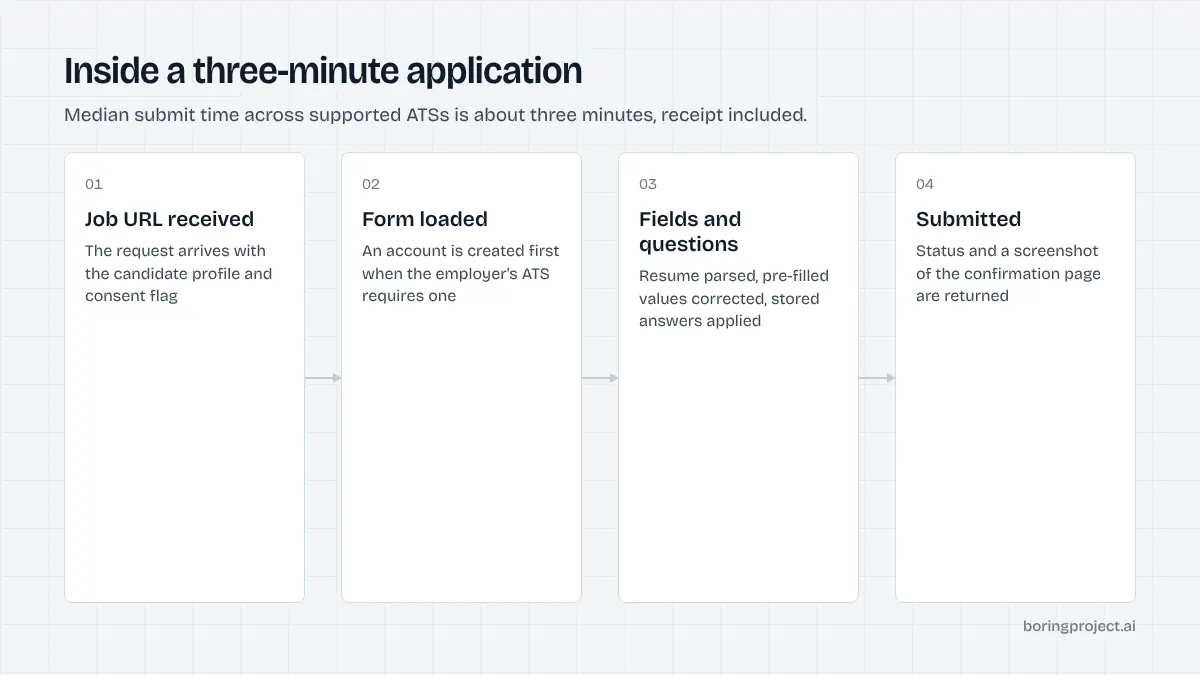
People ask how long does an automated job application take expecting a single number. There is a useful one: across all the ATSs we support, the median time from receiving a job URL and candidate profile to a submitted application is about three minutes. But the median hides a wide spread, and the spread is almost entirely explained by the employer's platform.
This post breaks the three minutes down into steps, shows which platforms sit above and below the median and why, and covers the stalls that turn a three-minute application into a thirty-minute one or a failure.
What happens in those three minutes
Load, detect, and (sometimes) register
The first step is loading the posting URL and identifying the ATS. For most platforms this is quick. The step that varies is account creation: Greenhouse, Lever, Ashby and Workable generally let a candidate apply without an account, while Workday, iCIMS, Taleo, SuccessFactors and Oracle Recruiting usually require one per employer. Registering adds a page or two, an email verification in some cases, and the first real chunk of time.
Parse and correct the resume
Many enterprise systems parse the uploaded resume into separate fields for each job, each degree and each skill. Parsing is imperfect, so the next step is checking those fields against the candidate's profile and correcting them. On a single-page form this step does not exist; on Workday or SuccessFactors it can be the longest step.
Fill, answer, submit, prove
Filling the standard fields is fast. Answering screening questions is fast when every question maps to a stored answer, and stops entirely when one does not, which is the "needs input" status. Submission itself is a click. The last step, capturing a screenshot of the confirmation page and returning it with the status, takes seconds but is the part that tells you the three minutes were not wasted.
Why some ATSs take longer
The step count is the whole story
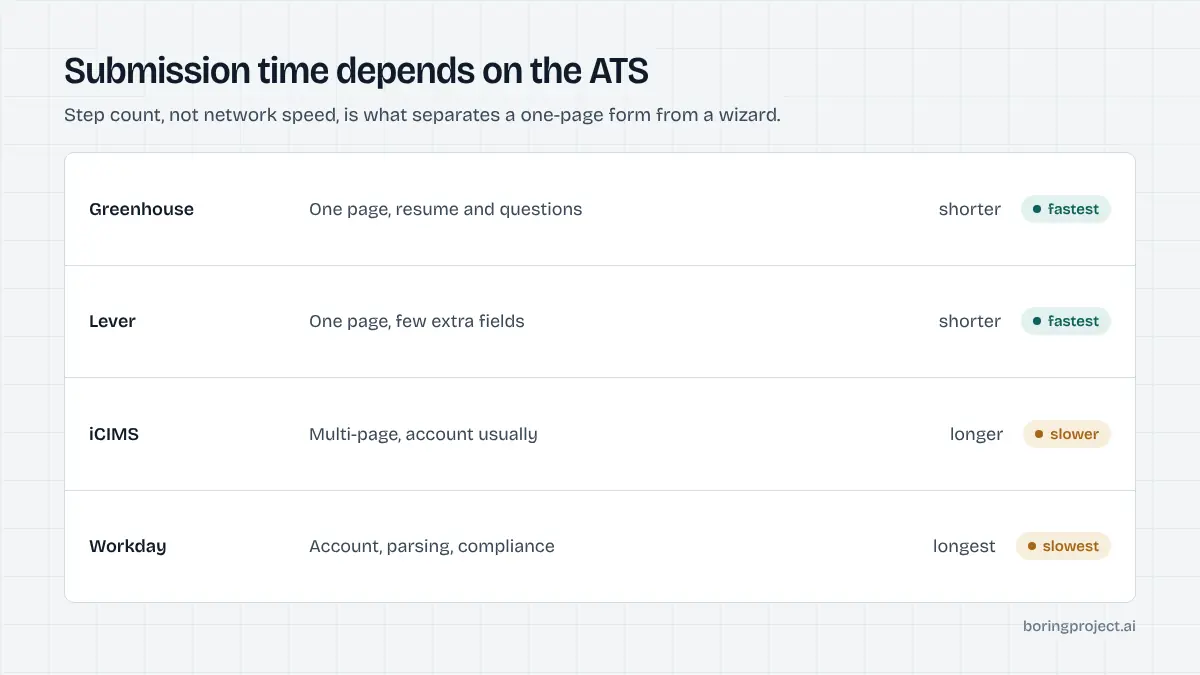
Platform differences in application submission time come down to how many discrete steps the form imposes. A qualitative ordering, based on what each platform typically requires:
| ATS | Account required | Pages | Resume parsing to correct | Typical time vs median |
|---|---|---|---|---|
| Greenhouse, Lever, Ashby | Usually no | 1 | No | Below |
| Workable, SmartRecruiters, Teamtailor | Sometimes | 1 to 2 | Light | Around |
| iCIMS, Taleo | Usually yes | Several | Yes | Above |
| SuccessFactors, Oracle Recruiting | Yes | Several | Yes | Above |
| Workday | Yes | Several, plus compliance | Yes | Above, often the longest |
These are patterns, not guarantees. Individual employers configure their systems differently, and a Greenhouse form with fifteen custom questions can take longer than a lean Workday one.
Two other factors move the number at the margin. Resume length matters on parsing platforms, because a four-page resume produces more fields to check than a one-page one. And the number of previous roles and degrees in the profile matters for the same reason: each becomes a separate structured entry on Workday, iCIMS and SuccessFactors, while a single-page form never asks.
For a candidate or a platform planning throughput, the useful mental model is a per-ATS budget rather than a single average. Short forms allow dense batches; enterprise forms need more time and more tolerance for the occasional pause.
Workday specifically
Workday is the platform people ask about most, because it is both widespread among large employers and consistently the slowest to apply through. The reasons are structural: a per-employer account, an initial resume parse that populates fields imperfectly, a multi-page flow that includes voluntary disclosures and sometimes employer-specific questionnaires, and session behaviour that can time out a slow applicant. Our guide to auto applying on Workday goes through each of these and how a careful system handles them.
Custom questionnaires and assessments
Any platform can be made slow by the employer attaching a long questionnaire or a third-party assessment. Questionnaires that map to stored answers add seconds each. Assessments (coding tests, personality inventories, video responses) are not something an application tool should complete on a candidate's behalf; a well-behaved system submits the application and reports that an assessment is pending for the candidate to do.
What makes an application stall or fail
Needs input
The most common pause is a question with no stored answer. The right behaviour is to stop, report "needs input" with the question text, and resume once an answer is supplied. The time to a final status then depends on the candidate or platform, not the tool. Systems that instead guess an answer are faster and worse.
Duplicate detection, timeouts and changed postings
Enterprise systems detect existing candidate accounts and may block a second application to the same role. Sessions time out. Postings close or change between the URL being queued and the form being loaded. Each of these should produce a clear "failed" status with a reason, not a silent drop. Knowing within minutes that an application failed is worth more than the application itself, because you can act on it.
Rate limits by design
Per-employer rate limits slow things down deliberately. Spacing applications to the same employer protects the candidate from looking like a bulk submitter and protects the employer from being flooded. A batch to fifty different employers finishes quickly; a batch of fifty to one employer is throttled, and should be. Our post on application success rate benchmarks covers how status and timing data read across a large volume.
So, in one line: how long does an automated job application take? A few minutes for most forms, longer for enterprise platforms, and a pause whenever honesty requires a human answer. If a tool promises much faster than that across every ATS, ask what it is skipping.
Frequently asked questions
How long does an automated job application take on average?
On our infrastructure, the median time from receiving a job URL and candidate profile to a submitted application is about three minutes. That median covers all supported ATSs. Short single-page forms finish faster; multi-page enterprise forms that require account creation take longer. The spread is wide enough that the platform matters more than the average.
Why is Workday slower than Greenhouse?
Workday requires a candidate account per employer, parses the uploaded resume into structured fields that often need correcting, and spreads the application across several pages including compliance and voluntary disclosure sections. Greenhouse is typically a single page with a resume upload and a few questions. The number of steps, not the network, drives the difference.
What does "needs input" mean for timing?
It means the application paused because the form asked something not covered by the candidate's stored answers, such as a role-specific screening question. The clock stops until the candidate or the integrating platform supplies the answer; then the application resumes from where it stopped. The time to a final status therefore depends on how quickly that answer arrives.
Does applying to many jobs at once make each one slower?
Not in a well-designed system, because applications run in parallel. What does slow things is per-employer rate limiting, which deliberately spaces out applications to the same employer so a candidate does not appear to be submitting in bulk. A batch of fifty applications to fifty different employers finishes much faster than fifty to one.
How long does it take to know whether an application succeeded?
A properly instrumented system returns a final status with a screenshot of the confirmation page as soon as the form submits, so you know within minutes. If a tool only reports "sent" without evidence, you may not find out it failed until you notice the lack of an acknowledgement email days later, which is the more costly kind of delay.
Is manual applying faster for any ATS?
For a single short Greenhouse or Lever form, a prepared human and an automated system finish in a similar time; the automation advantage there is consistency and not having to do it fifty times. For Workday, iCIMS and SuccessFactors, automation is substantially faster per application because it handles account creation and field correction without the usual friction.
Next step
If you are building a product and want to see the submitted, needs_input and failed statuses and the screenshot receipt for yourself, the API documentation walks through a first application end to end. Pricing is per successful application, so a stalled or failed submission costs nothing.