 The Boring Project
Auto Apply Jobs Canada: A Practical Guide
Canada job search automation runs into two things that differ from the US market: a high share of large employers on Workday, and work authorization and language questions that have to be answered precisely; this guide covers both and the boards you will start from.
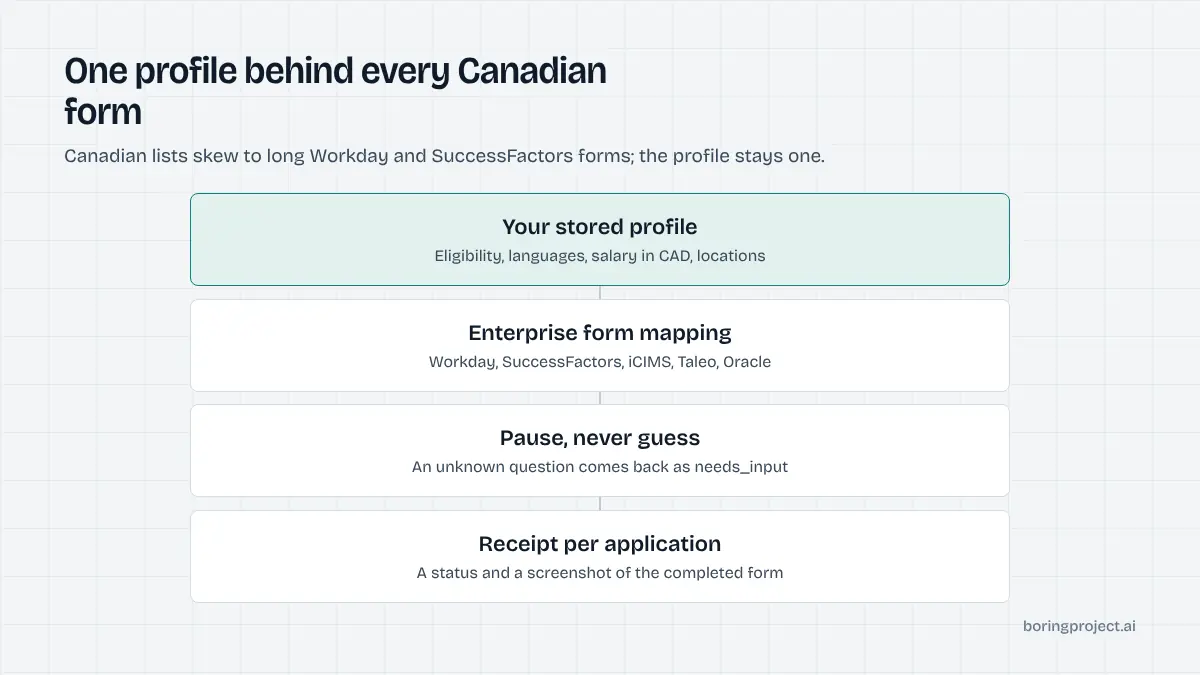
Canada looks like the US job market from a distance and behaves differently up close. The employer base is more concentrated, a few large organisations dominate each sector, and many of them run the same enterprise ATS. Add bilingual requirements in Quebec and the federal public service, and work eligibility questions that are phrased carefully for legal reasons, and the "apply to everything" approach breaks quickly.
This post is for anyone who wants to auto apply jobs canada wide without burning a candidate profile at a major employer or tripping over a form field they should have set once.
Where the postings are and where the forms are
Boards are for discovery
Indeed and LinkedIn carry most private-sector postings. Job Bank, run by the federal government, is where roles tied to immigration programs and LMIA requirements appear, and it is worth monitoring if you are on or seeking a work permit. Eluta and sector-specific boards still surface roles that are not on the big two.
For most mid-sized and large employers, clicking Apply on any of these sends you to the employer's careers site. The board is a feed; the application happens in the ATS.
Large employers cluster on Workday
Banking, insurance, telecom, retail chains, energy, universities, hospitals and provincial public bodies in Canada run Workday to a degree that stands out. SuccessFactors, iCIMS, Taleo and Oracle Recruiting appear as well, and tech companies use Greenhouse, Lever and Ashby, but a Canadian job seeker's list will skew toward long enterprise forms more than a US seeker's list of the same titles.
That has a practical consequence: per-application time by hand is high, and the value of automation is high too, as long as the tool handles the Workday specifics. Our guide to auto applying on Workday explains account creation, resume parsing and the common stall points.
One profile per employer, remembered
Workday-style systems hold a single candidate record per employer. Every application you make to that organisation is visible to its recruiters in one place. This is the strongest argument for a per-employer cap: a few targeted applications read as interest, a dozen unrelated ones read as noise.
The fields Canadian forms care about
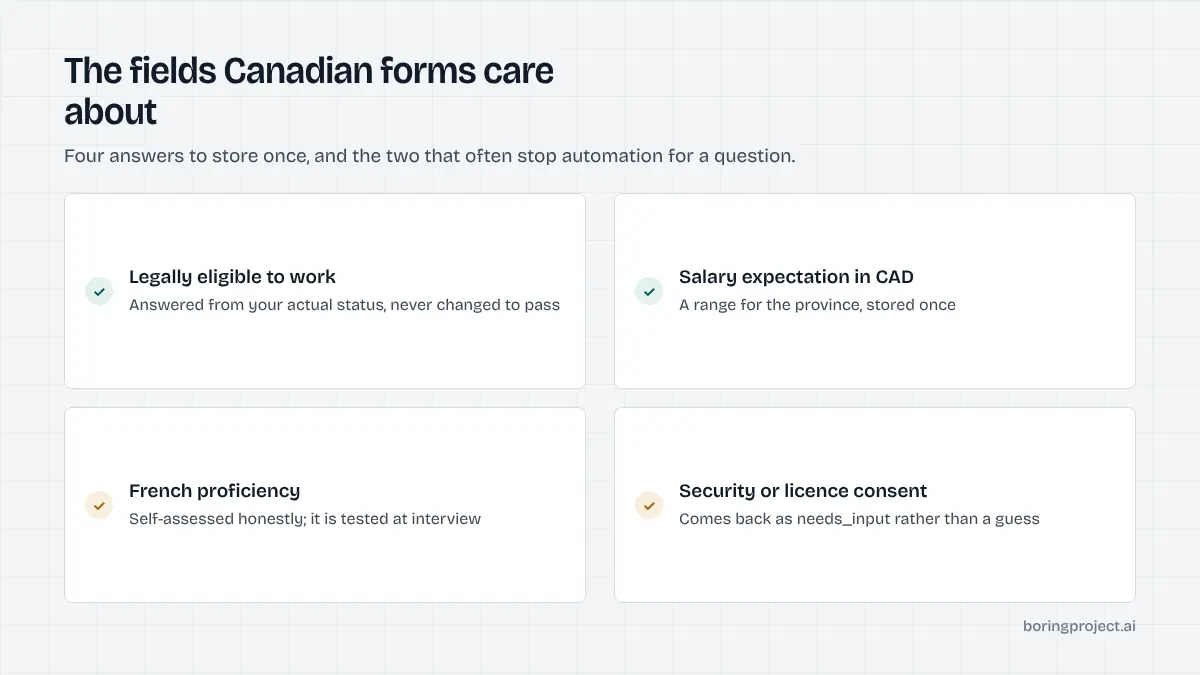
Most of what goes wrong when people auto apply jobs canada wide happens in three or four fields. Set them once, correctly, and the rest of the form is mechanical.
Work eligibility
The standard question is whether you are legally eligible to work in Canada, sometimes followed by whether you will require sponsorship or a work permit. Employers are limited in how they may ask about permanent eligibility; the Ontario Human Rights Tribunal, for example, has found that requiring permanent eligibility can be discriminatory. The basic eligibility question is nonetheless near-universal.
Answer from your actual status. Citizens, permanent residents, and holders of valid open or employer-specific work permits are all eligible to work, with conditions in the last case. Store the answer once and use a tool that will never change it to pass a screen. A wrong "yes" surfaces at offer stage and ends the process.
Language
Postings in Quebec and bilingual federal roles may require French, and the form may ask you to rate proficiency or to submit documents in French. Keep both English and French versions of your resume and a short letter if you are applying across regions, and make sure the tool uploads the right one per posting. Rating your own French honestly matters; it is tested.
Compensation, location and checks
Salary expectation fields are common and usually in CAD. Provide a range based on market data for the province, since pay varies noticeably between, say, Toronto and Halifax for the same title. Location questions often ask about willingness to relocate or to work on-site at a named city. Regulated sectors add background, credit or licence checks at application or offer stage. All of these belong in a stored profile, answered once.
Running canada job search automation well
Build the list by employer, not just by title
Because employers are concentrated, it helps to list the organisations you would actually join in each sector, then pull their open roles, rather than searching titles across every board. This naturally limits applications per employer and produces a shorter, better list.
A simple structure is a sheet with one row per posting: employer, title, city or remote, ATS, language requirement, eligibility notes, date added, and status. The ATS column is more useful than it sounds, because it predicts how long the application will take and how likely it is to need your input. The language column stops the wrong resume going to a French-first posting.
Let the tool stop for the questions you did not anticipate
Canadian enterprise forms sometimes add a question that your profile does not cover: a specific licence, a security screening consent, a bilingual self-assessment. The right behaviour is a "needs input" status, not a guess. You answer once, the tool continues, and the answer is saved.
Federal public service applications are a special case. They typically run through the government's own system with structured screening questions tied to essential qualifications, and they expect you to demonstrate each one in writing. No tool should draft those for you, and most will correctly stop. Budget your own time for them and let automation handle the private-sector forms around them.
Track by employer and by ATS
Reply times differ sharply between a scale-up on Greenhouse and a bank on Workday. Track applications, acknowledgements and screening calls per employer and per platform so you can see which half of the list is moving. The post on tracking automated applications covers a simple setup that works with any tool that returns a receipt.
A final note on volume. Canadian recruiters are often in-house and work across many requisitions; they recognise names. A disciplined list, accurate eligibility answers, the right-language resume, and receipts you can check will outperform raw volume here more clearly than almost anywhere else.
Frequently asked questions
Does auto apply work in Canada, given how many employers use Workday?
It works, but the Workday share changes what to expect. Large Canadian employers across banking, telecom, retail, energy and the public sector commonly run Workday, which requires an account per employer and a multi-page form. Automation saves the most time there, provided the tool handles account creation, resume parsing corrections and the compliance pages, and tells you clearly when a submission failed.
How should the work authorization question be answered?
Truthfully, from your stored profile. Canadian forms typically ask whether you are legally eligible to work in Canada, and sometimes whether you will need sponsorship. Several provinces restrict how employers may ask about permanent eligibility, but the basic eligibility question is standard. If you hold a work permit with conditions, answer yes and be ready to explain the conditions on a call.
Do I need a French version of my resume?
For roles in Quebec and for federal public service positions marked bilingual, often yes, or at least a French cover letter. Elsewhere, English is usually sufficient unless the posting states otherwise. Store both versions if you are applying across regions and make sure the tool uploads the right one; sending an English-only application to a French-first posting is an easy mistake.
Which job boards matter in Canada?
Indeed and LinkedIn carry the bulk of private-sector postings, with Job Bank (the federal board) important for roles tied to LMIA and immigration programs, and Eluta and sector boards surfacing roles the big two miss. Most larger employers redirect from any board to their own careers site, so the board is a discovery layer and the employer's ATS is where the application actually happens.
What should I do about postings that say "Canadian experience required"?
Treat it as a signal about the employer rather than a hard filter, unless it is tied to a regulated licence. Human rights commissions in several provinces have published guidance that blanket Canadian-experience requirements can be discriminatory. Apply if you otherwise match, answer the eligibility question accurately, and let your actual experience speak in the resume.
Will applying to many roles at one large Canadian employer hurt me?
It can. Workday-based employers keep a single candidate profile across all their postings, so a recruiter sees every role you applied to. Three related applications in a month is fine; fifteen across unrelated departments is not. Set a per-employer cap in whatever tool you use, or keep one manually.
Next step
If your list is mostly Workday and SuccessFactors employers and you want the forms handled with a receipt per application, Search + Apply does that from a profile you control, with per-employer rate limits built in. It runs on the same job application API used by staffing and career platforms; pricing is per successful application.