 The Boring Project
How to Auto Apply for Software Engineer Jobs
Engineers who auto apply for software engineer jobs deal with a specific set of platforms, forms and questions. This page explains how developer job search automation works on Greenhouse, Lever, Ashby and the enterprise systems, what your profile needs to contain, and how to keep the process from working against you.
Know the platforms you will be applying on
Engineering roles are concentrated on a handful of applicant tracking systems, and their forms differ enough that a tool's coverage of each matters.
Greenhouse, Lever and Ashby
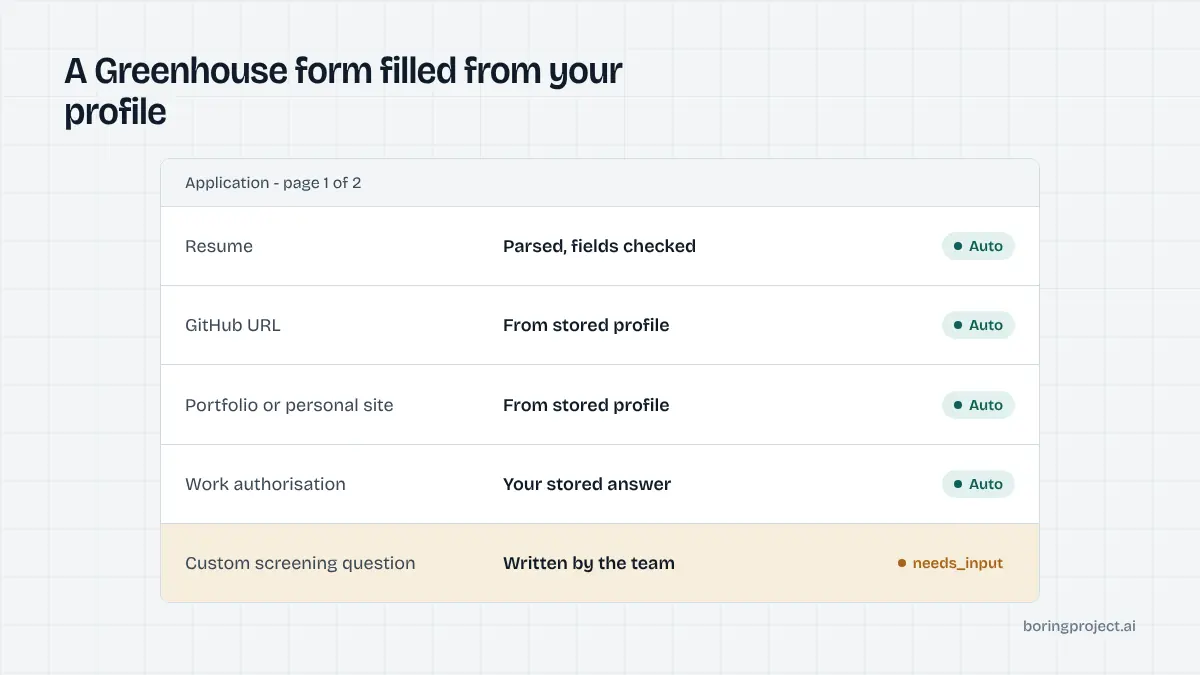
These three dominate among startups and scale-ups. Their forms are comparatively simple: a single page or two, resume upload with parsing, a few structured questions, and often fields for GitHub, portfolio and LinkedIn URLs.
Custom screening questions are common and are usually written by the hiring team, so they vary widely between companies. The form pattern and its quirks are covered in how to auto apply on Greenhouse; Lever and Ashby are similar in spirit with their own layouts.
Workday, iCIMS and the enterprise systems
Large technology companies, banks, retailers and other enterprises hiring engineers more often run Workday, iCIMS, SuccessFactors or Taleo. Expect account creation, multi-step flows, a parsed-resume review step, and longer screening sections including eligibility, relocation and compensation questions. These are where automation saves the most time per application and where poor tools fail most often.
What this means for tool choice
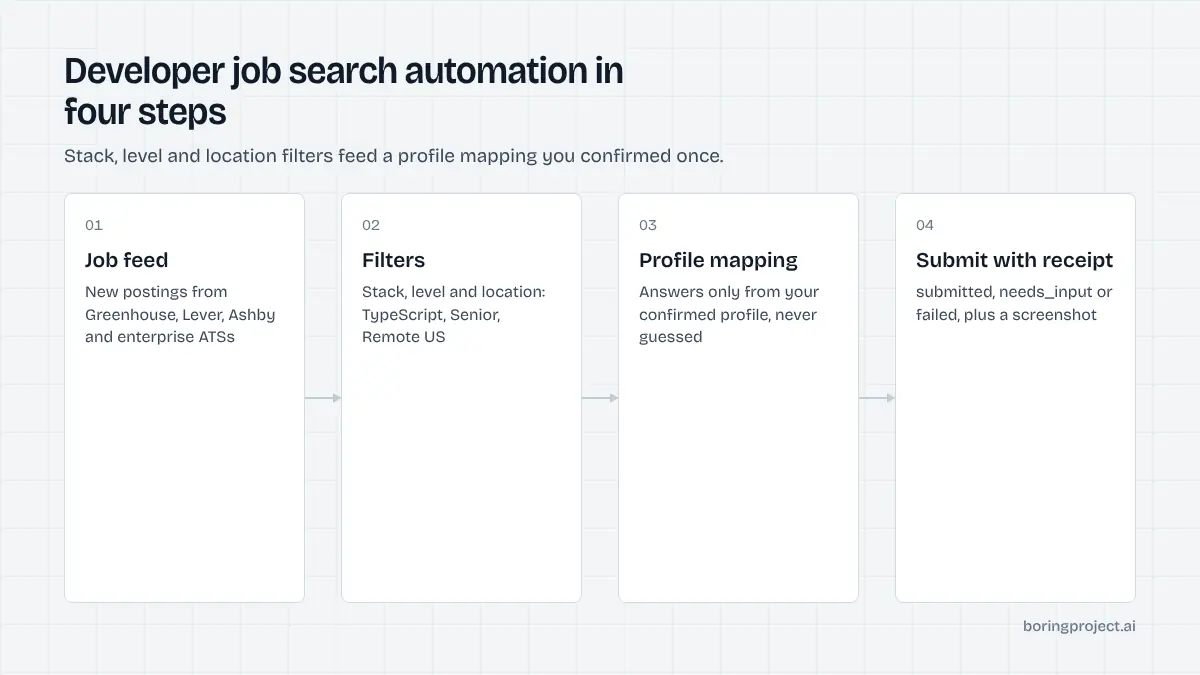
Ask any tool which of these platforms it handles end to end, then test it on three real postings from your target list, one from each group. A tool that is excellent on Greenhouse and fails silently on Workday will skew your applications toward smaller companies without telling you. You want submitted, needs-input or failed for every attempt, with a screenshot, so the coverage gaps are visible.
| Platform group | Typical employers | Form complexity | What to check in a tool |
|---|---|---|---|
| Greenhouse, Lever, Ashby | Startups, scale-ups | Low to medium | Custom question handling, URL fields |
| Workday, iCIMS, SuccessFactors, Taleo | Enterprises, large tech | High | Account creation, multi-step, parsed resume |
| Smaller or in-house systems | Agencies, some mid-size firms | Varies | Honest failure reporting |
Build a profile the tool can answer from
A tool set up to auto apply for software engineer jobs only answers well when the facts are already written down. For engineers, the profile needs more structure than a resume provides.
Stack and experience, with honest numbers
Keep a short table of technologies and real years of hands-on use. Engineering forms frequently ask "years of experience with Python" or "have you shipped production code in Go" as knockouts, and senior postings use them to filter aggressively. A stored, accurate figure lets the tool answer instantly and consistently; a rounded-up figure gets you to a technical screen you then fail.
Level, compensation and location
Decide which levels you are targeting and filter to them; a senior engineer's profile sent to junior postings and staff postings alike reads as untargeted. For compensation questions, store a range you would actually accept.
Public salary data helps calibrate it, and our software engineer salary page is a reasonable starting point for ranges by level and location. Record remote, hybrid and on-site preferences precisely, including which cities you would consider.
Links and artefacts
GitHub, portfolio, personal site and LinkedIn URLs should be stored once and filled consistently. Check that the repositories you link are ones you can discuss in depth.
Engineering reviewers open them, and a pinned repository with a clear README is worth more than a dozen forks. Skip optional cover letter fields unless you can write something specific to the company.
Finally, record the questions your tool pauses on. After a few weeks you will have a list of the screening questions engineering teams actually ask, and you can add considered answers to your profile so future applications complete without interruption.
Run it without damaging your prospects
Engineering hiring is relationship-heavy within a company, and recruiters see every application you have ever made to them in a single view. Automation should respect that.
One application per role, one relationship per company
Deduplicate by canonical job URL and by employer. Do not reapply to a role that rejected you, and do not apply to five roles at the same company in one week; pick the one or two that fit and let the recruiter route you. Many engineering teams explicitly prefer that.
If you also apply by hand, or through a referral, log those in the same sheet as the automated ones. Referrals in particular should never be duplicated by an automated submission, because the referral link is usually the better route and the second application can confuse the routing.
Consistency across resume, form and public profiles
Your stored answers, resume and LinkedIn should agree on titles, dates and technologies. Reviewers compare them, and inconsistencies read as either carelessness or inflation. If you maintain more than one resume variant, map each to a filter so the right one goes to the right role type, and keep the facts identical across variants.
Spend the saved time on what follows
Filling forms is the part of a developer job search worth automating; coding screens, take-home tasks and system design interviews are not, and no tool should attempt them. The honest value of developer job search automation is that a well-filtered stream of correctly completed applications frees your evenings for preparation. Track outcomes in a simple sheet, review weekly, and shift your filters toward the companies and levels that respond.
Frequently asked questions
Which ATS platforms do most software engineering postings use?
Startups and scale-ups lean heavily on Greenhouse, Lever and Ashby, all of which have relatively simple single or two-page forms. Larger technology companies and non-tech enterprises hiring engineers more often use Workday, iCIMS or SuccessFactors, which have multi-step flows with account creation. A tool should handle both groups cleanly; test it on your actual target list.
Should I include my GitHub and portfolio links in automated applications?
Yes, where the form has a field for them, which Greenhouse, Lever and Ashby forms usually do. Store the URLs in your profile so they are filled consistently. Make sure the repositories you point to are ones you would discuss in an interview, because engineering reviewers do open them, and an abandoned or trivial repository can do more harm than no link.
How should I handle 'years of experience with X' questions?
Answer from a stored, honest figure per technology. Engineering forms ask these as knockouts more often than people expect, especially for senior roles. Rounding up a year on a framework you used briefly can pass the form and fail the technical screen, which wastes everyone's time. Keep a short table of technologies and real years in your profile.
Does automation help with take-home assignments or coding screens?
No, and it should not try. Automation covers the application form; what follows is assessment. Treat the time saved on forms as time to spend on the screens that result. If a tool claims to complete assessments for you, that is a different and much more serious integrity problem than filling a form.
How do I keep automated applications from hurting my reputation at a company?
Apply once per role, keep answers consistent with your resume and profiles, skip optional free-text fields rather than filling them with boilerplate, and do not reapply to roles that rejected you within the employer's stated window. Engineering recruiters at a given company see all your applications in one view, so treat each company as one relationship.
Is it worth automating if I only want a handful of specific companies?
Only partly. For a short, specific list, the useful automation is monitoring: being told within a day when a target company posts a role that matches your level and stack, and having the form prefilled from your profile. Bulk submission adds little when the list is ten companies. Use the tool for speed and consistency, not reach.
Next step
The job application API behind Search + Apply handles Greenhouse, Lever, Ashby, Workday, iCIMS and the rest of the platforms engineering teams use, answers screening questions only from your confirmed profile, requires your consent on each application, and returns a screenshot receipt with every status.