 The Boring Project
How to Auto Apply for Nursing Jobs
Nurses who auto apply for nursing jobs mostly meet long enterprise forms on Workday, Taleo and iCIMS, with licence, certification and shift questions that have exact answers. This guide covers what healthcare job application automation must get right, and how to set it up so it does.
Why nursing applications are different
Most guidance on application automation is written for office roles with simple forms. Nursing is not that. The forms are longer, the questions are more precise, and the cost of a wrong answer is higher.
The platforms are enterprise-grade
Hospital systems, health networks and large providers overwhelmingly use Workday, Taleo, iCIMS or SuccessFactors. These involve creating an account, a multi-step flow, a parsed-resume review, and a screening section that can run to dozens of questions. A single manual application can take half an hour, which is why automation is attractive here and why tools that only handle simple forms are not useful.
Workday and Taleo in particular have distinctive flows. Our walkthroughs of how to auto apply on Workday and how to auto apply on Taleo describe the steps a tool has to complete end to end.
The questions have verifiable answers
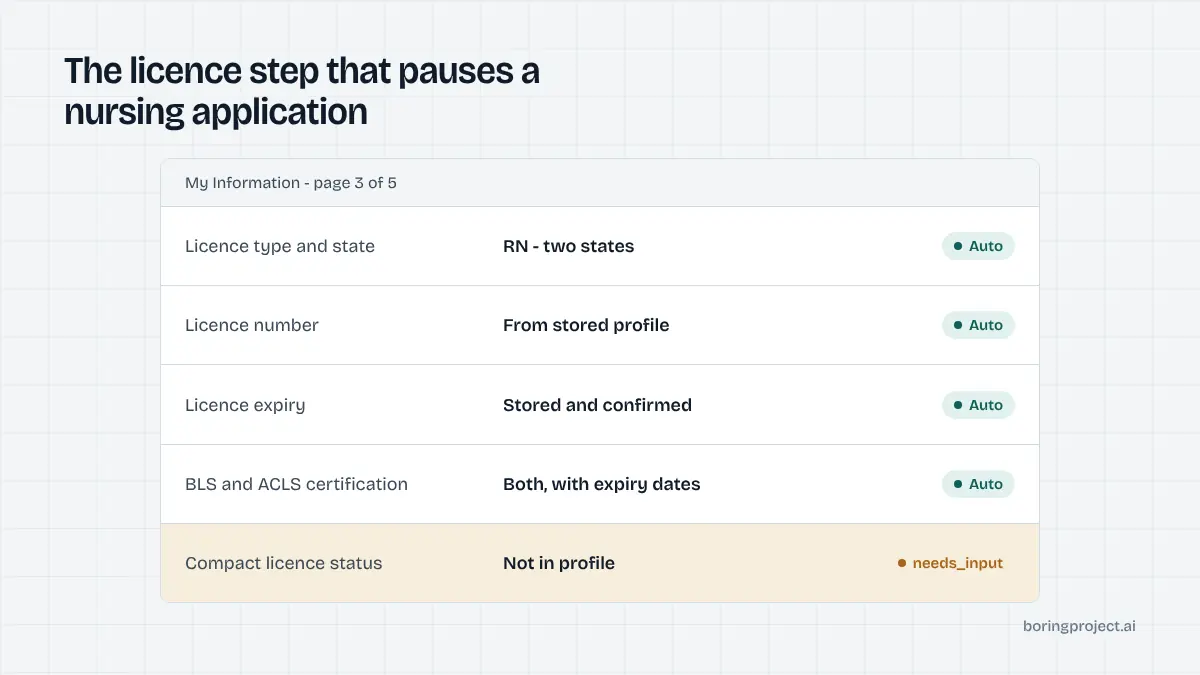
Licence type and state, licence number, expiry, compact status, certifications such as BLS, ACLS or PALS with expiry dates, years in a specialty, shift availability, and willingness to float between units. Every one of these is checked at some point in hiring, and many are checked before a human reads the application. There is no room for a tool to guess.
Volume is lower, fit is higher
Nurses typically target a specific specialty, shift pattern and geography. The useful version of healthcare job application automation is not applying to hundreds of postings but applying promptly and completely to the ones that match, across several health systems whose forms you would otherwise fill by hand one at a time.
That also changes how you judge a tool. The question is not how many applications it can send in a day but whether it completes a forty-field Workday form correctly, pauses on the questions it cannot answer, and shows you proof afterwards.
Setting up a profile that answers healthcare forms
A tool that can auto apply for nursing jobs is only as accurate as the profile behind it. For nursing, that means structured credentials rather than a resume alone.
Licences and certifications as structured fields
Record each licence separately: type (RN, LPN or LVN, APRN), issuing state or board, number, issue and expiry dates, and whether it is a compact or multistate licence. Record each certification the same way with its expiry.
Forms ask for these in individual fields, sometimes validate the format, and often ask the expiry explicitly. A free-text line on a resume cannot populate those fields reliably.
Experience by unit and setting
Store years of experience per specialty and setting: medical-surgical, ICU, emergency, perioperative, paediatrics, long-term care, home health, and so on. Screening questions like "Do you have at least two years of recent acute care experience?" are common knockouts, and the answer must come from a real figure rather than an inference from job titles.
Shift, schedule and location
Record the shifts you will work (days, nights, rotating, weekends), the hours per week you want, whether you will float, and the facilities or radius you will travel to. Nights and weekend questions are knockouts on many postings. Being honest here means a fast no from roles you would have declined anyway, which is the correct outcome.
| Profile area | Example fields | Why it matters |
|---|---|---|
| Licences | Type, state, number, expiry, compact status | Validated fields, eligibility knockouts |
| Certifications | BLS, ACLS, PALS, specialty certs with expiry | Required for many units, checked at offer |
| Experience | Years per specialty and setting | Minimum experience knockouts |
| Availability | Shifts, hours, floating, weekends | Schedule knockouts |
| Location | Facilities, radius, relocation | On-site roles reject distant applicants |
Running automation safely in healthcare hiring
With the profile in place, the remaining questions are about how the tool behaves. These matter more in healthcare than elsewhere because credential accuracy is scrutinised.
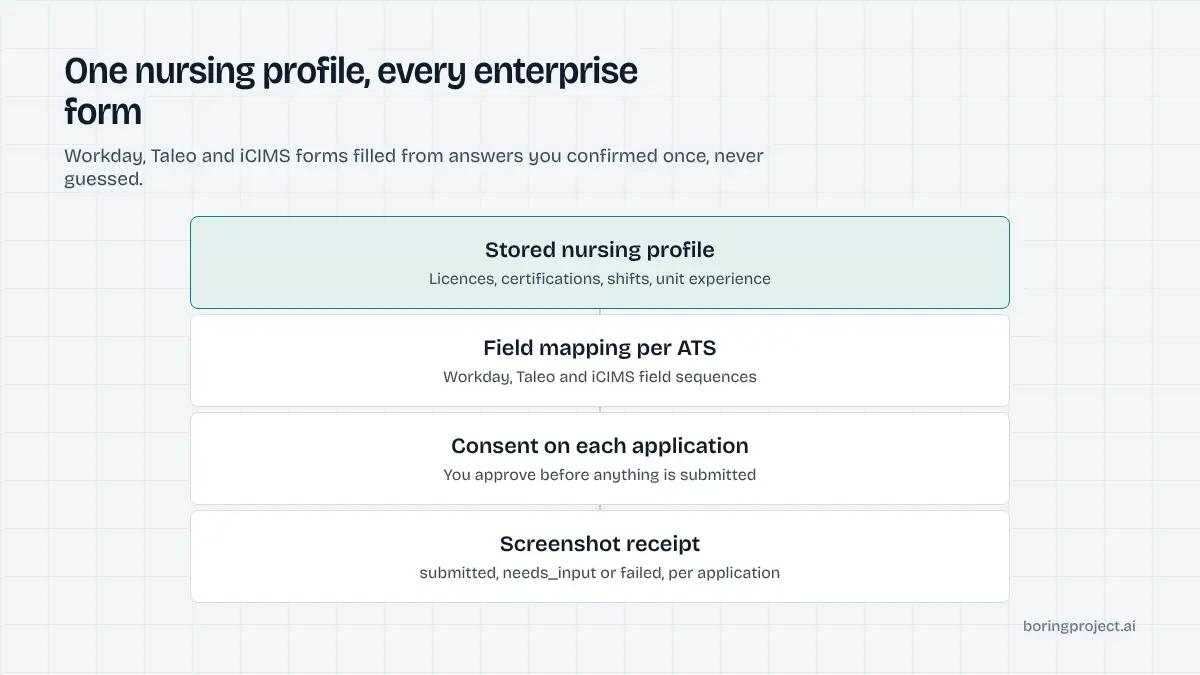
Consent and review on each application
Choose a tool that shows you each application before it is submitted, or at minimum each day's batch. Nursing postings often have small but important differences: a unit, a shift, a facility, a sign-on condition. A short review catches the mismatch that filters miss, and it keeps you aware of what has been sent in your name to employers you may apply to again.
Pause, do not guess
When a form asks something not in your profile, such as a specific competency or a facility-specific requirement, the tool should stop, mark the application as needing your input, and ask. A tool that fills in a plausible answer to complete the form is making a credential claim on your behalf. In healthcare that claim is verified, and the consequences of a false one go beyond a lost application.
Keep receipts and keep the profile current
Insist on a screenshot of each confirmation page and a status per application. Review your profile monthly for certification expiries and licence renewals, because an answer that was true in March may not be in June. A simple sheet with employer, role, unit, shift, date, status and reply lets you see which systems respond and keep your search focused on them.
Frequently asked questions
Can automation fill in my nursing licence details correctly?
Yes, if they are stored as structured data: licence type, issuing state or body, licence number, expiry date, and compact or multistate status where relevant. Healthcare forms ask for these in separate fields and often validate them. Enter them once, carefully, and check the first few submitted applications against the receipts to confirm the mapping is right.
Which ATS platforms do hospitals and health systems use most?
Large hospital systems and health networks very commonly run Workday, Taleo, iCIMS or SuccessFactors, which have multi-step flows with account creation and detailed screening. Staffing agencies and smaller clinics use a wider mix, including simpler systems. A tool should handle the enterprise platforms end to end, because that is where most nursing postings live.
Are shift and unit questions knockouts?
Often. A posting for night shift in an intensive care unit will usually ask whether you can work nights and whether you have ICU experience, and a no on either can end the application automatically. Answer them from stored facts about your real availability and experience. Passing the form with an inaccurate answer only moves the rejection to the interview or the offer.
Should I automate applications to travel or agency nursing roles?
You can, but read the posting type carefully. Agency and travel roles often collect your details for a recruiter pool rather than a specific position, and some are recurring listings that stay open indefinitely. Filter to the contract lengths, locations and specialties you actually want, and expect follow-up by phone rather than an ATS status.
How do I handle certification expiry dates in a long search?
Store each certification with its expiry date and review the profile monthly. A BLS or ACLS card that lapses mid-search makes every subsequent automated answer inaccurate. Some employers will accept proof of renewal in progress, but the form answer should reflect what is true on the day it is submitted.
Is auto apply appropriate for new graduate nurse programmes?
Only with care. New graduate residency programmes often have fixed application windows, specific document requirements and cohort start dates, and many prefer or require applying through their own portal. Automation can prefill the forms and keep you within deadlines, but review each application yourself and confirm the programme's requirements before anything is submitted.
Next step
The job application API that powers Search + Apply handles Workday, Taleo, iCIMS and SuccessFactors end to end, answers licence, certification and shift questions only from a candidate's confirmed profile, requires consent on every application, and returns a screenshot receipt with each status. It was designed for exactly the kind of long, high-stakes form that nursing applications involve.