 The Boring Project
How to Auto Apply for Data Scientist Jobs
Data science job automation works best when you treat the target list like a dataset: filter hard on stack and seniority, store honest answers once, and let the tool handle form submission across the ATSs employers actually use.
Data science is a crowded market with vague titles. "Data Scientist" can mean an analyst writing SQL dashboards, a statistician running experiments, or an ML engineer shipping models. That ambiguity makes auto apply both tempting (there are a lot of postings) and risky (most of them are not for you).
This guide is for candidates who want to auto apply for data scientist jobs without wasting applications on mismatched roles. The focus is on filtering, the fields that trip people up, and the practical differences between ATS platforms.
Filtering: the step that decides everything
Define the role you are applying for, not the title
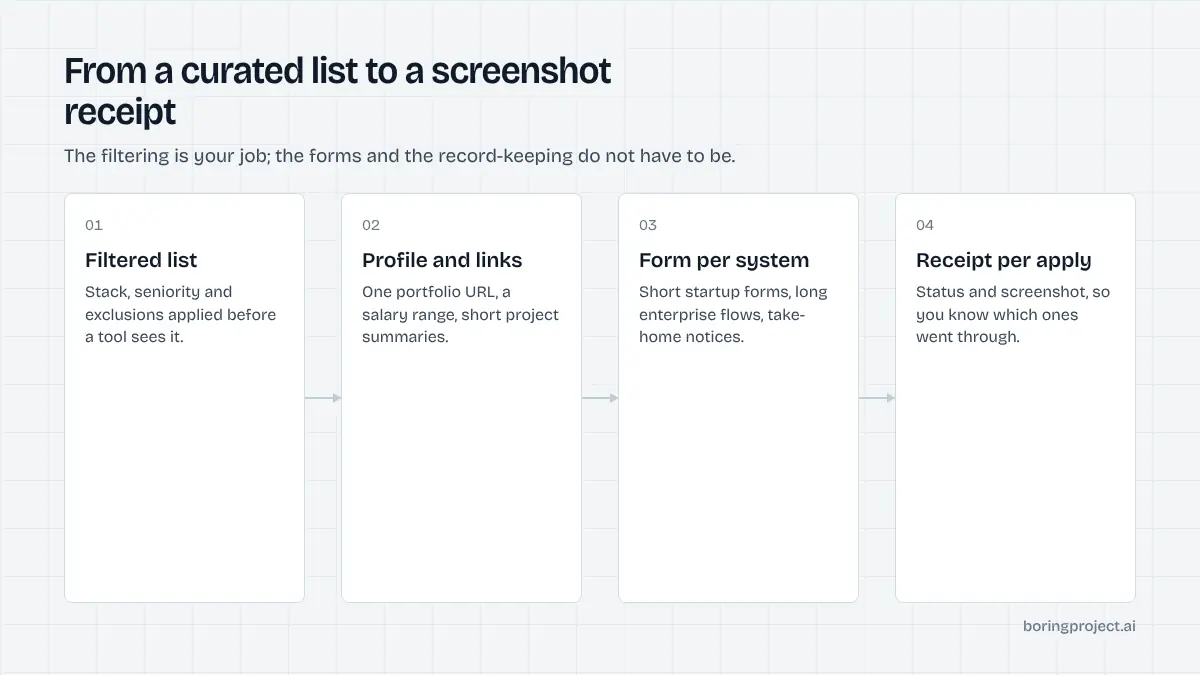
Before touching any tool, write down three things: the kind of work (analytics, experimentation, modelling, ML infrastructure), the stack you can defend in an interview, and the seniority band you are aiming at. Then translate those into include and exclude terms.
Titles alone are a poor filter. "Senior Data Scientist" at one company is an IC with two years of experience; at another it is a staff-level role. Use the description's requirements list, not the title, as the primary signal.
Build a two-list filter and apply it before the tool sees anything
A simple approach that works:
| List | Examples |
|---|---|
| Must contain | Python, SQL, plus one of: PyTorch, TensorFlow, Spark, dbt, causal inference, experimentation |
| Must not contain | Security clearance, on-site only (city you will not relocate to), PhD required (if you lack one), 10+ years |
| Soft preference | Named domain you know (fintech, health, ads), remote or hybrid, posted in the last 14 days |
Most auto-apply tools match on title and location, so the stack filter is something you run yourself. Half an hour of reading descriptions each morning produces a cleaner queue than any keyword rule.
Decide your seniority band and stick to it
Applying one level up is reasonable; applying two levels up is noise. If you have two years of experience and apply to principal roles, the rejection costs you nothing immediately but trains recruiters at that company to skim past your name. Pick a band, apply within it, and widen only if the reply rate is genuinely zero after a few weeks.
A useful habit is to keep the filtered list in a spreadsheet with the posting URL, the tag (analytics, modelling, ML infrastructure), the ATS, and the date added. That sheet is what you hand to the tool, and it is also what you review when deciding which segment to cut or expand. Without it, you are judging the whole search on a single averaged reply rate, which hides what is working.
The fields that trip up data science applicants
Portfolio, GitHub and publication links
Greenhouse, Lever and Ashby forms often include an optional website or portfolio field. Workday and iCIMS usually do not, and some enterprise forms only accept a LinkedIn URL. Keep one public URL you would show any employer, store it in your profile, and let the tool fill the field only where a matching field exists.
Resist the urge to paste links into free-text answer boxes. Reviewers rarely click them there, and it makes the answer read as padding.
Salary expectations and level questions
Many forms require a salary expectation, and some teams use it as a hard filter. Enter a range based on data rather than instinct. Our data scientist salary reference breaks figures down by level and location, which makes the number easier to justify when a recruiter asks.
If the form asks for a single integer, use the midpoint of your range. If it is optional, leaving it blank is fine.
Technical screening and "describe a project" questions
These are evaluated by people, and generic answers stand out immediately. Write two or three short, concrete project summaries once: the problem, the method, the metric that moved, and your specific contribution. Map each to the question types you see most, and store them.
A tool that drafts new answers for each application without your review is a liability here. The safer pattern is to pause and ask when a question does not match a stored answer. The post on how ATS screening questions are structured and scored explains which question types are knockouts and which are read by humans.
What to expect from the ATSs you will meet
Startup and tech forms: fast and mostly uniform
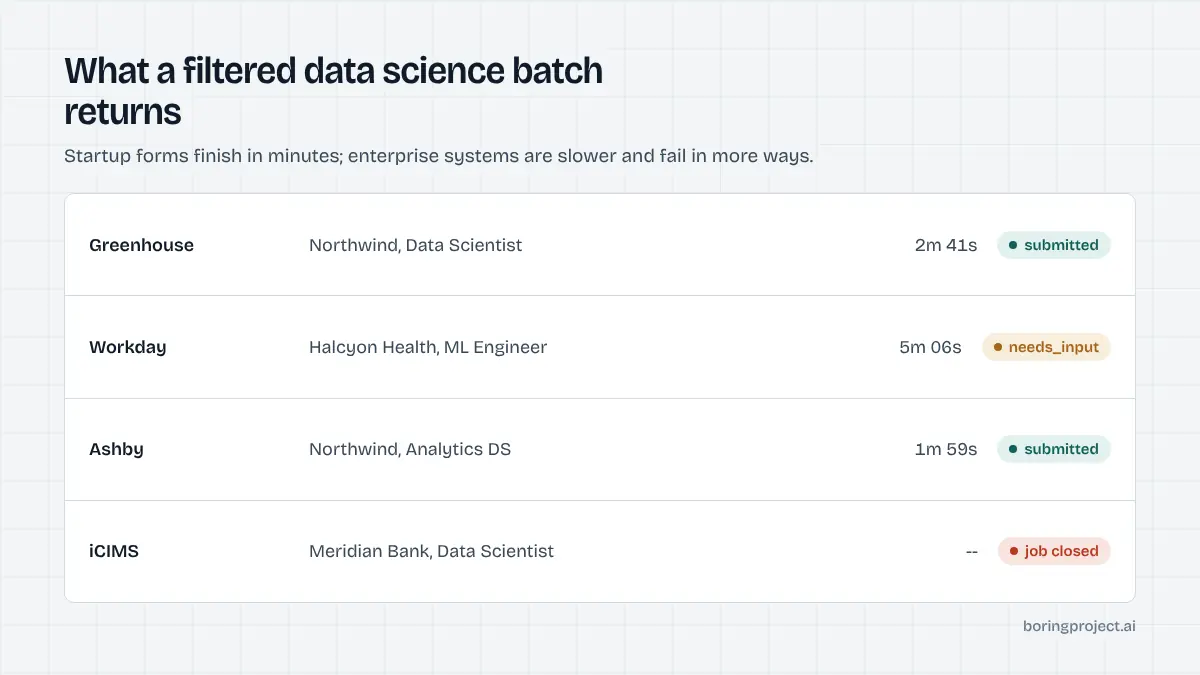
Greenhouse, Lever and Ashby dominate tech hiring. The forms are short, resume upload is a single step, and custom questions are usually a handful of short-answer or yes/no items. An application typically completes in a few minutes, and a daily batch of 20 to 30 well-filtered roles is realistic.
The main variation is in EEO and demographic questions, which are optional and should be answered however you choose, consistently.
Enterprise forms: slower and more fragile
Banks, insurers, pharma, telecoms and large retailers hire data scientists through Workday, iCIMS, Taleo, SuccessFactors and Oracle Recruiting Cloud. These require an account per employer, parse your resume into structured fields (often imperfectly), and add pages for work history, education and compliance questions.
Per-application time is several times longer than on a startup form, and failure modes are more varied: session timeouts, duplicate-profile detection, and required fields hidden on later pages. A tool that returns a status and a screenshot per application matters more here than anywhere else, because you need to know which ones actually went through.
Mixed pipelines: measure separately
If your list spans both categories, track reply rates separately. Enterprise data science hiring tends to move slowly and reply late; startups reply within days or not at all. Judging the whole pipeline on one average hides which half is working.
Data science job automation, done this way, is less about volume and more about removing the tedium from a list you have already curated. The filtering is your job. The forms do not need to be.
Frequently asked questions
Does auto apply work for data scientist roles, or are they too specialised?
It works for the submission step, which is the mechanical part. What it cannot do is decide which roles match your actual experience, and data science titles are vague enough that this filtering matters more than in most fields. Spend your effort on a precise target list and let the tool fill forms; do not expect it to judge fit for you.
How do I filter data science postings by stack?
Most tools filter on title and location only, so stack filtering usually means reading the description. Build a short list of must-have terms (for example Python, SQL, and one of PyTorch, Spark or dbt) and a list of disqualifiers (clearance required, on-site in a city you will not move to). Feed the tool only the URLs that pass both lists.
What should I do about portfolio and GitHub fields?
Keep one public URL that you are happy for any employer to see and store it in the tool's profile. Many Greenhouse and Lever forms have an optional "website or portfolio" field; Workday often has none. A good tool fills the field where it exists and skips it where it does not, rather than pasting a link into a free-text box where it does not belong.
Can an auto-apply tool answer technical screening questions for me?
It should only reuse answers you have already written and approved. Questions like "describe a model you deployed to production" are evaluated by humans and are easy to spot when generic. Write two or three short, specific answers once, map them to the common question types, and let the tool pause and ask you when it meets something new.
Which ATSs will I meet most often in data science hiring?
Tech companies and startups cluster on Greenhouse, Lever and Ashby. Banks, insurers, pharma and large retailers tend to use Workday, iCIMS, Taleo or SuccessFactors. Consultancies mix both. The short forms submit in a few minutes; the enterprise ones need account creation and resume parsing and take noticeably longer per application.
Should I set a salary expectation on every application?
Where the form requires a number, give a range anchored to published market data for your level and city rather than leaving it blank or entering a placeholder. A placeholder like 0 or 1 is read as evasive by some teams and can cause auto-rejection in others. Where the field is optional, leaving it empty is acceptable.
Next step
If you have a filtered list and want the submissions handled, Search + Apply takes your approved roles, fills each form from a profile you control, and returns a receipt with a screenshot per application. It runs on the same job application API that career platforms integrate, with per-application pricing.