 The Boring Project
How to Auto Apply for DevOps Jobs
DevOps job search automation is less about applying to hundreds of roles and more about submitting a carefully filtered list without hand-typing the same infrastructure details into every ATS form; this guide covers the filtering, the awkward fields, and the time savings by platform.
DevOps engineers tend to be sceptical of tools that promise to do their job for them, and that scepticism is healthy when applied to job search automation. The pitch for most consumer auto-apply products is volume. For infrastructure roles, volume is rarely the constraint.
What is a constraint is the tedium: re-entering the same cloud platforms, the same on-call history, the same certifications, into forms that each want them in a slightly different shape. That part is worth automating. The judgement about which roles to pursue is not.
Step 1: Get the list right before any tool touches it
Separate DevOps, SRE, platform and cloud roles
Companies use these titles loosely. A "DevOps Engineer" posting can describe an SRE with a pager, a platform team building internal tooling, a cloud migration contractor, or a build and release engineer. Each has a different interview, a different compensation band and a different day job.
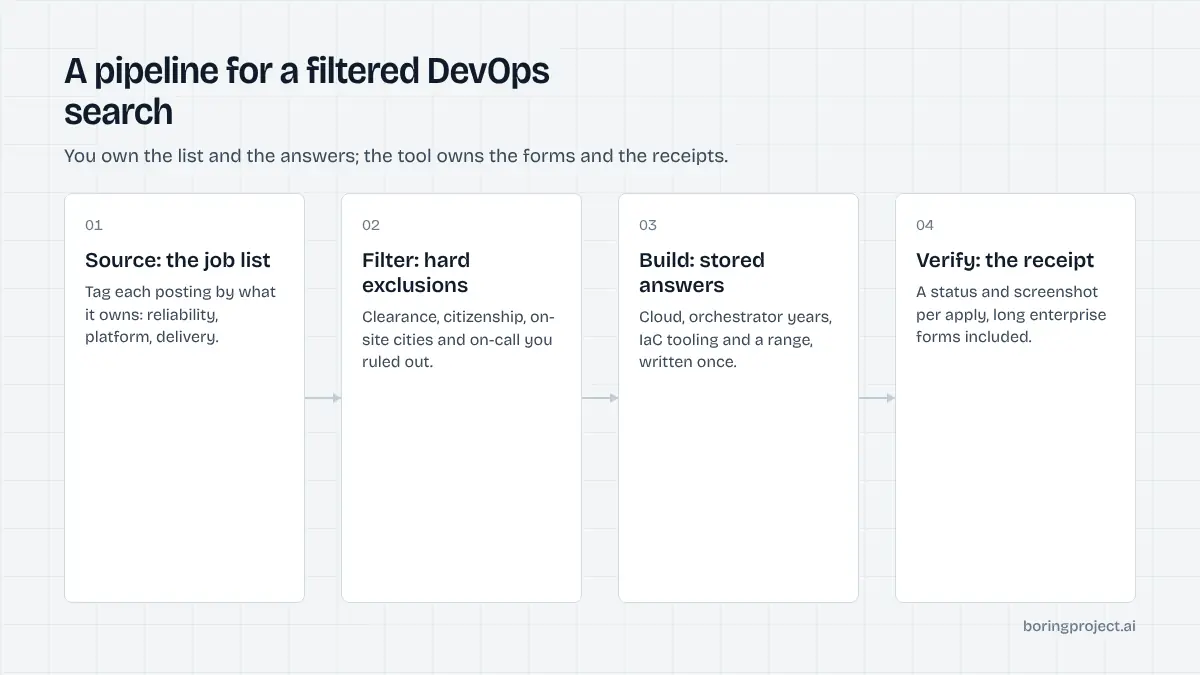
Read the first ten lines of each posting and tag it by what it actually owns: reliability, infrastructure, developer experience, or delivery pipeline. Apply only to the tags you want. This takes longer than a keyword filter and saves far more time downstream.
A quick table helps when you are triaging a long list:
| Signal in the posting | Likely role | Apply if you want |
|---|---|---|
| Pager rotation, SLOs, incident review | SRE | Reliability work and on-call |
| Internal developer platform, golden paths | Platform engineering | Tooling and enablement |
| Terraform, cloud migration, cost | Cloud or infrastructure | Infrastructure ownership |
| Build systems, release trains, artifact management | Release or build engineering | Delivery pipeline work |
Most postings mix two of these. Tag by the one that takes most of the week according to the description, not the one in the title.
Use hard exclusions for clearance, citizenship and location
Infrastructure roles at government contractors, defence suppliers and parts of finance frequently require an active security clearance or a specific citizenship. These are hard filters in the ATS. If you do not meet them, remove the posting rather than letting a tool apply and answer "no".
The same applies to on-site requirements in a city you will not move to, and to postings that require 24/7 on-call if you have decided against it. Exclusions are where devops job search automation saves the most time: every role you remove is a form you never fill.
Decide how you will handle salary fields
Many forms require a salary expectation. A stored range, adjusted per segment, is better than a single number. Startup and enterprise infrastructure pay differs enough that one figure is wrong for one of them. Our DevOps engineer salary reference is a reasonable anchor by level and location.
Step 2: Prepare the answers once, carefully
The questions you will see on almost every form
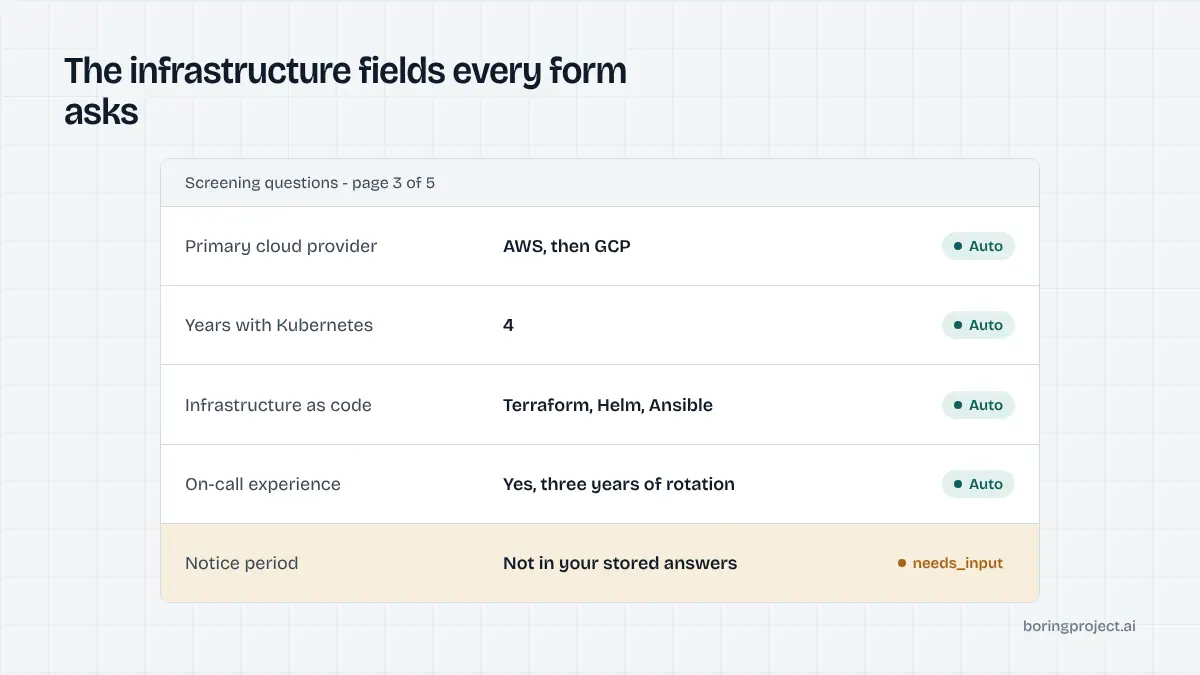
Infrastructure screening questions are more consistent than in most fields. Expect some combination of: primary cloud provider(s), years with Kubernetes or a named orchestrator, infrastructure-as-code tooling, on-call experience, and a scripting language. Write the answers once, with numbers where a number is asked for, and store them in the tool's profile.
Keep the wording identical to your resume. Some ATSs parse the resume into structured skills and cross-check against your answers; mismatches look careless.
Years-of-experience fields deserve particular care. If a form asks for years with Kubernetes and you answer four, make sure the resume supports four, not two. Recruiters do check, and an inflated number here is the kind of small discrepancy that ends a process late rather than early.
Certifications and structured fields
Workday, SuccessFactors and iCIMS often have a dedicated certifications section that is parsed into structured data, separate from the resume. Store exact certification names, issuing bodies and dates so the tool can fill those fields precisely. Greenhouse and Lever usually rely on the resume alone, so the same data does no harm there.
Where the tool must stop and ask you
Any question about availability, notice period, relocation, or a specific technology you have not stored an answer for should pause the application rather than being guessed. The right behaviour is a "needs input" status: you answer once, the tool continues, and the answer is saved for next time. A tool that silently fabricates an answer to a technical question is not one you want applying under your name.
Step 3: Know what the ATS will cost you in time
Short forms: Greenhouse, Lever, Ashby, Workable
Most startups and scale-ups hiring platform and DevOps engineers use one of these. The forms are a single page, the resume upload is a single step, and custom questions are limited. A well-prepared application completes in a few minutes, whether you do it by hand or with a tool. The tool's advantage is consistency across dozens of them, not raw speed on any single one.
Long forms: Workday, iCIMS, Taleo, SuccessFactors
Large enterprises, banks, telecoms and public-sector bodies hiring infrastructure engineers run these. Expect account creation per employer, multi-page forms, resume parsing that needs correcting, and compliance pages. Per-application time is several times longer, and failures (timeouts, duplicate profiles, hidden required fields) are more common.
This is where automation earns its keep, provided it reports honestly. A per-application status with a screenshot receipt lets you confirm that the long form actually went through. Our guide on how auto apply works on Workday covers the specific failure modes to expect.
Budget for the mix
A realistic daily plan for an infrastructure candidate is small: a handful of enterprise applications and a dozen or so short-form ones, all pre-filtered. Measured by replies rather than sends, that list will outperform a bulk run on unfiltered titles every time.
If you want to auto apply for DevOps jobs and keep that discipline, the tool should be the boring part. You own the list and the answers; it owns the forms and the receipts.
Frequently asked questions
Is auto apply worth it for DevOps roles when there are fewer postings than for general software engineering?
Yes, for a different reason. DevOps and platform candidates typically have a narrower list, so the value is not in volume but in removing the repetitive form work for each carefully chosen role. Thirty well-matched applications submitted with consistent, accurate answers is a better outcome than three hundred mismatched ones, and automation makes the thirty painless.
How do I keep DevOps, SRE and platform engineering postings separate?
Filter on the description, not the title. Look for the on-call expectation, the primary cloud, and whether the role owns infrastructure, reliability, or developer tooling. Titles are used interchangeably by many companies, so a "DevOps Engineer" posting may be a pure SRE role or a build engineer role. Reading the first ten lines of each posting is faster than correcting a bad list later.
What do I do about security clearance and citizenship questions?
Answer them accurately and treat them as hard filters. Many infrastructure roles at government contractors, defence and some finance employers require an existing clearance or a specific citizenship. If you do not hold it, exclude those postings; an automated application that answers "no" still consumes a recruiter's time and does nothing for you.
Will an auto-apply tool handle Workday forms used by large employers?
Good ones do, but expect them to take longer and occasionally stop for input. Workday requires an account per employer, parses your resume into separate fields, and may add pages for compliance questions. Look for a tool that reports a clear status per application and returns a screenshot, so you can confirm that a long form actually submitted.
Should I mention certifications like AWS or Kubernetes in screening answers?
Mention them where a form asks about certifications or required skills, and keep the wording consistent with your resume. Some ATS forms have a dedicated certifications section that is parsed into structured data; others only read the resume. Store the exact names and dates once in your profile so the tool enters them identically each time.
How should I set salary expectations for infrastructure roles?
Use a range based on published data for your level, location and remote status, and enter the midpoint where a single number is required. Infrastructure compensation varies widely between startups and large enterprises, so a single figure applied to both is wrong for one of them. Adjust the stored range per list if you are applying to both segments.
Next step
If you would rather hand over a CSV of approved postings and get receipts back, Managed Applies does that with no code and the same consent and no-fabrication rules. Talk to us about managed applies and we will walk through how it fits a filtered infrastructure job search; pricing is per successful application.