 The Boring Project
Teal Review: A Strong Tracker, Not an Apply Bot
Teal holds 4.3 on Trustpilot from 120 reviews, which is a genuinely respectable record in a market full of one-star wreckage; this teal review covers what that score covers, and why is teal worth it hinges on which problem you have.
The record is solid
4.3 from 120, which actually means something
Teal's Trustpilot profile shows 4.3 out of 5 from 120 reviews. For a teal review that is a usable base. That is not the four-thousand-review certainty of the biggest players, but 120 is enough that the score is not a rounding error. A few disgruntled customers will not move it much.
Set it against the neighbourhood. JobCopilot is at 1.7 from 100 reviews, a comparable sample with a radically worse result. Simplify sits at 2.7 from 22. Teal at 4.3 from 120 is one of the better-evidenced positive records in this market, and its Ahrefs domain rating of 75 against this site's 29 confirms it is an established business rather than a recent arrival.
What the score is rating
Teal is a job tracker with resume tooling attached: application boards, resume building and tailoring, keyword matching against job descriptions, and a Chrome extension for capturing roles. It is in the same family as Huntr and Careerflow.
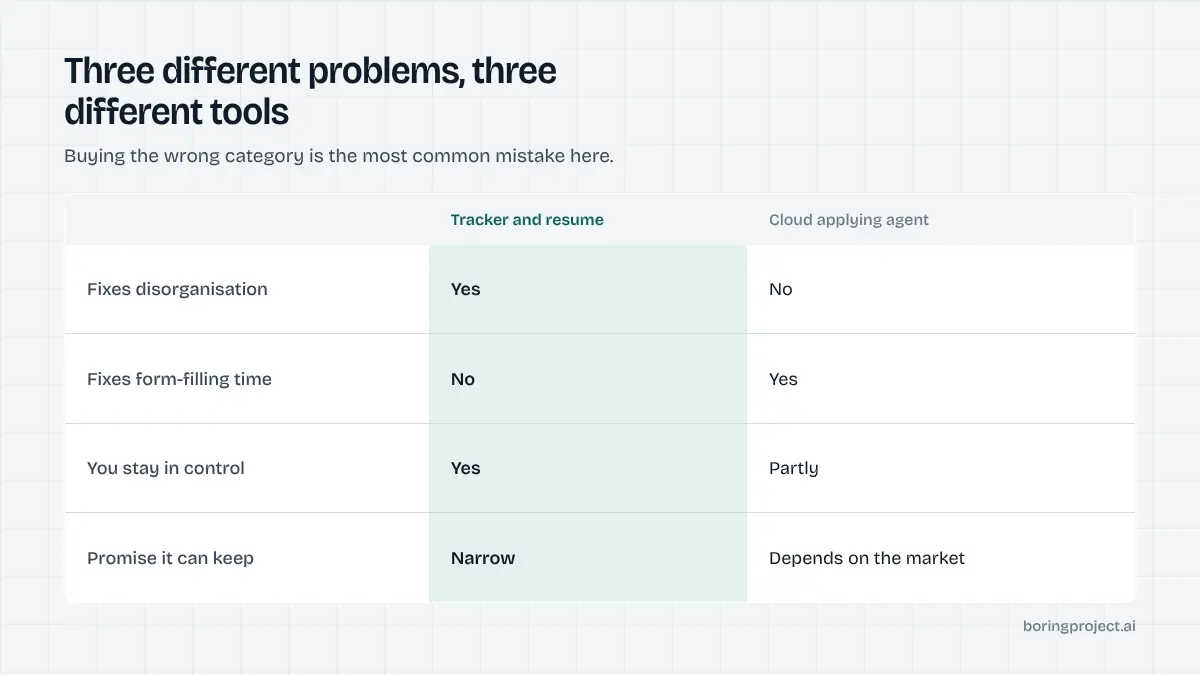
Document and organisation tools are easier to rate well than applying tools, because the promise is narrow and verifiable. A tracker either keeps your search organised or it does not. An applying tool is implicitly promising interviews, which depend on the market and the candidate, and that is how products end up at 1.7 stars without necessarily being badly built.
Pricing we are not going to invent
Teal publishes plans including a free tier, and the figures our automated extraction returned for it were a mess of weekly breakdowns and partial numbers. We proved that approach unreliable across this market, so rather than print something wrong we will say this: check the live pricing page, and note that weekly-framed prices in this category are usually an annual commitment presented in its smallest unit.
The confusion that costs people money
It does not apply to jobs for you
Teal is routinely compared with cloud auto-apply agents, and it is not one. You apply. Teal helps you organise the search, tailor the resume and keep track of what you sent.
That matters because the two products fix different bottlenecks. If your problem is that you have no idea what you applied for three weeks ago, Teal is exactly right. If your problem is that each Workday application eats twenty minutes, Teal does not touch it.
Tracking is more valuable than it sounds
The reason a tracker earns its keep is that employer-side status reporting is close to worthless. "In progress" means only that the requisition is open and nobody has dispositioned you. Applications die silently when roles close. A large share end with no notification at all. We cover that in why an application says in progress.
Your own log is the only reliable record of your search. That is a genuine problem, genuinely solved.
Resume tailoring has limits worth knowing
The keyword-matching feature is useful and oversold across this whole category. Applicant tracking systems rarely reject on resume content; what they do is parse layouts badly and let recruiters search the resulting records. So matching the language of a posting helps you surface in searches and signals you read the job. It is not defeating a scoring robot, because the robot mostly does not exist.
So is Teal worth it?
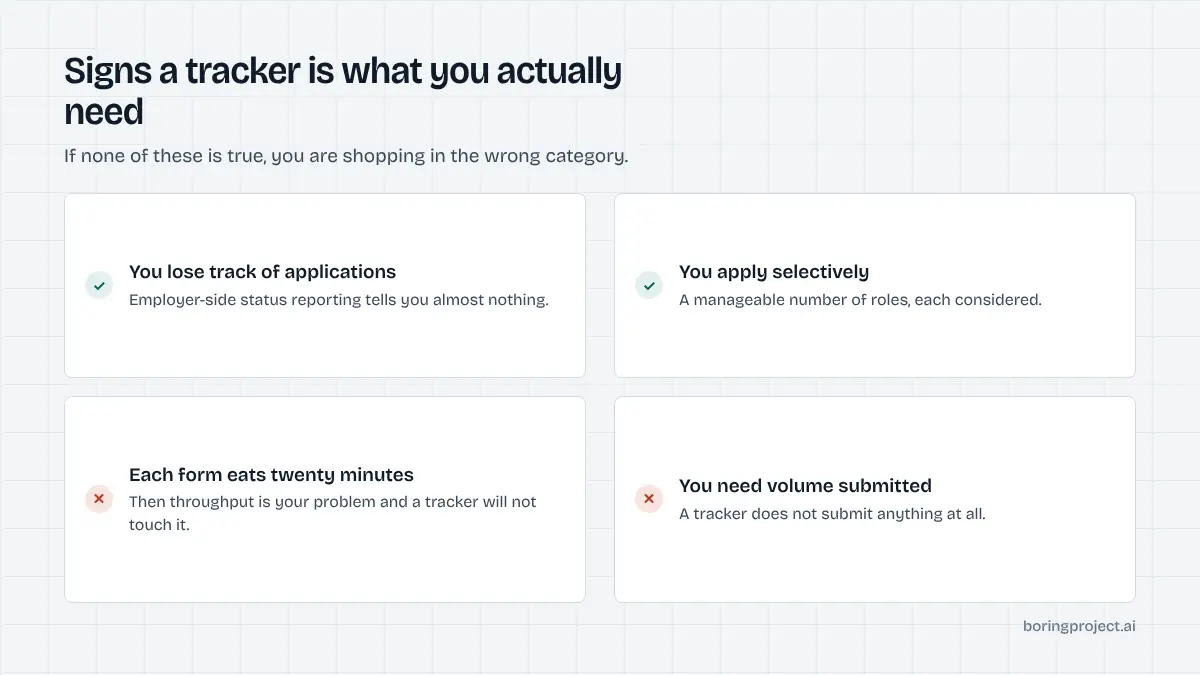
Yes, for a selective search you want to run properly
If you are applying to a manageable number of roles and want them tracked, tailored and visible in one place, this is among the safest purchases in this market on the evidence: 120 reviews at 4.3, an established company, and a free tier to test with.
No, if you need volume, and how to test it free
A tracker does not increase throughput. If you are applying at pace and the constraint is form-filling time, the honest answer is that Teal is not the product, and deciding how many applications a day your search actually needs is covered in how many jobs should I apply to a day.
Use the free tier and ask whether you are opening it after a week. Trackers fail by abandonment rather than by breaking, and nobody can predict that for you.
If the tracking is fine and the volume is not
A tracker tells you what you sent. It does not send more. If you have read this far and recognised that your search is organised but too slow, that is the opposite problem and the one we handle: name the role once and we file the applications across 40+ systems with a receipt each time. Pricing starts at $99 a year for 3,600 applications.
Frequently asked questions
What is Teal's Trustpilot score?
4.3 out of 5 from 120 reviews. The sample is large enough to be meaningful without being definitive, and it is one of the stronger evidenced positive records in this market, where several comparable products sit between 1.7 and 2.7 on similar review counts.
Does Teal apply to jobs for me?
No. Teal tracks applications, builds and tailors resumes and captures roles through a browser extension. You submit the applications yourself. It is frequently compared with cloud auto-apply agents, which do submit on your behalf, and that comparison confuses two different products.
Is Teal worth paying for?
If your bottleneck is organisation, targeting or the resume itself, yes, and the free tier lets you confirm that before paying. If your bottleneck is the time each application takes, a tracker will not change it and you are shopping in the wrong category.
How much does Teal cost?
It publishes plans including a free tier, but we have not verified current figures against its own pricing page and will not print numbers we cannot stand behind. Be aware that prices framed per week in this category usually represent an annual commitment shown in its smallest unit.
Is Teal's resume keyword matching worth using?
It is useful, with a caveat. Matching the language of a posting helps you surface when a recruiter searches their database and signals you read the role. It is not beating an automated score, because applicant tracking systems rarely reject on resume content. Parse reliability matters more than keyword density.
Teal or a cloud auto-apply agent?
They solve different problems. Choose Teal if you want control, organisation and a reliable record of a considered search. Choose an agent if you want volume submitted without you present, and accept that you will see a log rather than each form.
Next step
Run the free tier for a week and notice whether you keep opening it. A tracker you abandon is worth nothing regardless of its rating, and that is the only test that predicts whether this becomes useful for you.