 The Boring Project
Reverse Recruiter vs Auto Apply: Which to Choose
A reverse recruiter is a person who applies and networks for you at a monthly retainer; auto apply is software that submits at volume for far less. This guide lays out reverse recruiting cost bands, what each approach is good at, and the hybrid model that most serious job searches end up using.
What each option actually is
The two are often compared as if they were substitutes. They are not. One buys human judgement and relationships; the other buys throughput. Understanding the mechanics clears up most of the confusion in the reverse recruiter vs auto apply debate.
It also explains why the price gap is so wide. You are not paying a reverse recruiter a premium for the same output; you are paying for a different output that happens to include submitted applications as a by-product.
Reverse recruiting: a person on your side of the table
A reverse recruiter is hired by the candidate, not the employer. They build a target list, find roles, tailor materials, submit applications and, in many firms, reach out to hiring managers or find referrals. The deliverable is a managed campaign rather than a count of submissions, and the relationship usually runs for one to a few months.
Auto apply: software that submits for you
Auto-apply tools fall into two camps. Autofill extensions fill the employer's form in your browser and leave the submit button to you; cloud agents find roles and submit from their own servers while you are away. Neither researches a company or sends a thoughtful note to a hiring manager. They remove the typing, not the thinking.
Where the two overlap
Both end in a submitted application on an employer's applicant tracking system. That is the only point of overlap. Everything upstream (research, targeting, outreach) is where a human earns the fee, and everything about scale is where software earns its subscription.
Cost, volume, quality and speed
The honest comparison is along four axes. We give cost as bands because plans vary by seniority, hours and volume, and because exact figures on vendor sites change without notice.
Cost bands
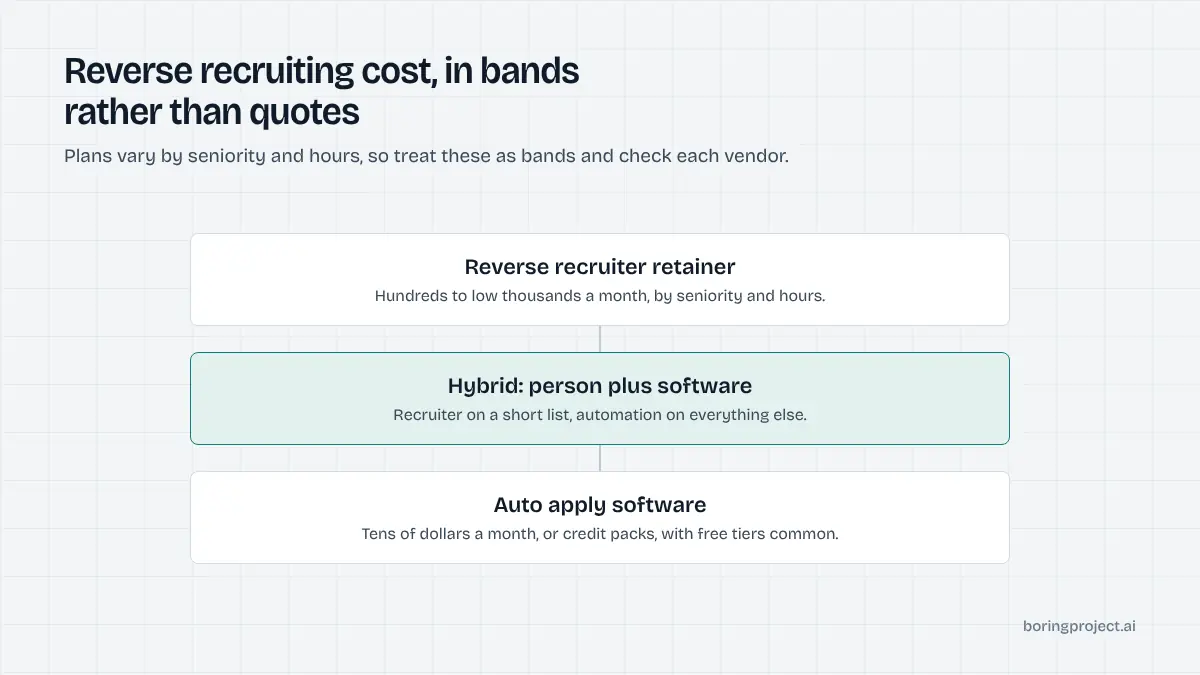
As of vendor sites in 2026, reverse recruiting is typically sold as a monthly retainer or fixed package, commonly in the hundreds to low thousands of dollars per month, with executive-level services at the top of that band. Auto-apply software is usually in the tens of dollars per month or sold as credit packs, with free tiers common. Human application services that only submit, without strategy or outreach, sit between the two; we compare those separately in our piece on a human job application service vs AI.
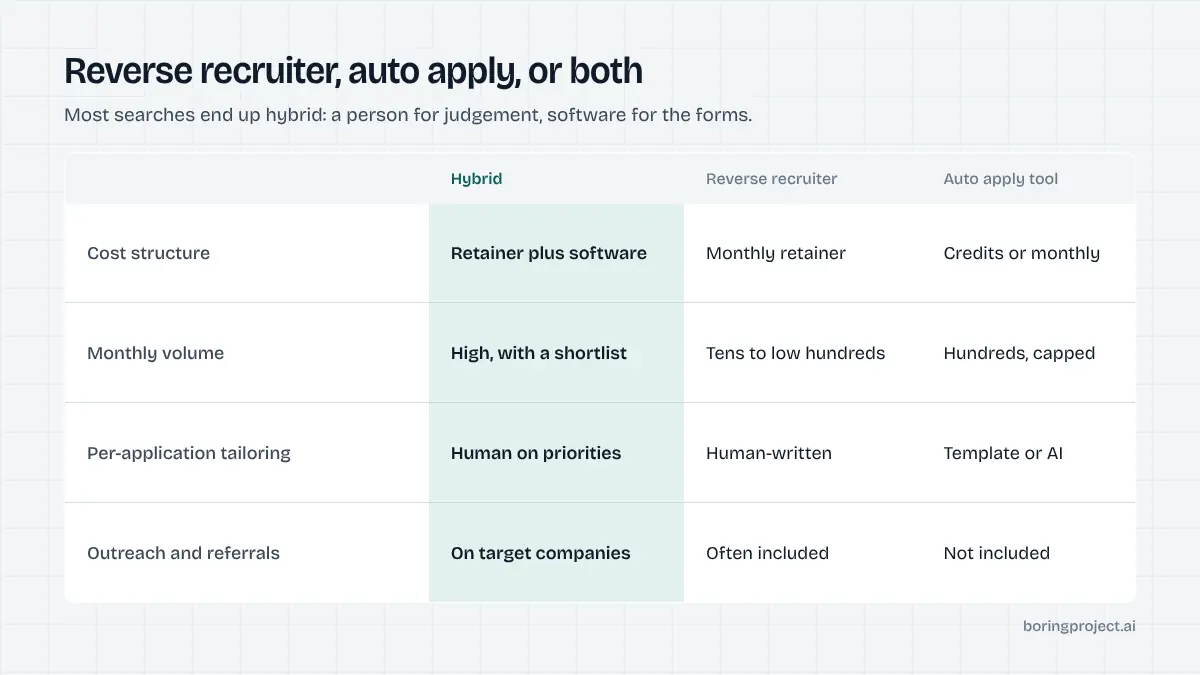
| Axis | Reverse recruiter | Auto apply tool |
|---|---|---|
| Typical cost structure | Monthly retainer or package; hours-based tiers | Monthly subscription, credits, or free tier |
| Typical cost band (2026) | Hundreds to low thousands per month | Tens of dollars per month |
| Monthly volume | Tens to low hundreds of applications | Hundreds, limited by plan caps |
| Per-application tailoring | Human-written, researched | Template or AI-generated |
| Outreach and referrals | Often included | Not included |
| Proof per submission | Usually a dashboard log or screenshot | Varies; often a status only |
Volume and speed
Software wins on both. A cloud agent can submit more in a day than a recruiter can in a week, and it starts the moment you finish onboarding. A reverse recruiter needs a strategy call, a target list and a few days before the first batch goes out. If your constraint is time to first application, software is faster.
Volume is not free of trade-offs, though. Each automated submission carries the risk of a wrong screening answer that you never see, and a large number of weak applications to one employer can make the strong one less credible. Volume helps most when the roles are standardised and the forms predictable.
Quality and fit
The recruiter wins here, for a reason that has nothing to do with software quality. A person reads the posting, decides it is a reach or a fit, and writes to the hiring manager. No current auto-apply tool does the outreach, and most tailor by rewriting keywords rather than by understanding a company. For roles where referrals and fit decide the outcome, that gap matters.
The honest caveat is that quality is hard to measure. We do not publish interview-rate claims for either approach because the available numbers are self-reported by vendors. Judge quality by reading a sample of what each produced for you, not by a conversion statistic on a landing page.
The hybrid model: humans for judgement, software for forms
Most reverse recruiting firms quietly discovered that filling ATS forms by hand is the worst use of a skilled person's hour. The result is a hybrid operating model that is now common on both sides of the market.
How a hybrid search is structured
The candidate and recruiter agree a short list of priority companies, usually five to twenty, where the recruiter does research, outreach and bespoke materials. Everything else that fits the candidate's criteria is submitted by automation with the candidate's consent, so volume continues without eating recruiter hours. The two tracks are logged together so nothing is duplicated.
What the automation layer needs to do well
For the hybrid to work, the software side must behave like a careful junior, not a spammer. That means filling the employer's actual ATS form rather than only board quick-apply buttons, refusing to invent answers to screening questions, returning a receipt for every submission, and respecting per-employer rate limits. Those are the same requirements we built into our own auto-apply software for reverse recruiters.
Who should pick which
If you are early-career, applying to standardised roles, and your main problem is hours, start with software and keep the recruiter budget. If you are senior, switching fields, or targeting a small number of companies where a warm introduction changes everything, a reverse recruiter is the better spend. If you are a reverse recruiting firm, the question is not either-or; it is how to run the automation layer without hiring more people to click submit, which is a case for Managed Applies or an API rather than a consumer tool.
Frequently asked questions
What does a reverse recruiter actually do?
A reverse recruiter works for the candidate rather than the employer. They research target companies, find relevant openings, tailor the resume and cover letter, submit applications and often reach out to hiring managers or referrals on your behalf. Some also coach you through interviews. The emphasis is on a smaller number of well-researched applications and human outreach.
How much does reverse recruiting cost compared with auto apply?
As of vendor sites in 2026, reverse recruiting is generally priced as a monthly retainer or package in the hundreds to low thousands of dollars per month, varying by seniority and hours included. Auto-apply software is usually priced in the tens of dollars per month, or by credit packs. Treat these as bands, not quotes; check each provider directly.
Which gets more interviews, a reverse recruiter or auto apply?
There is no honest universal answer, and we do not publish invented rates. Auto apply wins on raw volume of submissions; a reverse recruiter wins on relevance, networking and material quality per application. For roles where fit and referrals matter, the human route tends to convert better per application. For high-volume, standardised roles, volume often matters more.
What is the hybrid model?
The hybrid model uses software for the repetitive layer and a person for the judgement layer. Automation submits the long tail of reasonable-fit roles with your consent, while the recruiter concentrates on a short list of priority companies, outreach and interview prep. Many reverse recruiting firms now run this way internally, using automation to fill forms.
Are automated applications submitted by a reverse recruiter still ethical?
Yes, provided the candidate consents to each application, the answers are truthful, and no screening question is fabricated. The problem with careless automation is not that software pressed submit; it is that the content was wrong. A recruiter using automation responsibly keeps a receipt per submission and reviews anything the system could not answer.
Can I just do both myself?
You can. Use an auto-apply tool for volume on roles you would be happy to take, and spend the time you save on five or ten target companies where you research, network and write a real cover letter. That is the hybrid model without a retainer, and it works if you are disciplined about tracking what went where.
Next step
If you run a reverse recruiting or career service and want the automation layer without building it, Managed Applies takes a CSV of candidates and jobs and returns a screenshot receipt for every submission, priced per successful application. Talk to us about Managed Applies and we will walk through how the hybrid model fits your workflow.