 The Boring Project
Human Job Application Service vs AI Auto Apply
A human job application service uses people to fill and submit applications for you; AI auto apply uses software. This guide compares a job application service run by humans with automated tools on cost, turnaround and quality, and is specific about where humans still win.
What you are actually comparing
The two options share a goal and almost nothing else. Being precise about what each delivers makes the human job application service vs AI decision much easier than the marketing suggests.
It also helps to separate the submission layer from the strategy layer. Both options below are about getting applications in. Neither replaces the thinking about which roles to pursue, although a good human assistant will push back on a bad target in a way software will not.
The human service model
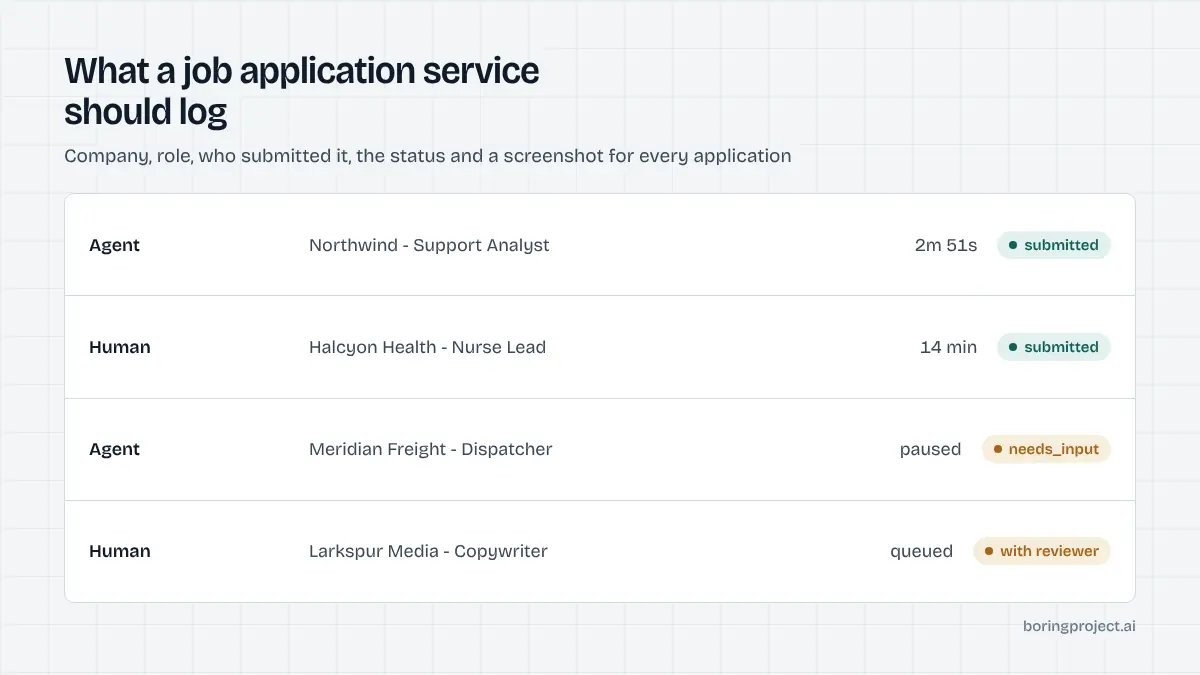
A human application service assigns a trained assistant or recruiter who finds roles that match your targets, prepares a tailored resume and cover letter, fills the employer's form and submits it. Most log every submission in a dashboard, and some provide a screenshot per application as proof. Services such as Scale.jobs, Careerify and ApplyAll sit in this category as of their sites in 2026; our Scale.jobs review looks at one of them closely.
The AI auto-apply model
An AI auto-apply tool either fills the employer's form in your browser and waits for you to submit, or runs on the vendor's servers and submits on a schedule. Materials are generated from templates or language models, screening questions are answered from your profile where possible, and volume is limited by plan caps rather than human hours.
What neither includes by default
Neither a submission-focused human service nor an auto-apply tool does strategic outreach, referrals or interview coaching unless sold as add-ons. That strategic layer is the domain of reverse recruiting, which we treat separately in our comparison of a reverse recruiter vs auto apply.
Cost, time and quality
These three axes decide the question for most people. We give structures and bands rather than prices because plans change and vary by volume.
Be careful with vendor outcome statistics on both sides. Success rates and interview counts on landing pages are self-reported and rarely defined, so we do not repeat them here. Compare on things you can verify: pricing structure, turnaround, what you get back per application, and what happens on a question the system cannot answer.
Cost
Human services are typically priced as credits consumed per application, one-time packages for a fixed number of applications, or monthly tiers of recruiter hours, as of vendor sites in 2026. The per-application cost is higher than software because a person's time is in it. AI tools are usually monthly subscriptions or credit packs at a small fraction of that per application, with free tiers common at the autofill end.
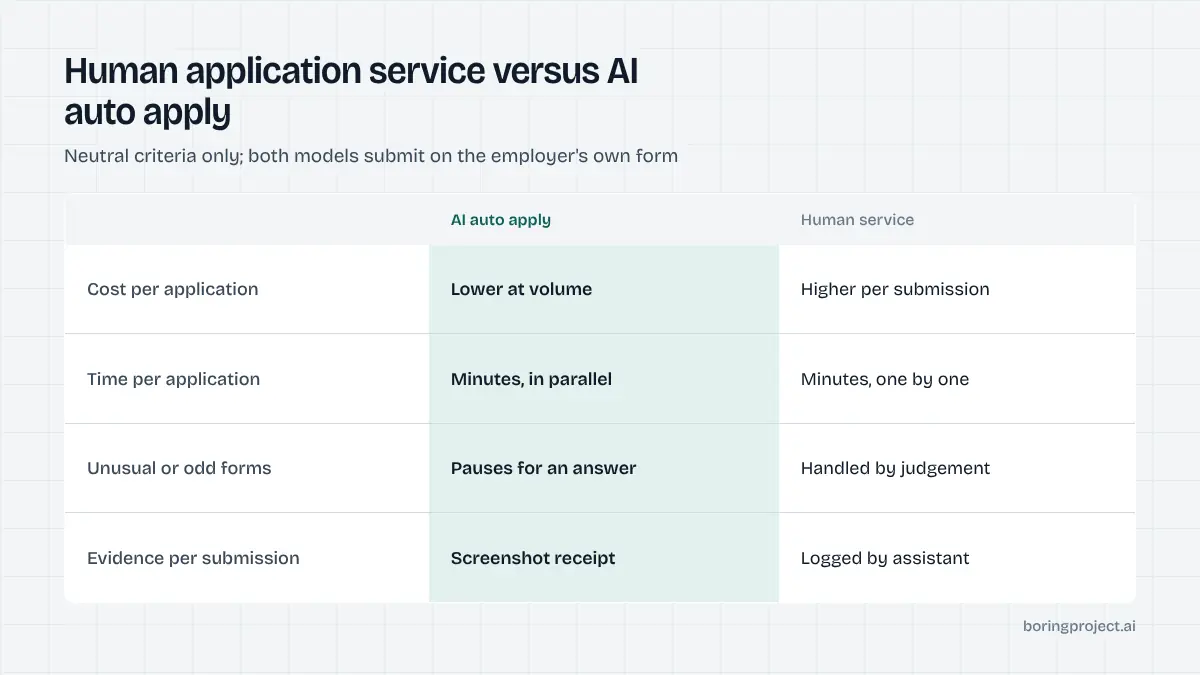
| Axis | Human service | AI auto apply |
|---|---|---|
| Who fills and submits | Trained assistant or recruiter | Software, in browser or cloud |
| Pricing structure (2026) | Credits, fixed packages or hour tiers | Subscription, credits or free tier |
| Relative cost per application | Higher | Lower |
| Turnaround | Daily or weekly cadence | Minutes, around the clock |
| Handling of odd forms | Strong | Variable |
| Unknown screening questions | Asked or judged by a person | Guessed, skipped or paused |
| Proof per submission | Often a screenshot | Varies; APIs return receipts |
Time
Software is faster per application and runs in parallel. Humans work in batches and keep business hours, so a service quoting a daily cadence is normal. The practical question is not speed but freshness: for roles where applying in the first day matters, software's always-on cadence is an advantage. For most roles, a day's delay changes little.
Onboarding time runs the other way. A human service usually needs a call or questionnaire to understand your targets before the first batch; a software tool starts as soon as your profile is complete. Budget a few days for the human route to reach full cadence.
Quality
A good human assistant reads the posting, notices a mismatch, and writes an answer that fits. Software, including good software, matches patterns. The gap is widest on free-text questions, unusual forms, and eligibility judgement calls. It is narrowest on standardised ATS forms where the fields are the same every time, which is most high-volume hiring.
When humans win, and when they do not
The useful answer is not "humans are better" or "AI is cheaper". It is a short list of conditions under which each one wins decisively.
Humans win on judgement and evidence
Choose a human service when the forms are unusual, when questions about salary, relocation, visa status or clearances need a considered answer, when you need a screenshot for every submission, or when you are a career changer whose fit needs explaining. A person can also decline to apply to a role that is clearly wrong, which saves you from a rejection that lands on your record with that employer.
Software wins on volume and standardised forms
Choose AI auto apply when the roles are standardised, the forms are the common ATS platforms, and the realistic limit on your search is hours. The best automated tools now behave conservatively: they refuse to fabricate answers, pause for input on unknown questions, and keep a per-submission log. Pick those, and the quality gap narrows to the free-text layer.
The combined model most operations end up with
Businesses that submit for many candidates rarely choose one. Automation handles standard forms server-side, with candidate consent captured on each application and a screenshot receipt returned by webhook, while a needs_input status routes exceptions to a person. That keeps human hours for judgement and gives the operation receipts for everything. If you would rather not build that pipeline, Managed Applies runs it for you: a CSV in, receipts out, humans only where the system flags a question.
Frequently asked questions
What is a human application service?
It is a service where trained assistants or recruiters apply to jobs on your behalf. You share your resume, targets and preferences; they find roles, fill the employer's form, attach tailored materials and submit, usually logging each application with a screenshot. It differs from reverse recruiting in that the focus is on submitting applications rather than strategy and outreach.
How does the cost compare with AI auto apply?
As of vendor sites in 2026, human services are typically sold as credits, one-time packages for a fixed number of applications, or monthly hour-based tiers, and cost more per application than software. AI auto-apply tools are usually monthly subscriptions in the tens of dollars or credit packs. Exact figures change often, so compare per-application cost at your real volume.
Is a human service slower?
Per application, yes. A person reads the posting, adjusts materials and fills the form, which takes minutes; a cloud agent submits in a similar span but runs many in parallel and around the clock. Human services usually quote a daily or weekly application cadence rather than instant submission. Speed matters less than most people think unless you are racing fresh postings.
When does a human service clearly win?
When forms are unusual, when the role involves judgement calls on eligibility or salary, when you need evidence for every submission, or when a single wrong answer would be disqualifying. Humans also win for career changers whose fit needs explaining. For standardised, high-volume roles the advantage shrinks and software becomes the better spend.
Do AI tools fabricate screening answers?
Some do, by design or by accident, because they are optimised to complete forms. Responsible tools and APIs refuse to answer a question they do not have data for and instead pause the application for a human. Before using any automated tool, ask the vendor exactly what happens on an unknown question and whether you can see the answers submitted.
Can a business combine humans and automation?
Yes, and most operations that submit at scale do. Automation handles standard forms server-side with consent and receipts, and a needs_input status routes the exceptions to a person. That keeps human time for judgement rather than typing. Managed Applies works this way: a CSV in, receipts out, with humans handling only what the system flags.
Next step
If you run a career service, staffing desk or job board and want human-grade evidence with software-grade volume, Managed Applies submits on your candidates' behalf and returns a screenshot receipt for every application, priced per successful submission. Talk to us about Managed Applies to see how it would fit your current process.