 The Boring Project
Find My Profession Review: The Market's Best Record
Find My Profession carries 4.8 on Trustpilot from 788 reviews, the best-evidenced record we found anywhere in this market; this find my profession review explains what that buys and why is find my profession worth it still turns on arithmetic.
The record, and what makes it unusual
4.8 from 788 reviews
Find My Profession's Trustpilot profile shows 4.8 out of 5 across 788 reviews, with the profile claimed since 2018 and the company replying to roughly two thirds of negative reviews.
Spend a morning reading this market's primary sources and that number stops looking ordinary. Most of what passes for a find my profession review online quotes it without the context that makes it remarkable. JobCopilot sits at 1.7 from 100 reviews. ApplyBlast at 2.1 from nine. Simplify at 2.7. Against that, 788 ratings averaging 4.8 over eight years is the strongest public record we have verified in this category, and it is not close.
Worth noting honestly: Trustpilot flags that the company has not invited customers recently, which means the reviews are largely unprompted. That cuts in their favour rather than against, since prompted review campaigns are the usual way a score gets inflated.
What the service actually is
This is not software. It is reverse recruiting: a team that runs your job search, finds roles, writes the documents and submits applications on your behalf, with resume and LinkedIn writing sold alongside. Human beings doing the work, priced accordingly.
That category difference explains the score more than any feature does. A person reading a job description before applying produces a materially different experience from an agent matching on keywords, and reviewers notice.
Pricing, which we will not guess at
Managed search of this kind runs at a different order of magnitude from a consumer subscription, and the figures our extraction returned were not clean enough to publish. We have caught competitor blogs printing wrong prices for products across this market, so we are not joining them. Get a quote and get the terms in writing.
The arithmetic that decides it
Cost per application is the wrong frame, and also the right one
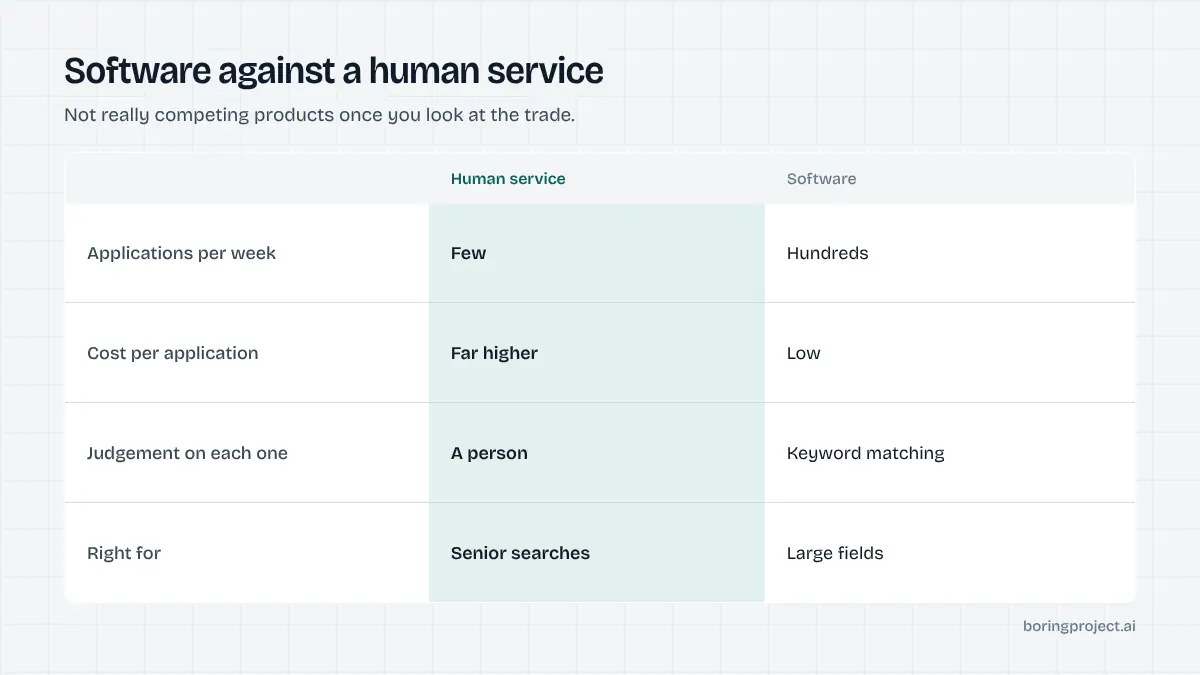
A human service cannot compete with software on volume. Software sends hundreds of applications a month; a reverse recruiting team sends a fraction of that, and each one costs far more.
If you are comparing on cost per application, a human service loses by an enormous margin and the comparison is over. The reason people buy anyway is that at senior levels the count is not what matters: a search where five well-aimed applications beat four hundred scattershot ones is exactly where human judgement earns its fee. That is a real argument, and our comparison of the tools in this market sets out where each category wins.
Throughput and onboarding are the two things to pin down
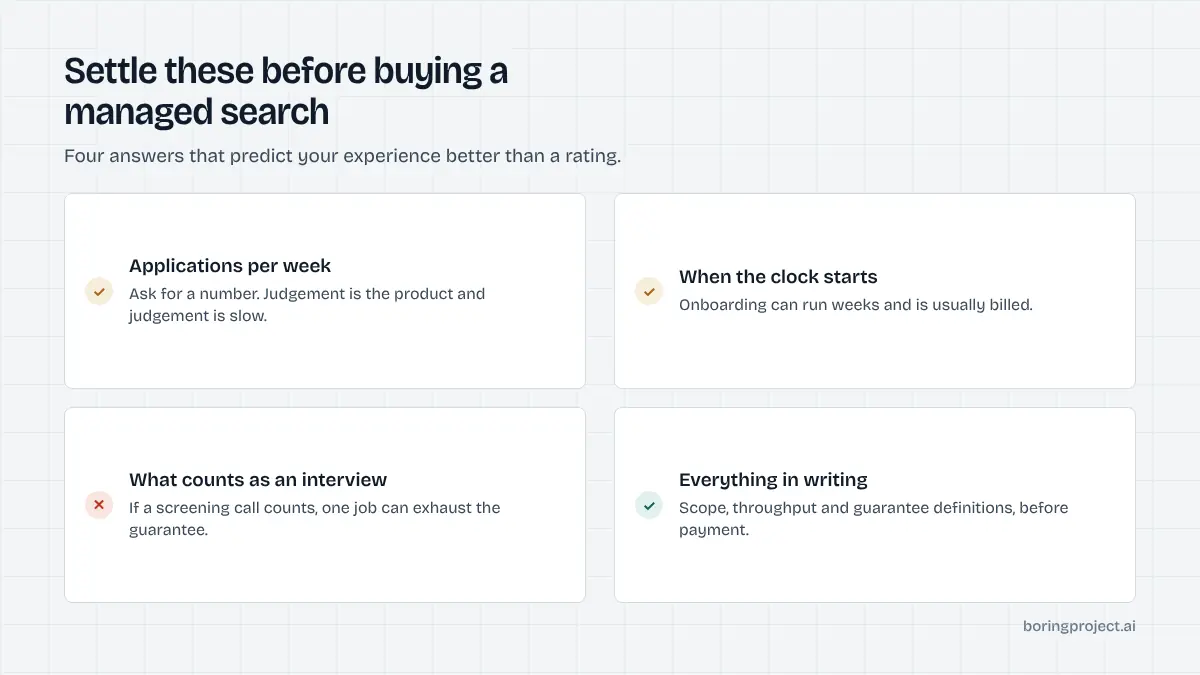
Ask how many applications per week the service actually submits, and how long onboarding takes before the search begins. Both are routinely underestimated by buyers, and both directly determine what you get for a month's fee. A month spent onboarding is a month you paid for without applications going out.
Guarantee terms are where managed searches live or die
Services in this category frequently attach an interview guarantee. The terms decide whether it protects you: what counts as an interview, whether a recruiter screening call counts, who makes the determination, what keeps you eligible, and how the clock starts.
This is not a criticism of any particular company, it is a general caution about a general practice. Get the definitions in writing before you pay, and specifically ask whether a brief screening call counts as an interview against the guarantee. If it does, a single job can exhaust your protection.
So is Find My Profession worth it?
On evidence, it is the strongest buy in this category
If you want a managed search and are weighing providers on public record, 788 reviews at 4.8 is the best case anyone in this market can make. That is a genuine finding and we are happy to state it plainly.
On arithmetic, it depends entirely on your level
For a senior or executive search where each application matters and your time is expensive, the fee can be straightforwardly worth it. For a graduate or junior search in a large field, where the strategy is volume, you will pay human prices for an approach that does not need humans, and the same money spent on software plus your own effort goes further. The volume question is covered in how many applications to get a job.
If the fee is the obstacle rather than the approach
If you want the applying taken off your hands but a managed search is beyond what you will spend, the middle option is software that does the submitting without the human judgement. That is us: you name the role once and applications go out across 40+ applicant tracking systems with a receipt for each. Our pricing is $99 a year for 3,600 applications, which is a different order of magnitude from managed search and buys a different thing. Judgement is what you lose.
Frequently asked questions
What is Find My Profession's Trustpilot score?
4.8 out of 5 from 788 reviews, on a profile claimed since 2018, with the company replying to around two thirds of negative reviews. It is the strongest evidenced record we verified across this market, where comparable products often sit between 1.7 and 2.7.
Is Find My Profession worth the money?
It depends on your level rather than on the service quality. For a senior search where each application deserves judgement and your own time is expensive, the fee is defensible. For a junior search in a large field, where volume is the strategy, software plus your own effort covers the same ground for far less.
What is reverse recruiting?
A service where a team runs your job search for you: finding roles, preparing documents and submitting applications on your behalf. It is human labour rather than software, which is why throughput is lower and cost per application is far higher than an automated tool.
How many applications will a reverse recruiter send?
Far fewer than software, and you should ask for a specific weekly number before buying rather than assume. Human judgement on each application is the thing you are paying for, and it is inherently slower. Also ask how long onboarding takes, since that period is paid for but produces no applications.
Should I trust an interview guarantee?
Only once you have the definitions in writing. Ask what counts as an interview, whether a short recruiter screening call counts, who decides, what keeps you eligible and when the clock starts. These terms, not the headline promise, determine whether a guarantee protects you.
Is a human service better than an auto-apply tool?
Better at judgement, worse at volume, and far more expensive per application. Which matters depends on your search: senior and specialised roles reward judgement, while large competitive fields reward throughput. They are not really competing products.
Next step
Before paying for any managed search, get three things in writing: applications submitted per week, onboarding duration, and the exact guarantee definitions including whether a screening call counts as an interview. Those three answers tell you more than any review score.