 The Boring Project
Sonara AI Review: What to Know Before Paying
Sonara is a US-only auto-apply subscription that fills a daily queue and submits up to 15 applications a day on business days; this review covers how it works, what is known about sonara pricing, and who it fits.
What Sonara is and how the apply model works
The pitch and a note on status
Sonara describes itself as a platform that "continuously finds and applies to relevant job openings until you're hired". Its homepage walks through three steps: it learns your preferences, including target salary; it finds matching roles using your resume; and it applies on your behalf. It positions itself as a partner of job boards including Monster.
Anyone reading a Sonara AI review in 2026 usually wants to know first whether the product still exists. When we checked in November 2026 the homepage was live, showed current listings, carried a 2026 copyright and listed support hours and a phone number. We saw no shutdown notice. Its pricing page, however, did not load for us. We are flagging that rather than drawing a conclusion from it.
A daily queue with a review window
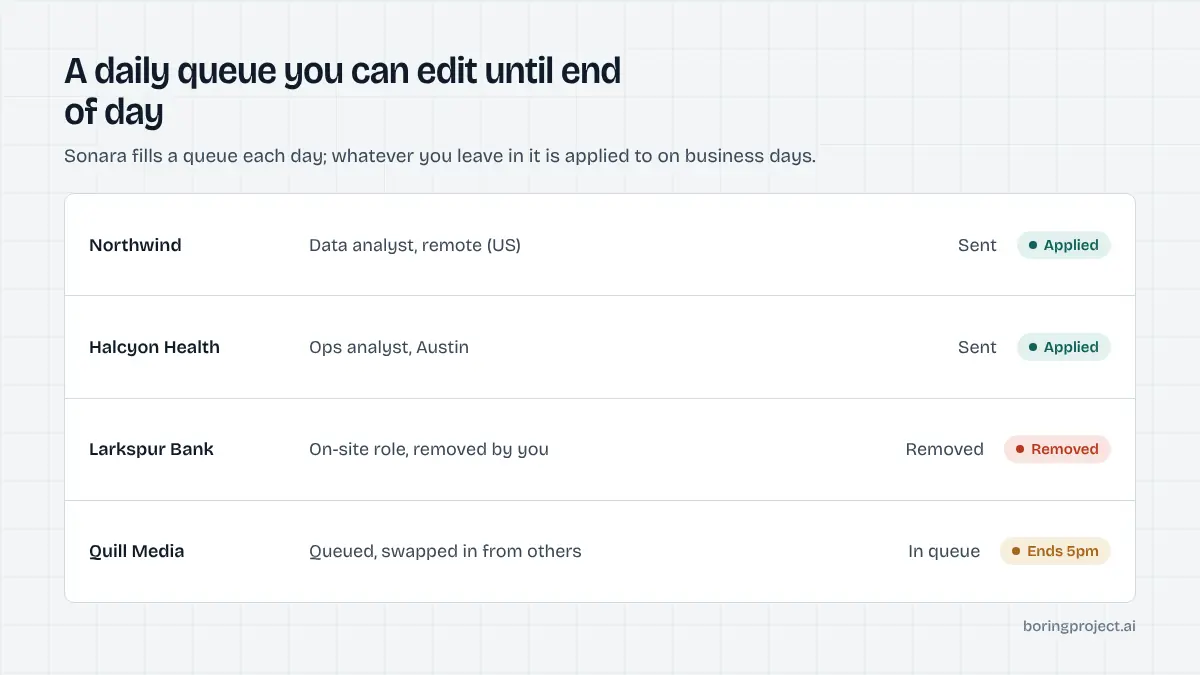
This is the mechanic that distinguishes Sonara from pure set-and-forget bots. Each day it fills a job queue for you. You can inspect that queue until the end of the day, remove roles you do not want and swap in others from an "other jobs" list. Whatever remains is applied to in the background.
Applications go out on business days only, excluding weekends, and you receive an email confirmation for each one once it is sent. The process is described as "automated systems with human oversight", which we read as oversight of the pipeline rather than a person reviewing each application.
Where it applies and the hard limits
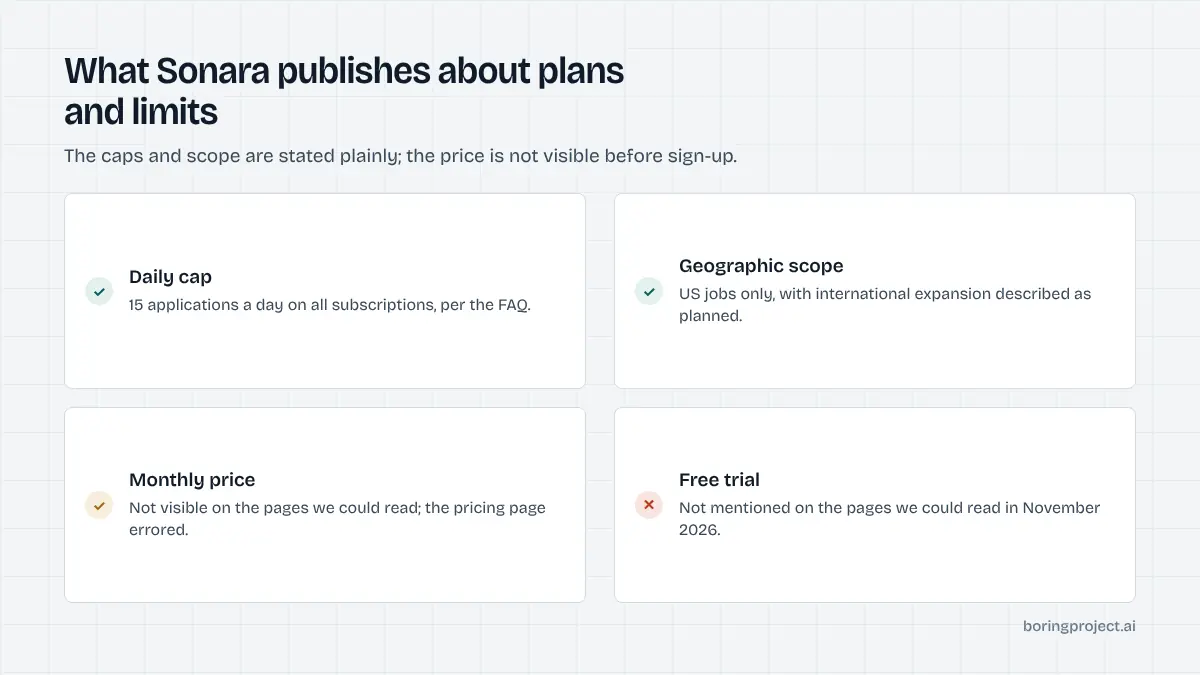
Two constraints are stated plainly in the FAQ. First, applications are supported only for US jobs, with international expansion described as planned. Second, "the limit for all subscriptions is set at 15 applications per day". The FAQ says higher-limit plans, possibly an unlimited plan, and a "boost pack" are being explored, but none were listed.
The site does not publish which applicant tracking systems it can complete forms on. Given the Monster partnership and the live listings on the homepage, expect a mix of board-sourced and career-page postings, and verify in your first week.
Sonara pricing as stated on their site
What we could and could not verify
The homepage shows "Get Started" and "Sign Up" buttons and no prices. The pricing page returned an error. The FAQ discusses plan structure in general terms without amounts. So we are not quoting a price in this Sonara AI review, and we would be wary of any third-party page that does so without a date.
| Item | Status as of November 2026 |
|---|---|
| Monthly price | Not visible on pages we could read |
| Free trial | Not mentioned |
| Daily cap | 15 applications per day on all subscriptions |
| Geographic scope | US jobs only |
| Referral programme | Referred friend gets 20% off first month; referrer gets $10 when they subscribe |
What the structure tells you
A uniform 15-per-day cap across all subscriptions means the plans are not differentiated by volume, at least for now. That is unusual in this category, where most vendors sell tiers by application count. It suggests Sonara is selling the matching and queue workflow as the product, with volume held constant. If you want more than roughly 300 applications a month, Sonara's own FAQ says that option does not yet exist.
Budgeting without a published price
If you proceed to sign-up and see a price, compare it on a per-application basis: monthly price divided by roughly 22 business days times 15. Then compare that number against tools that publish flat monthly caps. Also check whether the trial, if any, lets you see a real queue before you are billed, since match quality is the thing you are actually paying for.
Strengths, limitations and who it fits
Strengths
The daily queue with an end-of-day veto is a sensible middle ground. You get most of the time savings of automation while retaining a daily look at what will be sent under your name. Per-application email confirmations give you a basic paper trail, which several competitors do not offer. Salary-aware matching is useful for anyone who wants to filter out roles below a floor.
Business-days-only sending is also a quiet positive: applications arriving mid-week are more likely to be seen promptly than ones that land in a weekend backlog.
Limitations
The constraints are significant. US-only rules out most of the world. Fifteen applications per day is modest compared with tools offering 50 to 100 or more. Pricing was not visible to us, and the site does not publish an ATS compatibility list or describe a screenshot receipt per submission. The "human oversight" phrasing should not be read as human review of each application.
Because the status question comes up, it is worth saying plainly: we found an active site and no shutdown notice, but we could not load the pricing page, and we are not in a position to say more than that. For a wider field of options, including tools with published pricing, see our list of Sonara alternatives. If you are weighing whether automated applying is right for you at all, our piece on whether auto apply is safe covers the risks worth knowing.
Who it fits
Sonara fits a US-based job seeker who wants a steady, moderate stream of applications with a daily chance to veto, and who values salary-filtered matching over raw volume. It is not a fit for international candidates, for high-volume applicants, or for anyone who wants to see pricing before entering the sign-up flow.
If you are building a product rather than job hunting, a 15-a-day consumer subscription is not infrastructure. Staffing agencies, job boards and career platforms need a job application API that accepts a job URL and a candidate profile, completes the employer's form across 40+ ATS integrations, and returns a webhook with a submitted, needs_input or failed status plus a screenshot receipt. Consent is required on every application and screening answers are never fabricated, with per-employer rate limits built in.
Frequently asked questions
Is Sonara AI still active in 2026?
As far as we could tell from its public site in November 2026, yes. The homepage was live with current job listings, a 2026 copyright notice, phone and email support details and stated support hours. We found no shutdown notice. That said, the pricing page did not load for us, so treat any third-party claims about Sonara's status with care and check the site directly.
How much does Sonara cost?
We could not verify a price. Sonara's homepage shows only "Get Started" and "Sign Up" calls to action, and its pricing page returned an error when we tried to read it. Its FAQ states that all subscriptions are capped at 15 applications per day and that higher-volume plans and a possible "boost pack" are being explored. Expect pricing to appear during sign-up.
How does Sonara decide which jobs to apply to?
According to its site, Sonara learns your preferences, including desired salary, matches openings against your resume and fills a daily job queue. You can review the queue until the end of the day and remove roles or swap in others from an "other jobs" section. Anything left in the queue is applied to in the background on business days.
Can I use Sonara outside the United States?
Not at the time of review. Sonara's FAQ states that applications are supported only for US jobs, with international expansion described as planned. If you are searching in the UK, Europe, India or elsewhere, Sonara is not currently an option and you should look at tools with stated coverage in your market.
Does a human check Sonara's applications?
Sonara describes its process as automated systems with human oversight. It does not say that a person reviews each application before it is sent. You get an email confirmation per role once an application goes out, and you have the daily queue review window as your own checkpoint. Treat the human element as oversight of the system, not per-application review.
Is Sonara an option for staffing agencies or job boards?
No. It is a consumer subscription built around one job seeker's resume and preferences, capped at 15 applications per day and limited to US roles. Organisations that need to apply on behalf of many candidates with status callbacks and receipts should use a job application API or a managed service designed for that volume.
Next step
US job seekers who like the daily-veto model should go through Sonara's sign-up far enough to see the price and a sample queue before paying. Teams that need applications submitted for many candidates with receipts should talk to sales about Managed Applies.