 The Boring Project
LoopCV Review: How the Auto Apply Works
LoopCV automates job search through recurring "loops" that match postings and apply or email recruiters daily; this review covers the mechanics, loopcv pricing as published, and who it suits.
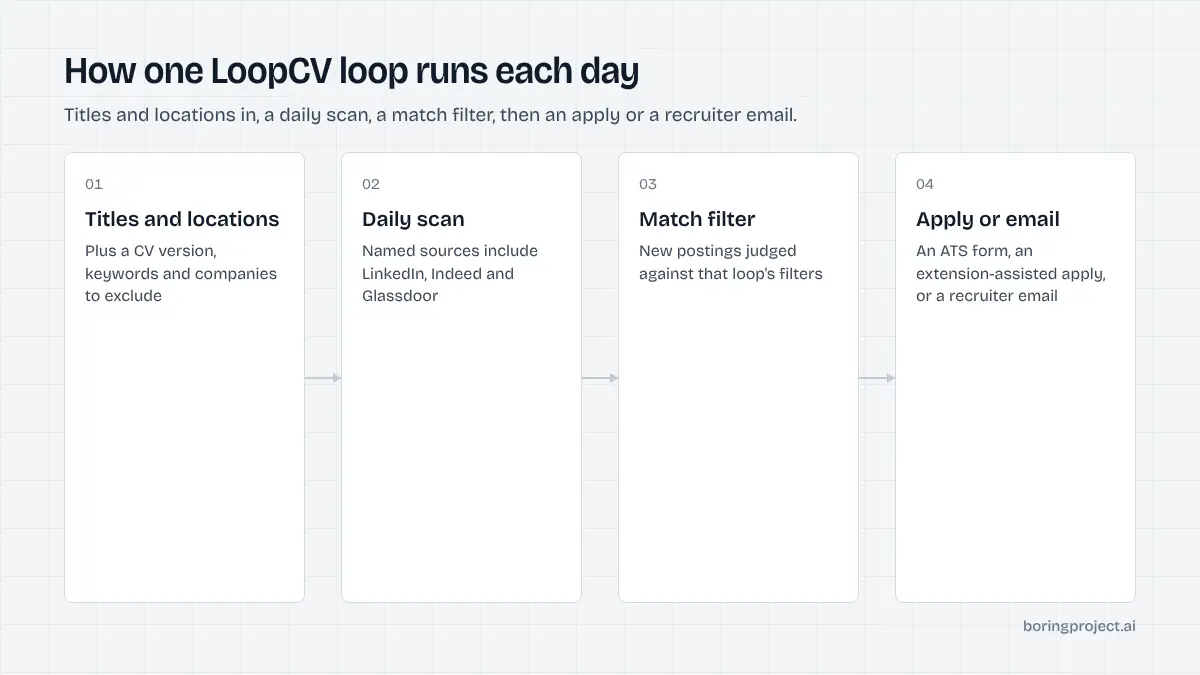
What LoopCV is and how the apply model works
The loop concept
This LoopCV review starts with the mechanics, because the loop is the unit everything else depends on. LoopCV is built around a single idea it calls a loop: you enter the job titles and locations you want, upload a CV, add filters such as keywords and companies to exclude, and set the loop running. Every day it scans its sources for new postings that match, then either applies for you or queues matches for manual review, depending on the mode you picked.
Multiple loops can run in parallel, which is how you would separate, say, a data analyst search in London from a BI developer search that is remote-only. Each loop can be paired with a specific CV version, and the platform tracks which version gets more replies.
Three application methods, not one
This is the part most reviews skip. LoopCV's own FAQ lists three ways it "applies": a browser extension for sites such as LinkedIn, form submissions through applicant tracking systems, and automated emails to recruiters whose addresses it finds.
That means the apply model is mixed. Some applications are genuine ATS submissions, some rely on your browser being open with the extension installed, and some are outreach emails with your CV attached. The dashboard counts them together, so when you evaluate results, separate the three before deciding what is working.
Where it applies
The site names LinkedIn, Indeed and Glassdoor, and describes pulling from 20 to 30+ platforms including company career pages. A full source list is not published and coverage is country-dependent. The email outreach feature only fires when a recruiter address can be found, so its hit rate varies widely by industry.
Daily volume is not fixed. LoopCV says the number of applications per day "depends on your plan limits and filters", which is honest but means you should run a free loop for a few days to see real numbers before buying.
LoopCV pricing as stated on their site
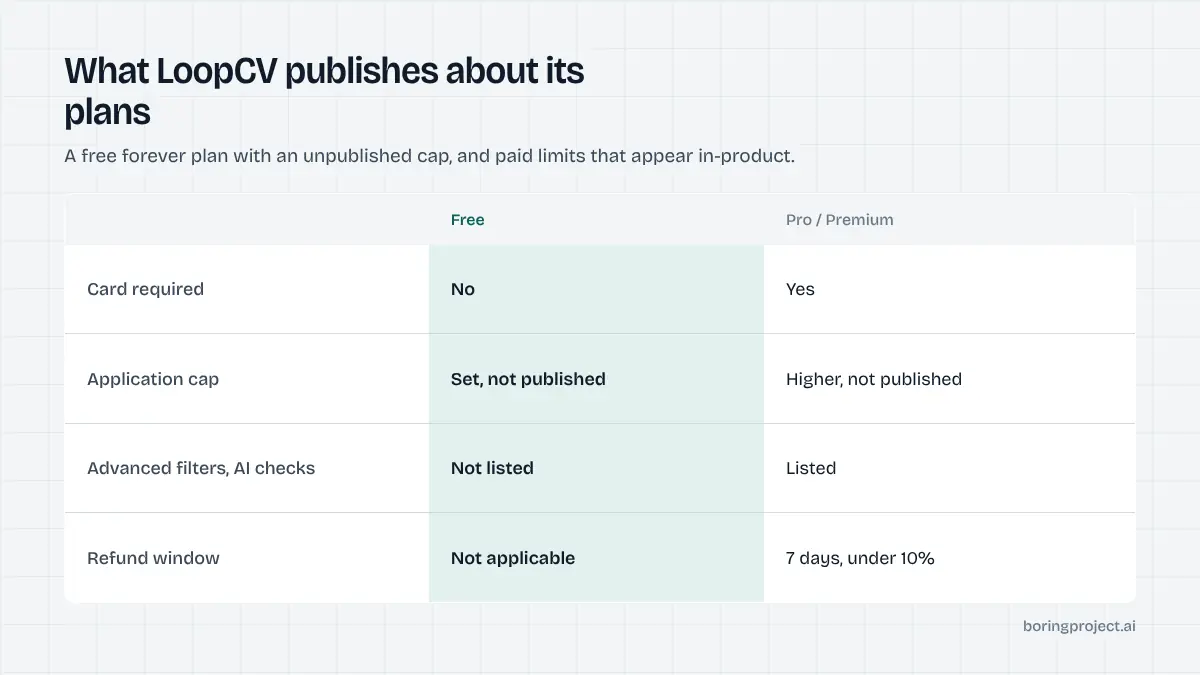
Cost is what brings most people to a LoopCV review, so here is what the site states and what it leaves out.
The free plan
As of November 2026, LoopCV states that it has a free forever plan with no credit card required. It includes automated applications across supported boards, CV matching and the application dashboard. Applications are capped at "a set number of matching jobs per day", and the site does not publish the number. In one place the FAQ describes the cap as monthly and elsewhere as daily, so expect the exact ceiling to show only once you are inside the product.
Paid tiers
The site says paid plans start from €9.99 per month and names Pro and Premium tiers. The pages we could read did not include a per-tier table, so the table below reflects what is stated rather than a full breakdown.
| Tier | Price as listed | What the site says it unlocks |
|---|---|---|
| Free | €0, no card | automated applications with a daily cap, CV matching, dashboard |
| Pro / Premium | from €9.99/month | higher daily limits, priority processing, advanced filters, AI CV checks; Premium described as "hundreds of matching roles per week" |
Two terms are worth noting. Refunds are offered within 7 days of purchase if you have used no more than 10% of the plan's application quota. A student discount exists, with details on a separate page we did not verify.
How it compares on price
A sub-€10 entry point makes LoopCV one of the cheaper paid auto-apply tools on the market, and the free tier is more generous than most trials. The trade-off is transparency: competitors that publish a full price-and-limit matrix are easier to budget against. If you care about knowing your exact application quota before paying, ask support before you subscribe.
Strengths, limitations and who it fits
Strengths
The loop model is a clean abstraction. It makes it easy to run several targeted searches at once instead of one broad net, and the CV A/B testing is a genuinely useful feature that most consumer tools lack. The free plan lets you validate match quality in your market at no cost.
The recruiter email channel is also a differentiator. Where a posting has no application form or you want a human to see your CV, outreach can get a reply that an ATS submission would not.
Limitations
The mixed apply model is the main caveat. Because applications, extension-assisted applies and outreach emails are bundled in one count, "applied to 40 jobs" can mean very different things. The site does not describe a per-application receipt or screenshot, and it does not say how unfamiliar screening questions are handled when an ATS form asks something not in your profile.
Pricing beyond the entry point is under-documented on public pages. And like every tool in the category, the headline multipliers on interviews are the vendor's own figures. For a comparison against tools with a single, clearly stated apply model, see our round-up of LoopCV alternatives.
Who it fits
LoopCV fits a budget-conscious job seeker, particularly in Europe given the euro pricing, who wants to run a few focused searches and is comfortable with a mix of automated applications and recruiter outreach. It is a sensible first tool to try because the free plan carries no risk.
It is less suited to someone who needs a clear audit trail of exactly what was submitted where, or who is applying mainly through large-employer career portals where multi-step forms dominate.
If you are building a product rather than job hunting, LoopCV is not the layer you want. Job boards, staffing agencies and career services that need to submit applications for many candidates need a job application API: send a job URL and a candidate profile, get the employer's ATS form filled and submitted across 40+ systems, and receive a webhook with a submitted, needs_input or failed status plus a screenshot receipt. Consent is captured per application and screening answers are never fabricated. The API documentation covers the request shape and status model.
Frequently asked questions
What is a loop in LoopCV?
A loop is a saved search plus an action. You give it one or more job titles and locations, add keyword filters and company exclusions, and choose whether LoopCV should apply automatically or just surface matches for you to review. The loop re-runs daily, picks up new postings, and either applies or emails a recruiter depending on what the posting supports.
Does LoopCV actually submit applications or only email recruiters?
Both, according to its FAQ. It lists three application methods: a browser extension for sites such as LinkedIn, direct form submissions through applicant tracking systems, and automated emails to recruiters whose addresses it finds. Which method a given posting gets depends on the source, so some of your "applications" will be outreach emails rather than ATS submissions.
How much does LoopCV cost?
As of its site in November 2026, LoopCV offers a free forever plan with no credit card required and says paid plans start from €9.99 per month. It names Pro and Premium tiers but does not publish a full per-tier price and limit table on the pages we could read. There is a 7-day refund window if under 10% of the application quota has been used.
Which job boards does LoopCV cover?
The site names LinkedIn, Indeed and Glassdoor and describes aggregating from 20 to 30+ platforms including company career pages. It does not publish a complete list, and coverage differs by country. If you are searching in a smaller market, create a free loop and inspect the matches before paying for volume.
Is the LoopCV free plan enough for a real job search?
It depends on your volume. The free plan caps automated applications at a set number of matching jobs per day, and the site is inconsistent about whether that cap is daily or monthly. For a targeted search of a few applications per day it can be adequate; for a high-volume search you will hit the ceiling quickly and need a paid tier.
Can a staffing agency use LoopCV for its candidates?
LoopCV is designed around a single job seeker's CV and preferences, with per-account loops. There is no stated multi-candidate workspace, API or webhook. Agencies, job boards and career platforms that need to apply on behalf of many people with status reporting are better served by a job application API or a managed service built for that purpose.
Next step
Job seekers can start a free loop today and judge match quality in a week. Teams that need applications submitted for many candidates, with receipts and status callbacks, should talk to sales about Managed Applies for a no-code pilot.