 The Boring Project
7 LoopCV Alternatives for Auto Apply
A neutral list of seven LoopCV competitors grouped by apply model, covering hosted agents that submit for you, autofill extensions you supervise, a human recruiter service, and an API route for teams building products.
LoopCV, as of its site in 2026, describes itself as a platform where you create a loop of job titles and locations and it applies to matching roles automatically, with an option to email your CV directly to companies. That is the cloud auto-submit model. We cover the product in depth in our LoopCV review.
The LoopCV alternatives below are grouped by how they get an application submitted, because that is the decision that matters most. Within a group the tools are closer to each other than they are to anything in another group.
Hosted agents that apply for you
These are the direct substitutes. Each runs on the vendor's infrastructure and submits applications without you at the keyboard.
JobCopilot
JobCopilot describes itself as an AI agent that searches job boards and submits applications on your behalf on a recurring schedule, with cover letter and resume tools alongside. Apply model: cloud auto-submit. It is the most common like-for-like comparison with LoopCV; the differences are in job sources, how preferences are set and what you can review afterwards.
Sonara
Sonara positions itself as an AI job search assistant that discovers matching roles and applies for you as part of a subscription. Apply model: cloud auto-submit. As with any hands-off agent, the key questions are which application systems it can complete and how it handles screening questions that are not answered by your profile.
JobHire.AI
JobHire.AI describes an AI-driven job search platform that tailors resumes and applies to matching roles automatically. Apply model: cloud auto-submit, with document tailoring built in. It is a reasonable alternative if the resume customisation side matters to you as much as the submission side.
Agents with previews, and tools you supervise
These options sit between fully hands-off and fully manual.
Massive
Massive, the job tool at usemassive.com rather than the unrelated market data company, offers an Autopilot mode that matches jobs and submits applications, with a preview of the generated resume and cover letter per job and a monthly cap on applications. Apply model: cloud auto-submit with document-level preview. You can also pick jobs manually rather than running Autopilot.
JobWizard
JobWizard is a Chrome extension that autofills application forms on supported ATS platforms, drafts answers and cover letters, and then hands the form back to you for review and submission. Apply model: autofill, you click submit. As of its site in 2026 it sells non-renewing 30-day passes alongside a free tier, which suits people who search in bursts.
Careerflow
Careerflow bundles a resume builder, LinkedIn optimizer, job tracker and an autofill Chrome extension into one platform. Apply model: autofill, you click submit. It is the alternative for people whose real problem is the quality of their materials rather than the speed of submission, and who are happy to apply manually with the extension's help.
A human option and the API route
The remaining consumer alternative replaces software with a person, and the final option is for people who are not the end user at all.
Careerify
Careerify assigns a dedicated human recruiter who builds a search strategy from your targets, finds roles and applies every weekday. Each application is logged with a job-post screenshot, the resume and cover letter used, and a ledger of recruiter hours spent. Apply model: human service, priced by recruiter hours with a short card-required trial. It is slower and more expensive per application than LoopCV but handles any portal and gives you a person to talk to.
For builders: an API instead of a consumer tool
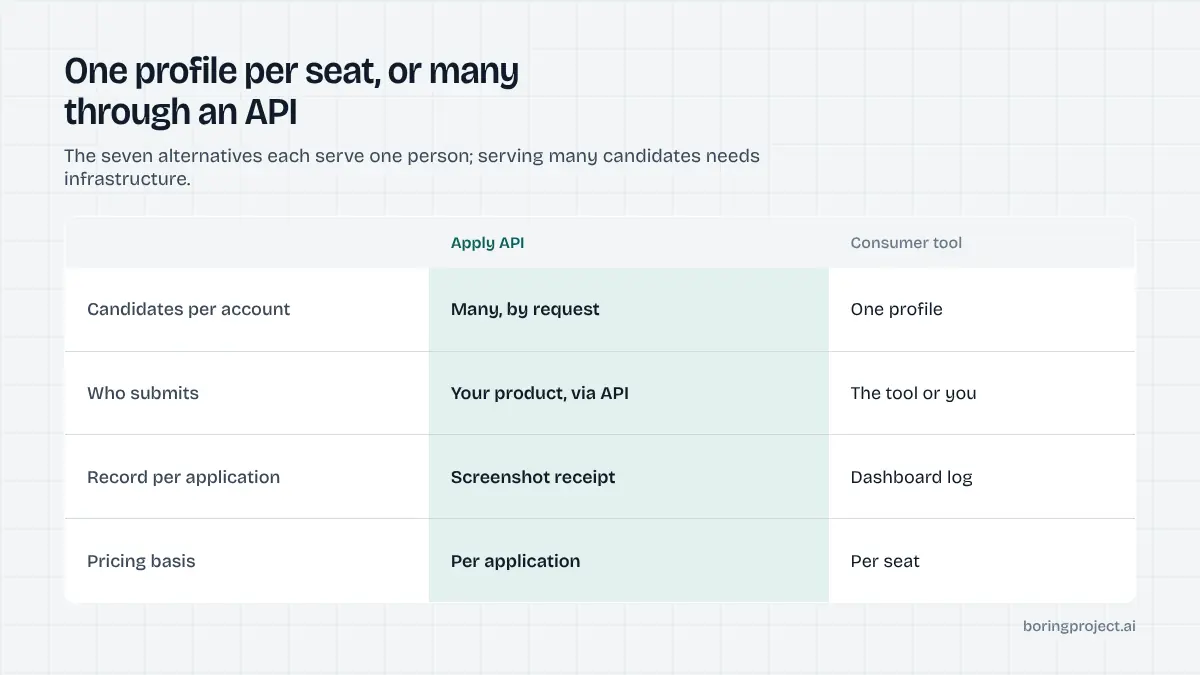
If you run a job board, a staffing agency, a reverse recruiting service or a career platform, none of the seven tools above is really an alternative, because each is designed around one person with one profile. What you need is the submission step as infrastructure your own product can call.
A job application API takes a job URL plus a candidate profile, fills and submits the employer's ATS form across systems such as Workday, Greenhouse, Lever, iCIMS, Taleo and SuccessFactors, and returns a webhook with a status of submitted, needs_input or failed along with a screenshot receipt. Candidate consent is required on every application, screening answers are never fabricated, and per-employer rate limits keep volume responsible. Pricing is per successful application. The API documentation describes the request and webhook formats.
Picking a category first
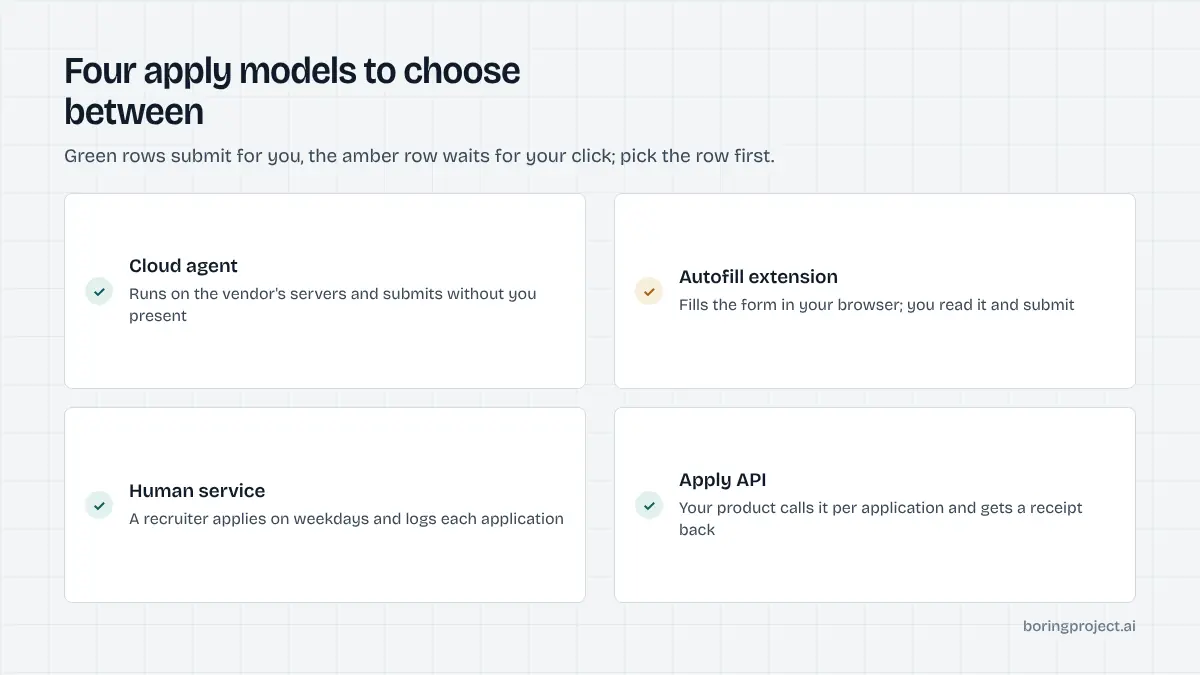
| Category | Examples here | Who submits | Best when |
|---|---|---|---|
| Cloud agent | JobCopilot, Sonara, JobHire.AI, Massive | Software | You want volume without supervision |
| Autofill extension | JobWizard, Careerflow | You | You want to see every field |
| Human service | Careerify | A recruiter | Portals are unusual or you want delegation |
| API | Job application API | Your product | You serve many candidates |
Decide which row you belong in before comparing tools within it. Most dissatisfaction with auto-apply tools comes from picking the wrong row, not the wrong tool.
A practical way to do that: write down how many applications you want sent per week, how many you are willing to read before submission, and whether your target employers use mainstream ATS platforms or unusual portals. Those three answers point to a row almost immediately, and the shortlist within the row is then two or three tools you can trial on real postings in an afternoon.
Frequently asked questions
What does LoopCV do, and why look for alternatives?
LoopCV describes itself as a platform where you set up a loop of job titles and locations and it automatically applies to matching roles, and can also email your CV to companies. It is a cloud auto-submit tool. People look elsewhere when they want more control over each application, broader ATS coverage, a human in the process, or infrastructure for many candidates rather than one.
Which LoopCV alternatives work the same way?
JobCopilot, Sonara, JobHire.AI and Massive all describe hosted agents that find jobs and submit applications on your behalf with little or no per-application review. They differ in job sources, how much you can preview before submission, monthly caps and pricing shape. If you like the hands-off model, compare those four on the employers you actually target.
Are there LoopCV competitors that do not submit automatically?
Yes. JobWizard and Careerflow are browser extensions that autofill forms on pages you open and leave the submit click to you. They are slower per application but you see every field before it goes out. They suit selective searches and people who have had problems with wrong screening answers from automated tools.
Is there a human alternative to LoopCV?
Careerify assigns a dedicated recruiter who sources roles, applies every weekday and logs each application with a job-post screenshot, the resume used and an hours ledger. It costs more per application than software and is priced by recruiter hours, but it handles portals that automated tools do not and gives you a named person to work with.
What should builders use instead of a consumer auto-apply tool?
A job application API. Consumer tools are built for one candidate and one profile. Job boards, staffing agencies and career platforms that submit for many candidates need programmatic access, consent captured per application, a status webhook and a receipt for each submission. An API provides that layer so your product owns the experience.
How do I compare these alternatives fairly?
Pick five real postings from employers you want and run each tool against them. Check ATS support, whether screening answers are visible before submission, how duplicates and your current employer are handled, and what record you get afterwards. Vendor success statistics are company claims; a small trial on your own targets is more informative.
Next step
Job seekers should shortlist two tools from the row that matches how much control they want and trial both on real postings. Teams and builders who need applications submitted for many candidates should start with our job application API and run a handful of test submissions against a live ATS.