 The Boring Project
Is Wobo Worth It?
Wobo gives away a daily application allowance and charges to remove the cap, so whether Wobo is worth it depends on whether five jobs a day constrains you; this covers wobo pricing, what the free tier really does and when the paid plan earns its fee.
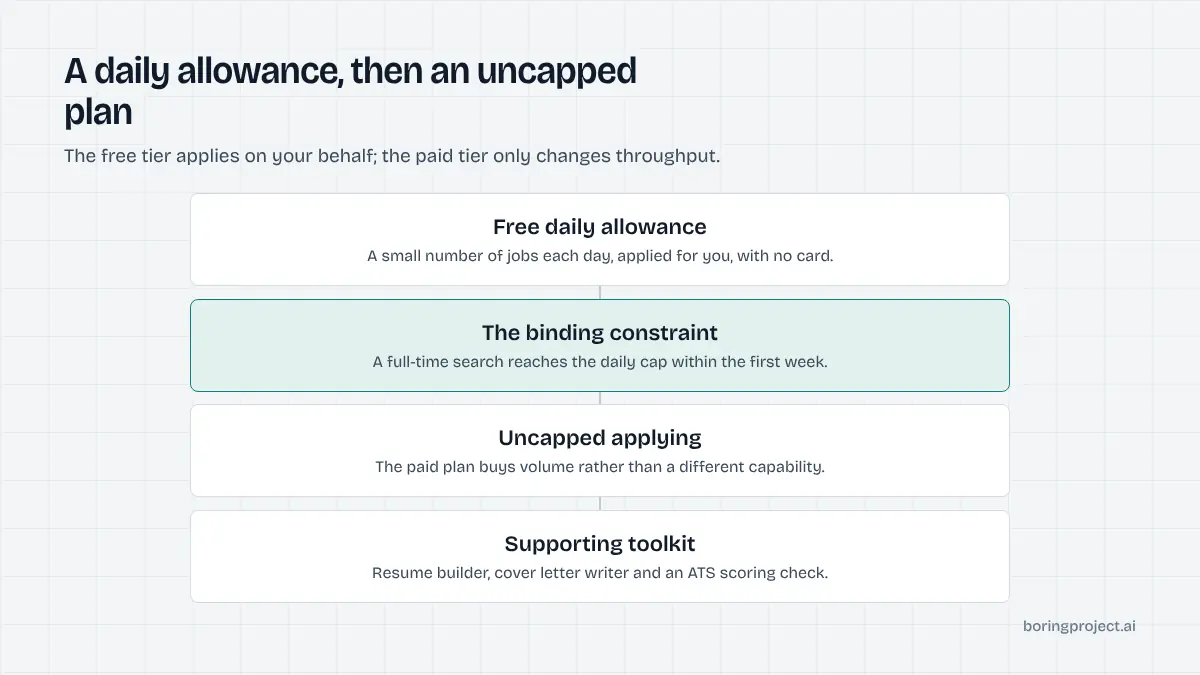
What you get at each level
The free tier does the actual job
Wobo's free plan is described as free forever and covers five jobs a day, with the product applying on your behalf within that allowance. That is a more substantial free tier than this category usually offers, where free generally means you can look at a dashboard.
Five a day is roughly 35 a week. For someone employed and applying selectively, that is not a teaser, it is a workable pace. The honest conclusion is that a good number of job seekers never need to pay for this product at all, and that is worth saying plainly before discussing the paid plan.
What Unlimited removes
The Unlimited plan is published at $34.99 a month and, as the name says, lifts the daily cap. Quarterly billing is offered as the cheaper rhythm, and the pricing page shows further tiers above Unlimited. A five-day free trial also appears on the page.
Because the free tier already applies for you, the paid plan is not buying a different capability. It is buying throughput. That makes the decision cleaner than most: you are not weighing feature lists, you are deciding whether you will exceed 35 applications a week.
The surrounding toolkit
Alongside applying, Wobo lists an AI resume builder, an AI cover letter generator, and an ATS resume checker that scores a resume against more than 24 criteria. These are the standard components in this category and are rarely the reason anyone chooses one tool over another, since free alternatives for each are plentiful. Judge the product on the applying.
Who should pay and who should not
The case for the paid plan
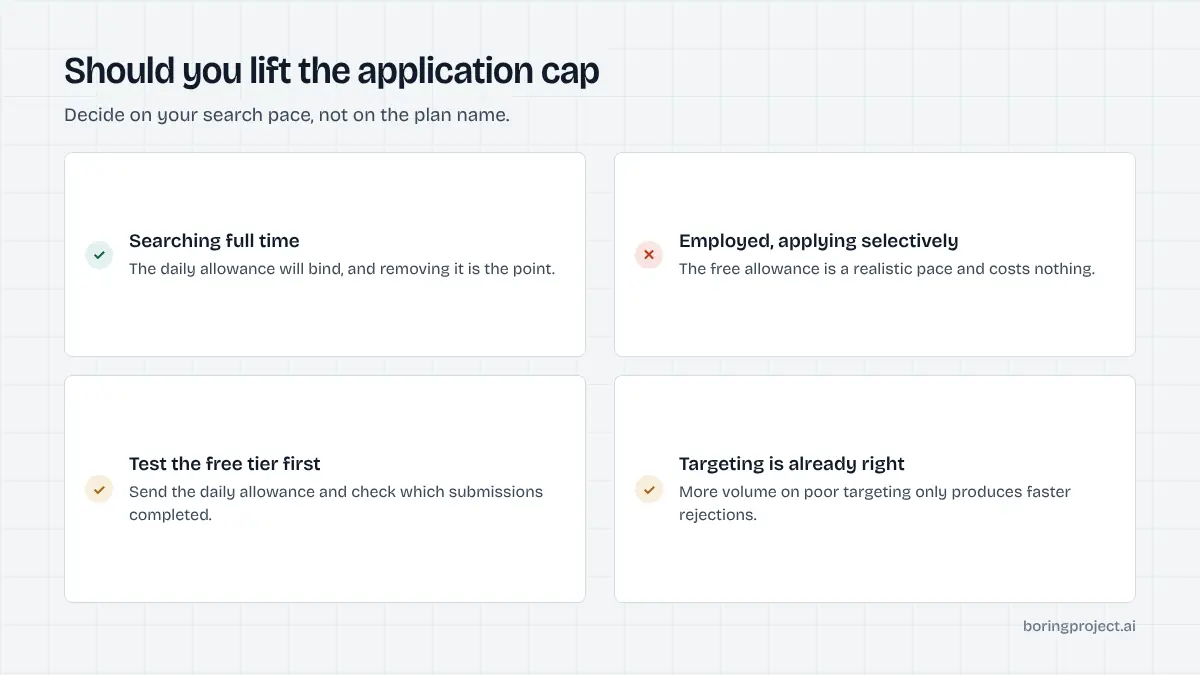
If you are between roles and searching full time, the cap will bind within the first week and $34.99 a month is in line with what comparable tools charge for unlimited applying. If you intend to search for a full quarter, the quarterly rhythm is the better buy on the published rates.
The sequence that makes sense is to run the free tier first for a week, watch where the applications actually land, and only then pay. Our guide on how to automate job applications sets out what to look for in that first week.
The case against
If you are employed and applying thoughtfully to a handful of roles, the free tier covers you and the paid plan is money spent on headroom you will not reach.
There is a second argument against, which applies to everyone considering unlimited applying. Removing a volume cap does not improve a search whose targeting is wrong; it simply produces more rejections faster. The cap is occasionally doing you a favour by forcing selectivity. Lift it deliberately, because you have roles to apply to, not because the plan name sounds better.
What the pricing page does not say
As with most consumer tools here, the page does not enumerate which applicant tracking systems the product can complete. That is the specification that decides whether unlimited volume is usable, since an uncapped plan is worth nothing against employers whose forms the tool cannot finish. Our guide to the best auto apply tools explains why published coverage, not plan names, is the thing to compare.
The free tier is the cheapest possible way to answer that question for yourself. Send five a day for a few days and look at what completed.
So is Wobo worth it?
When the free plan is enough
The short answer to is wobo worth it is that it depends on one thing, and it is not the feature list. The free plan is worth using by almost anyone searching for work, because five applications a day costs nothing and is a real pace. That is an unusual thing to be able to say about this category.
When to lift the cap
The paid plan is worth it specifically for a full-time search where 35 applications a week is the constraint, and the quarterly rate is the sensible version of that purchase. It is not worth it for a selective search, and the fact that the free tier is permanent means there is no pressure to decide quickly.
If you are a business
If you are assessing this for a business, the thing to notice is that none of the tiers mentions an API, a webhook or multi-candidate handling. Those are the requirements for applying on behalf of other people at volume, and they are what our job application API is built around.
Frequently asked questions
How much does Wobo cost?
Wobo's pricing page lists a free forever plan covering five jobs a day, and an Unlimited plan at $34.99 a month. The page also offers quarterly billing described as saving more than monthly, and shows additional higher tiers. These were the figures published at the time of writing, so check the live page before subscribing.
Is Wobo's free plan actually free?
It is described as free forever with an allowance of five jobs a day rather than a timed trial. On the published plan, Wobo applies for you within that allowance, which makes it a genuine way to test whether applications complete on the employers you care about before paying anything.
What does Wobo include besides applying?
Its product menu lists an AI job application feature that auto-applies with personalised resumes and cover letters, an AI resume builder, an AI cover letter generator, and an ATS resume checker that scores a resume across more than 24 criteria. The applying feature is the one the paid plan is really gating.
Does Wobo offer a trial on the paid plan?
A five-day free trial appears on its pricing page alongside the plans. Because the free forever tier already lets you send a limited number of applications, the trial matters mainly if you want to test the unlimited volume rather than the basic function. Confirm the trial terms and the renewal date before starting it.
Is five jobs a day enough on the free plan?
Five a day is around 35 a week, which is a reasonable pace for a selective search and genuinely useful rather than token. For a concentrated full-time search it will be the binding constraint, which is exactly what the paid tier removes. Start free and find out which describes you.
Can recruiters use Wobo for multiple candidates?
It is presented and priced as a product for an individual job seeker, with no stated multi-candidate workspace, API or webhook on its pricing page. One account per candidate would work mechanically but offers no central reporting or submission receipts, which is what agency work requires.
Next step
If you are job hunting, run the free daily allowance for a week and check which submissions actually completed before paying for volume. If you are applying for candidates at scale, a single-seat subscription is the wrong unit and per-application pricing is the right one.
All figures above are as published at the time of writing. Check Wobo's live pricing page before subscribing.