 The Boring Project
Is Tsenta Worth It?
Tsenta charges for applications rather than for the software, so the question of whether Tsenta is worth it comes down to volume; this breaks down tsenta pricing, the quota on each plan, and the cost model behind it.
What you actually pay for
The pricing model, in its own words
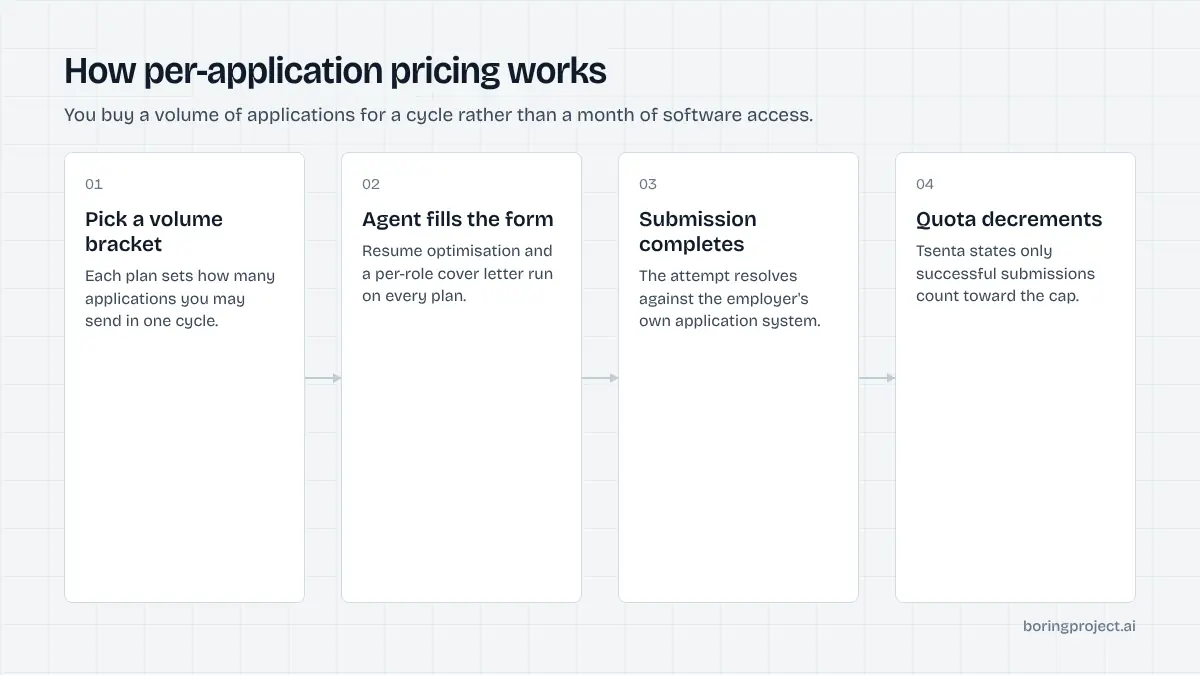
Tsenta's pricing page leads with a line that tells you most of what you need: pay for the applications, not the tool. Its three paid plans are Starter at $19 a month for 600 applications, Pro at $39 for 1,500, and Power at $99 for 4,500, each measured per 30-day cycle in USD. The page frames the result as about two to three cents per application.
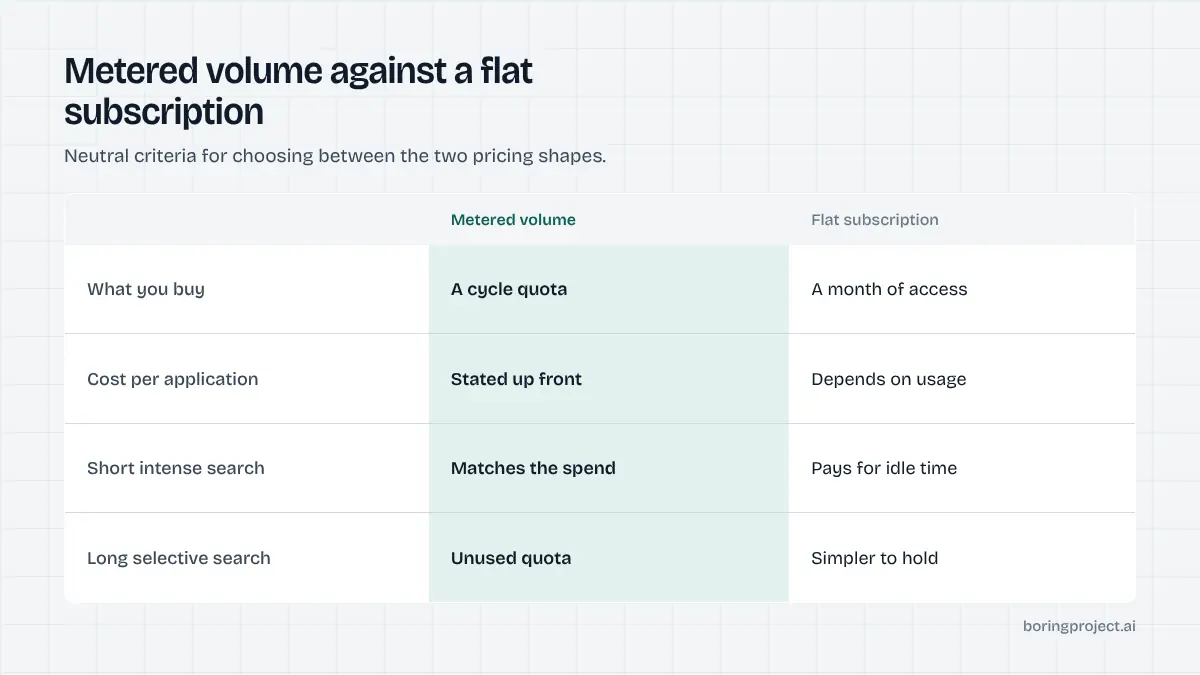
That is a meaningfully different shape from a flat subscription. With most consumer auto-apply tools you buy a month of access and the vendor absorbs how much you use it. Here the quota is the product, and the monthly fee is a volume bracket.
What every plan includes
The published plans are not feature-tiered in the usual way. Tsenta states that every plan includes resume optimization, a cover letter written for each role, the application tracker and reply monitoring, and that all plans run the same agent across the same employer systems. The tiers differ by throughput.
There is one exception worth reading carefully. Auto Apply is listed as something the Power plan adds, described as applying to newly matched roles rather than waiting for you to start each one. If genuinely hands-off applying is the reason you are considering the tool, that pushes you to the $99 tier regardless of how many applications you need.
The free allowance
Tsenta offers 25 free applications with no credit card required. An allowance is more useful than a timed trial for this category, because the thing you want to evaluate is not whether the interface works but where applications actually land and whether the submissions complete. Twenty-five is enough to check that.
Where the cost model works and where it does not
When per-application pricing is the cheaper shape
If you apply in bursts, metered pricing is usually kinder than a subscription. A concentrated two-week search that sends 400 applications costs less on a volume bracket than three months of a flat plan you stopped using after the first fortnight.
It is also easier to reason about. Cost per application is the number that matters when you are comparing tools, and this is one of the few consumer products that states it directly instead of leaving you to divide a monthly fee by an unknown. We cover how that compares with infrastructure pricing in our note on auto apply API pricing.
When it is the more expensive one
Metered pricing punishes a long, slow search. Someone applying to fifteen carefully chosen roles a week over four months will pay for four cycles and use a fraction of each quota. A free tracker plus manual applications would cost nothing and lose very little.
The quota also sets an implicit strategy. Buying 4,500 applications in a 30-day cycle only makes sense if you intend to use them, and 4,500 applications in a month is a volume play, not a targeted search. That is a legitimate approach, but it is worth deciding deliberately rather than drifting into it because you bought the tier.
The claim to check before you buy
Tsenta says only successful submissions count against your quota. If accurate, that is a genuine advantage over tools that bill every attempt, because failure rates in this category are not trivial. It also makes the stated cents-per-application figure more credible than the same figure from a tool that charges for attempts.
What the pricing page does not do is name the 30+ employer systems. Coverage is the hinge: a quota of 4,500 applications is worth nothing if the roles you want sit behind a system the agent cannot complete. Ask support about your specific targets first. Our guide to the best auto apply tools explains why published ATS coverage is the specification to compare.
So is Tsenta worth it?
The case for paying
The short answer to is tsenta worth it is that it depends on one thing, and it is not the feature list. On the published numbers, it is worth it for a short, high-volume search where you want the cost per application visible rather than buried in a subscription, and where you have confirmed that your target employers use systems the agent covers. The 25 free applications let you establish that for nothing, which is the right first step and costs you only time.
Where it does not fit
It is a poor fit for a long, selective search, where you will pay for cycles you barely use, and for anyone who needs hands-off applying on a budget, since Auto Apply sits on the $99 tier.
If you are a business
If you are reading this as a business rather than a job seeker, the model is the interesting part rather than the product. Per-application pricing is how application infrastructure is priced, and if you are placing candidates at volume you want that economics with your own interface on top, which is what our job application API provides.
Frequently asked questions
How much does Tsenta cost?
Tsenta publishes three paid plans on its pricing page, billed per 30-day cycle in USD: Starter at $19 for 600 applications, Pro at $39 for 1,500, and Power at $99 for 4,500. Its own page frames this as roughly two to three cents per application. Prices change, so treat these as the figures published at the time of writing and check the live page before buying.
Does Tsenta have a free plan?
Yes. Tsenta offers 25 free applications to start and states that no credit card is required. That is a usage allowance rather than a timed trial, so it does not expire after a set number of days. It is enough to see where applications actually land before you pay anything.
What do you get on every Tsenta plan?
According to its pricing page, every plan includes resume optimization, a cover letter generated for each role, the application tracker and reply monitoring, and all plans run the same agent across the same employer systems. The plans differ by how many applications you can send in a 30-day cycle. The Power plan additionally includes Auto Apply.
What is the difference between Tsenta's plans and its Auto Apply feature?
On the published plans, Auto Apply is listed as an addition to the Power tier rather than something included everywhere. The lower tiers still submit applications, but Tsenta describes Auto Apply as applying to newly matched roles without you initiating each one. If hands-off applying is the reason you are buying, that distinction decides which plan you need.
Do failed applications count against the Tsenta quota?
Tsenta states that only successful submissions count. That matters when comparing cost per application against tools that charge for every attempt, because a quota that excludes failures is worth more than the headline number suggests. Confirm how it classifies a partial submission before committing to a large plan.
How many systems does Tsenta apply to?
Its pricing page refers to the same agent running across 30+ employer systems on every plan. It does not enumerate them on that page. If your target employers use a specific applicant tracking system, ask support whether that system is covered before you pay, since coverage is what determines whether a volume quota is usable.
Next step
If you are job hunting, spend the 25 free applications first and look at where they actually landed before choosing a volume bracket. If you are applying on behalf of other people, price the work per application rather than per seat, and ask any vendor to show you a submission receipt before you commit.
Pricing in this category changes often. Every figure above is what Tsenta published at the time of writing; check the live pricing page before you buy.