 The Boring Project
Is Sprout Worth It?
Sprout sells capped application credits on three different billing rhythms, so whether Sprout is worth it depends on how fast you intend to apply; this sets out sprout pricing, the cap on each plan and the real cost per application.
What the plans actually give you
Three rhythms, not three feature tiers
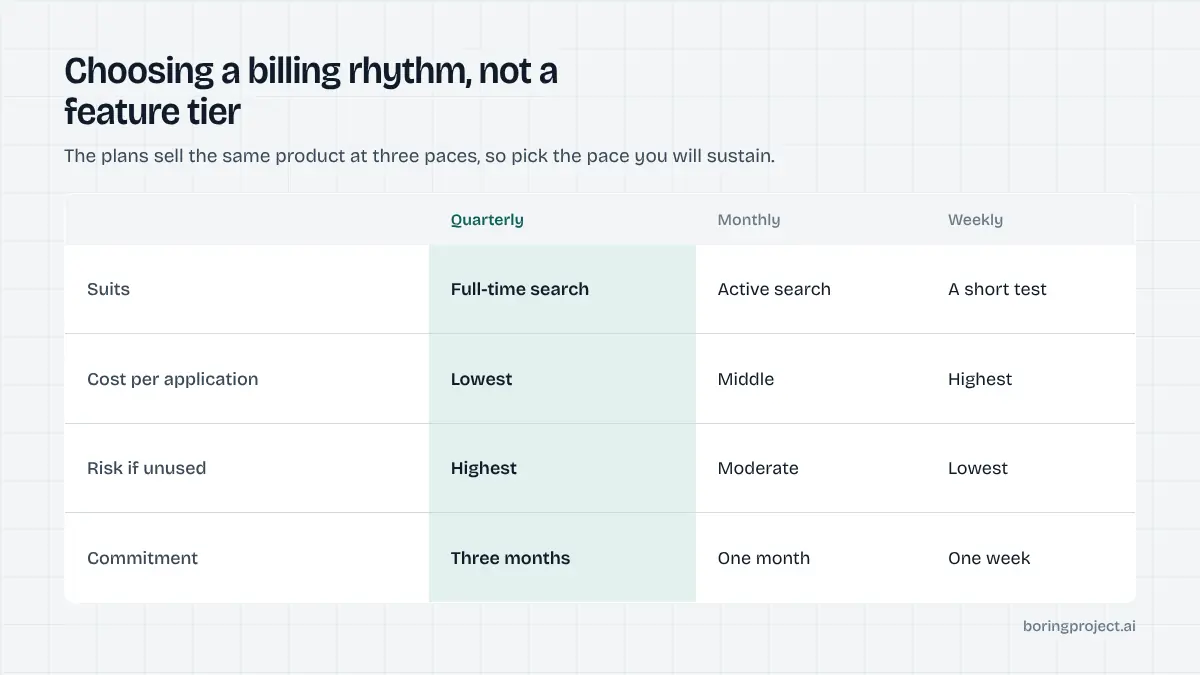
Sprout's published plans are Weekly at $19.99 for 50 applications a week, Monthly at $39.99 for 200 applications a month, and Quarterly at $79.99 for 600 applications across three months. The page describes them as flexible plans for credits to search, apply and land jobs, with no contracts.
The important thing is that these are not a good, better, best feature ladder. They are the same product sold at three speeds, and what you are choosing is a pace. That makes the decision unusually simple: estimate how many applications a week you will genuinely send, then pick the bracket that matches.
The cost per application
Dividing the published figures gives the number worth comparing. The weekly plan is roughly forty cents an application, the monthly plan around twenty cents, and the quarterly plan near thirteen cents.
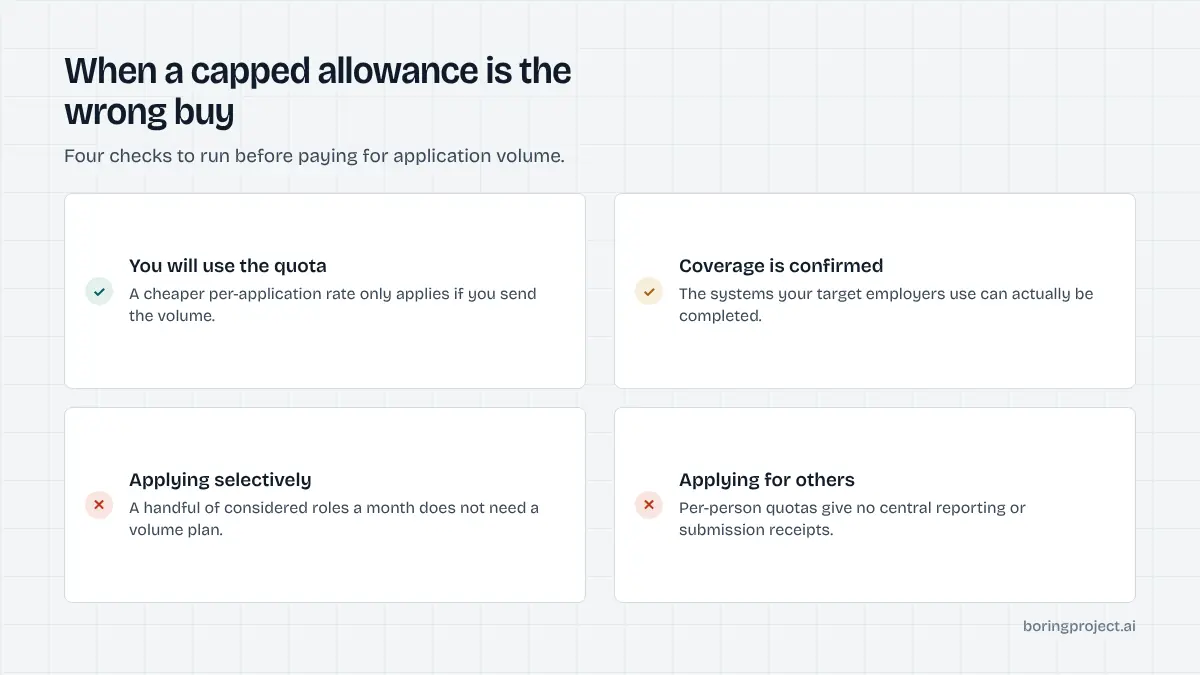
The quarterly plan is therefore about three times more efficient than the weekly one, but only if you use it. Six hundred applications in three months is around fifty a week sustained for thirteen weeks, which is a lot of applying. Buy the cheap bracket and use half of it and you have paid monthly-plan rates anyway.
Reading the discount honestly
The quarterly plan shows $79.99 against a struck-through $239.99 with a 70% off label. $239.99 is close to what six months of the monthly plan would cost, so treat it as a reference rate for the volume rather than a price being charged. The figure to judge is $79.99 for 600 applications.
Who the pricing suits
A good fit for a concentrated search
If you are between roles and applying hard, the quarterly plan is the sensible shape. A cap of 600 over three months is matched to a full-time search, and the per-application cost is the lowest of the three.
The weekly plan has a narrower but real use: testing. Twenty dollars and fifty applications is enough to find out whether the submissions complete and where they land, which matters more than any feature list in this category. It is worth understanding first whether you want a tool that fills forms for you to submit or one that submits on your behalf, a distinction we cover in auto apply versus autofill.
A poor fit for a selective search
If you are employed and applying to a handful of considered roles each month, every one of these plans is poor value. Fifty applications a week is not a targeting strategy, and paying for a quota you will not use is the most common way people waste money on this category. A free job tracker and manual applications would serve you better.
What the page does not tell you
Two things are missing from the pricing page and both matter. It does not name the applicant tracking systems the product can complete, and it does not say whether applications are submitted from your browser or from Sprout's servers. Coverage determines whether a quota is spendable at all, and the submission model determines whether the tool works while your laptop is shut. Our auto apply tools comparison explains why both belong on any shortlist.
The usage claims deserve the same reading. The 4.8 App Store rating can be checked independently. The 750,000 users and the 20 hours saved every week are the company's own figures, presented without a breakdown.
So is Sprout worth it?
The case for the quarterly plan
The short answer to is sprout worth it is that it depends on one thing, and it is not the feature list. For a full-time job search over a quarter, the quarterly plan is priced competitively for this category and the cap is realistic for the way people actually apply when unemployed. Start on the weekly plan, confirm your target employers' systems are covered and that submissions complete, then move up.
When to skip it entirely
For a slow, selective search it is not worth it, and no discount changes that, because the problem is buying volume you will not use.
If you are a business
If you are evaluating this on behalf of a staffing firm or a career platform rather than for yourself, consumer quotas are the wrong unit entirely. You need per-application pricing, submission receipts and consent records across many candidates, which is what our job application API is built to provide.
Frequently asked questions
How much does Sprout cost?
Sprout's pricing page lists three plans: Weekly at $19.99 for 50 applications per week, Monthly at $39.99 for 200 applications per month, and Quarterly at $79.99 for 600 applications over three months. The quarterly plan is shown against a crossed-out $239.99 and labelled 70% off. These were the published figures at the time of writing.
Which Sprout plan is cheapest per application?
On the published numbers, the quarterly plan. $79.99 for 600 applications works out near thirteen cents each, against roughly twenty cents on the monthly plan and about forty cents on the weekly one. The ranking only holds if you actually use the quota, since all three are capped allowances rather than unlimited access.
Does Sprout have a free plan?
Its pricing page shows three paid plans and does not advertise a permanently free tier. The entry point is the $19.99 weekly plan, which is the least expensive way to test the product before committing to a longer term. Check the live page in case a trial has been added since.
What does the 70% off on Sprout's quarterly plan mean?
The page shows $79.99 next to a struck-through $239.99 for the quarterly plan. $239.99 is roughly what six months of the monthly plan would cost, so read it as the standard rate for that volume rather than as a price anyone is currently paying. Judge the plan on the $79.99 figure and the 600-application cap.
Are Sprout's usage claims verifiable?
Sprout states it is used by more than 750,000 job seekers, saves over 20 hours every week, and is rated 4.8 out of 5 on the App Store. The App Store rating is independently checkable. The user count and the time saving are the company's own claims and are not broken down on the page, so weigh them accordingly.
Is Sprout suitable for a recruiter applying for several candidates?
It is priced and described as a product for one job seeker, with per-person application quotas and no stated multi-candidate workspace or API. Running an account per candidate would work mechanically but gives no central reporting and no submission receipts. Volume placement work needs application infrastructure rather than a consumer subscription.
Next step
If you are job hunting, buy the smallest plan first and spend it on real applications to confirm the forms complete on the employers you care about. If you are placing candidates, ignore consumer quotas and price the work per successful submission instead.
All prices above are those published at the time of writing. Check Sprout's live pricing page before buying.