 The Boring Project
Rezi Review: Two Profiles, One Of Them Empty
Rezi has two Trustpilot profiles on near-identical domains: one holding 4.6 out of 5 from 277 reviews, the other unclaimed with zero; this rezi review is about why that matters for anyone asking is rezi worth it from a search result.
The thing we found before we found the score
One brand, two profiles
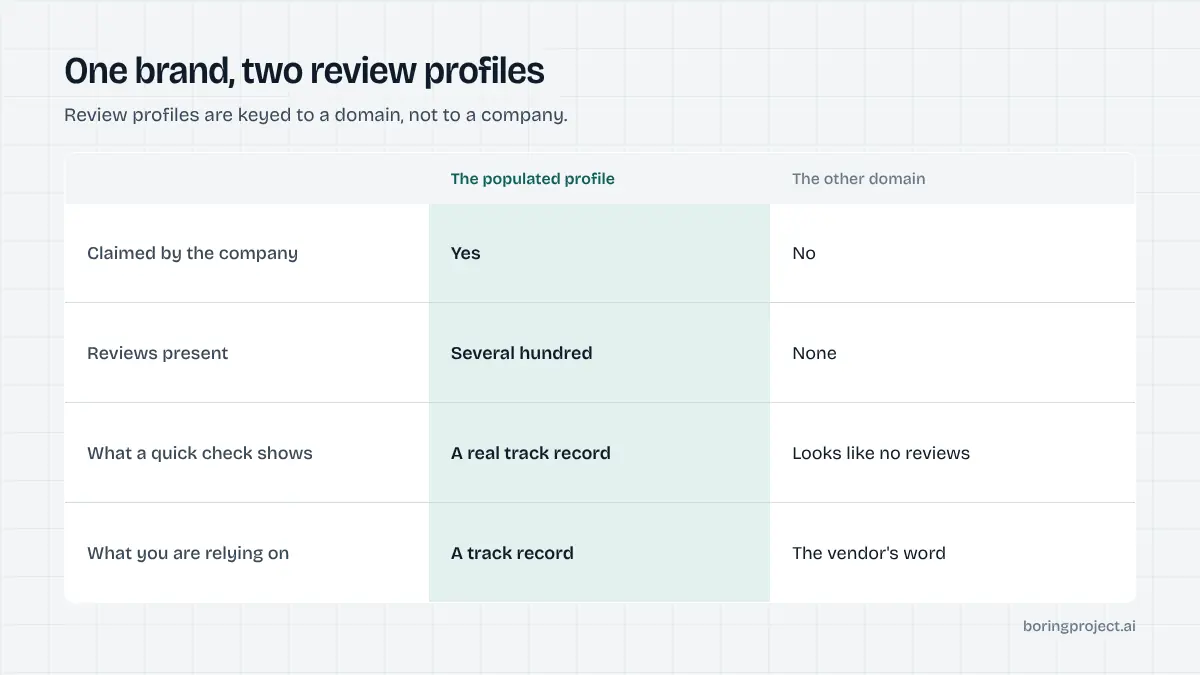
We were collecting verified review data across a hundred tools in this market, working from a list of domains. The entry for Rezi was rezi.ai. That profile exists, it is unclaimed, and it holds zero reviews.
Had we stopped there, this page would have reported that Rezi has no review presence. It does. The profile at rezi.io shows 4.6 out of 5 from 277 reviews. Same company, materially different picture, and the only difference is which top-level domain you typed.
Why this happens
Trustpilot profiles are keyed to a domain rather than to a company. A business that has operated on more than one domain, or that bought a second one defensively, can end up with a profile attached to each. One gets claimed and accumulates reviews over years. The other sits there, empty, looking exactly like a product nobody has reviewed.
This is not Rezi doing anything wrong. It is a structural quirk of how review platforms work, and it is a trap for anyone doing exactly what we were doing: comparing a long list of tools quickly from domain names.
What this does to comparison articles
Here is why any honest rezi review has to lead with this. The comparison content in this market is largely assembled at speed, often by people looking up each tool once. We have already caught several competitor-run roundups printing review figures that do not match the primary source at all. A wrong-domain lookup is one of the easier ways to get there without intending to.
So when you read a roundup that reports a tool as having few or no reviews, that claim is worth thirty seconds of checking. The score may be sitting on a domain the writer never tried.
Reading the real profile
4.6 from 277 is a solid middle
Two hundred and seventy-seven reviews is not the thirteen thousand that the largest resume builder in this market carries, and it is not the forty-seven that some reverse-recruiting firms are running on. It is a credible middle: enough people that a handful of enthusiastic customers cannot have set the number, recent enough to describe the product as it exists now.
At 4.6, that supports Rezi as a working resume builder. It does not tell you the product is right for your situation, which is a different question that no star rating answers.
What it is, and is not
Rezi is a resume builder with ATS-oriented formatting as its pitch: documents structured to survive the parsers that employer systems run your file through. That is a real problem and a reasonable thing to buy.
What it does not do is apply. The documents come out; the portals are still waiting. This is the same boundary that every tool in the resume half of this market sits behind, and it is worth being clear-eyed about when you budget your evenings.
Four checks before you trust any score
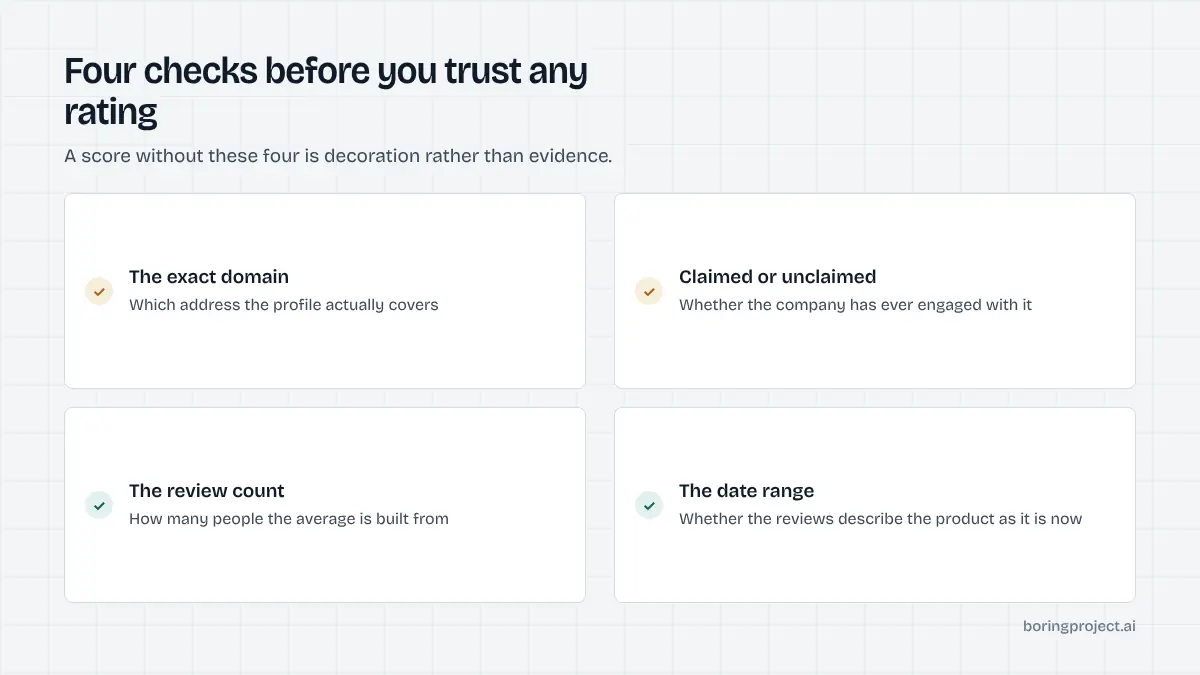
Confirm the exact domain the profile covers. Check whether the company has claimed it. Read the review count, not just the stars. Look at whether the reviews are from this year or from four years ago. A score presented without those four things is decoration rather than evidence.
Where this leaves the decision
For the document, the evidence is reasonable
If an ATS-friendly resume is what you are shopping for, 4.6 across 277 people is a reasonable basis to try it, and considerably more than most of this market can show you. On that evidence is rezi worth it comes out as a qualified yes for the document job, provided you read the populated profile rather than the empty one.
For the applications, this is the other half
Formatting a resume to survive a parser is useful precisely because that resume is about to be pushed through a lot of employer systems. Doing that pushing is the part that takes the time: a fresh account for every Workday instance, the same employment history retyped, the same knockout questions answered again.
That is the half we do. The Boring Project takes your target role once and files applications across Workday, Greenhouse, Lever and 40+ other systems, from $99 a year for 3,600 applications. We sell that, so treat our read on adjacent tools as the view of a company working in the same market. The review figures above come from Rezi's own Trustpilot profiles, both of them, and you can check either at the links.
Frequently asked questions
What is Rezi's Trustpilot score?
4.6 out of 5 from 277 reviews on the rezi.io profile. A separate profile under rezi.ai exists, is unclaimed, and holds zero reviews, so the score you find depends entirely on which domain you search.
Why are there two Rezi Trustpilot profiles?
Trustpilot profiles are keyed to a domain, and a company operating on more than one domain can end up with more than one profile. One gets claimed and accumulates reviews; the other sits empty. This is common and it quietly distorts comparison articles.
Is Rezi worth it?
On the real profile, 4.6 from 277 reviews is a solid mid-sized evidence base that supports the product as a resume builder. Just make sure you are reading the 277-review profile and not the empty one.
Does Rezi auto-apply to jobs?
Rezi's core product is resume building and ATS-oriented formatting. It is not an application-filing service, so the work of completing employer forms remains yours.
How can I tell if a review profile is trustworthy?
Check four things: the exact domain it covers, whether the company has claimed it, the number of reviews behind the score, and whether the reviews are recent or years old. A score with none of that context is not information.
Why does an unclaimed profile with zero reviews matter?
Because it is indistinguishable from a bad result if you glance at it. Anyone comparing a dozen tools quickly can record Rezi as having no reviews, when in fact it has 277 at 4.6 on the domain it actually operates from.