 The Boring Project
Is We Work Remotely Legit? Yes, And Employers Pay
We Work Remotely is one of the oldest remote job boards on the web, so is we work remotely legit is a quick yes; the more useful questions are is we work remotely free and why a board where employers pay behaves differently from one that scrapes listings.
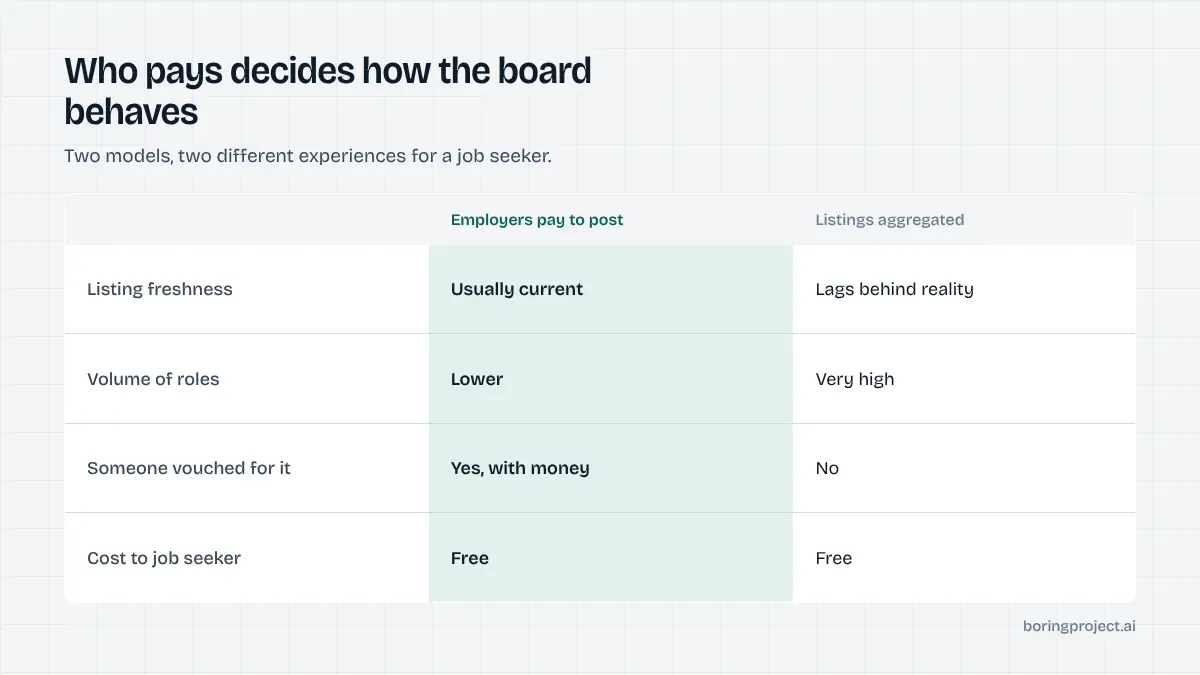
The model explains the quality
Employers pay to post
We Work Remotely is a curated remote job board: companies pay to list roles on it. That is the conventional job board model, and it is worth understanding because it predicts the experience you will have.
When someone has paid to publish a role, two things follow. The listing almost always corresponds to a genuine, current opening, because nobody pays to advertise a job they already filled. And the volume stays lower, because cost is a filter.
Why that beats aggregation for freshness
Compare it with an aggregator, which pulls listings from many sources into one index. Aggregators give you enormous volume and a staleness problem: a role gets indexed, the employer fills it, and the listing lingers until the next refresh. Applications to already-closed requisitions are the largest source of wasted effort in job searching.
Neither model is dishonest. They are different trades: volume and lag on one side, curation and freshness on the other.
The legitimacy question
The site runs on a domain carrying an Ahrefs rating of 79, among the highest of any site in this market. That reflects many years of operation and a very large number of other sites linking to it. On is we work remotely legit, there is no fraud signal here of any kind.
Free for job seekers, paid for employers
Which side pays
On is we work remotely free: browsing and applying is free if you are looking for work, and the money comes from the employer side.
That is the arrangement you want as a job seeker, and it is worth checking on any board you use. Where a site charges the job seeker instead, understand exactly what you are buying, because the thing that makes a board good is employers choosing to be on it rather than candidates paying to see it.
Remote work attracts more fraud, everywhere
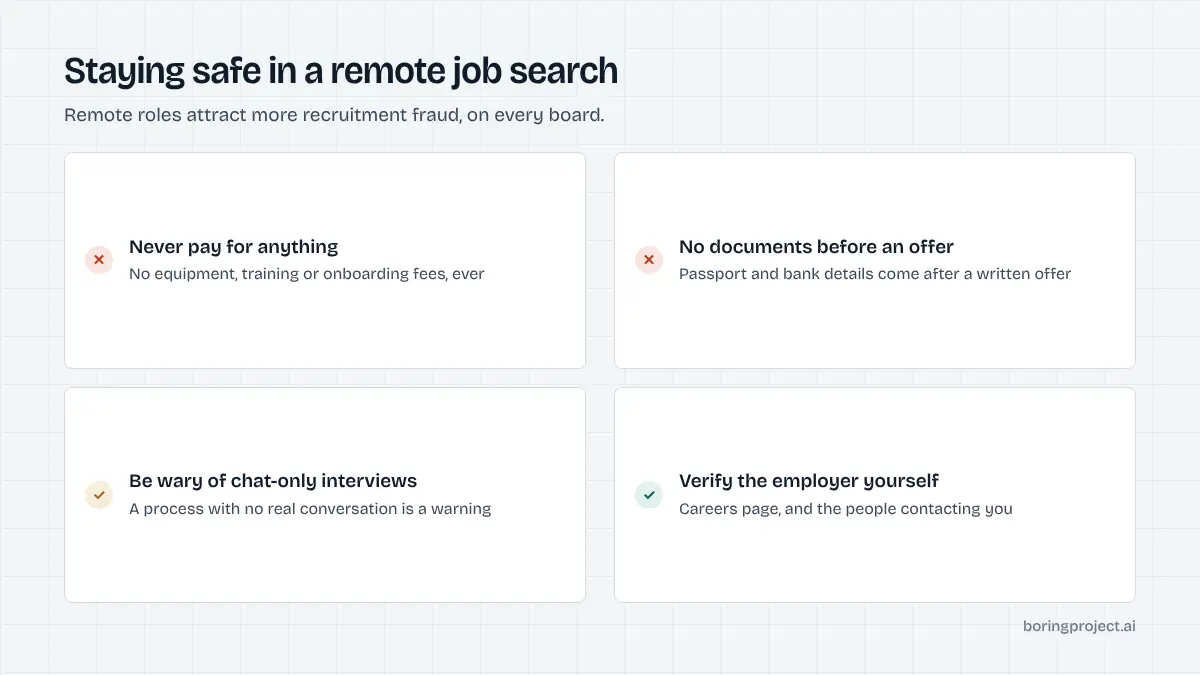
This is not about any particular board and it is the most useful thing on this page. Remote roles draw more recruitment fraud than onsite roles do, because the entire process can be conducted without anyone meeting.
The protections are behavioural and they work on every site:
Never pay for anything connected to a job application. No legitimate employer charges you for equipment, training or onboarding. Never send identity documents such as a passport scan before you have a written offer. Be sceptical of an interview conducted entirely over text chat. And be most sceptical of an offer that arrives quickly without a real conversation.
Verify the employer independently
Look the company up separately from the listing. Check that the careers page exists and that the role appears there. Check that the people contacting you have a traceable presence at that company. This takes a few minutes and catches almost everything.
Where this leaves the decision
A good board, for finding roles
For remote work specifically, a long-established curated board is a reasonable first stop. Expect fewer listings than an aggregator and expect more of them to be real.
Finding is not applying
A board surfaces roles. It does not fill in the employer's forms, create the account on their ATS, or answer the same screening questions for the twentieth time.
That is the part we handle. The Boring Project files applications across Workday, Greenhouse, Lever and 40+ other systems, from $99 a year for 3,600 applications, with a receipt for each attempt. We sell that, so weigh our view accordingly — a job board is not a competitor of ours and we have no reason to characterise one unfairly.
Frequently asked questions
Is We Work Remotely legit?
Yes. It is one of the longest-established remote job boards, with a very substantial web presence. Employers pay to post roles there, which is the conventional and more reliable job board model.
Is We Work Remotely free for job seekers?
Browsing and applying is free for job seekers. The revenue comes from employers paying to list roles, which is the normal arrangement for a curated board and the reason listings tend to be fresher than aggregated ones.
Why are paid-posting boards usually better quality?
Because someone spent money to put the role there. That filters out a lot of noise and means the listing almost always corresponds to a real, current opening, unlike an aggregated index where listings linger after a role is filled.
Are there fake jobs on remote job boards?
Remote work attracts more recruitment fraud than onsite work, on every board. The protection is behavioural rather than site-specific: never pay to apply, never send identity documents before an offer, and verify the employer independently.
Does We Work Remotely apply to jobs for you?
No. It is a job board, so it surfaces roles and the employer's application is still yours to complete. Auto-apply is a separate category of product.
How do I spot a remote job scam?
The reliable signals are requests for money, requests for bank or identity documents before an offer, an interview conducted entirely over chat, and an offer that arrives without a real conversation. Any one of those is a reason to stop.