 The Boring Project
Is Scale.jobs Legit? Yes, And It Is Not Software
Scale.jobs carries 4.5 out of 5 from 252 Trustpilot reviews, so is scale.jobs legit comes out as a clear yes; the thing that should actually shape your decision, and that is usually missed by people asking is scale.jobs a scam, is that human assistants rather than software do the applying.
The legitimacy question is easy
4.5 from 252 reviews
Scale.jobs' Trustpilot profile shows 4.5 out of 5 from 252 reviews. That is a mid-sized sample: not the thousands that the largest resume tools carry, but far beyond the handful that most of this market runs on.
For context from our own survey, we checked a hundred tools in this category against their own profiles and 79 had no review presence whatsoever. Two hundred and fifty-two people at 4.5 puts this firmly among the better-evidenced options available, which settles is scale.jobs legit without much argument.
What 4.5 across a service business means
Service businesses are harder to keep at a high rating than software, because every delivery involves a person having a good or bad day. A 4.5 sustained across 252 engagements suggests a process that works more often than not, with a real minority of people whose experience fell short.
The scam question
Nothing supports it. There is a claimed profile, a substantial review history and an established web presence. We compete in this market and we will say plainly that is scale.jobs a scam is a framing the evidence does not fit.
The thing people miss before buying
Humans do the work
This is the fact that should drive your decision, and it is frequently skimmed past. Applications are completed by human assistants rather than by an automated agent.
That is neither a flaw nor a selling point on its own. It is a completely different product shape, and buying it while expecting software economics is how people end up disappointed in something that worked exactly as designed.
What changes when a person does it
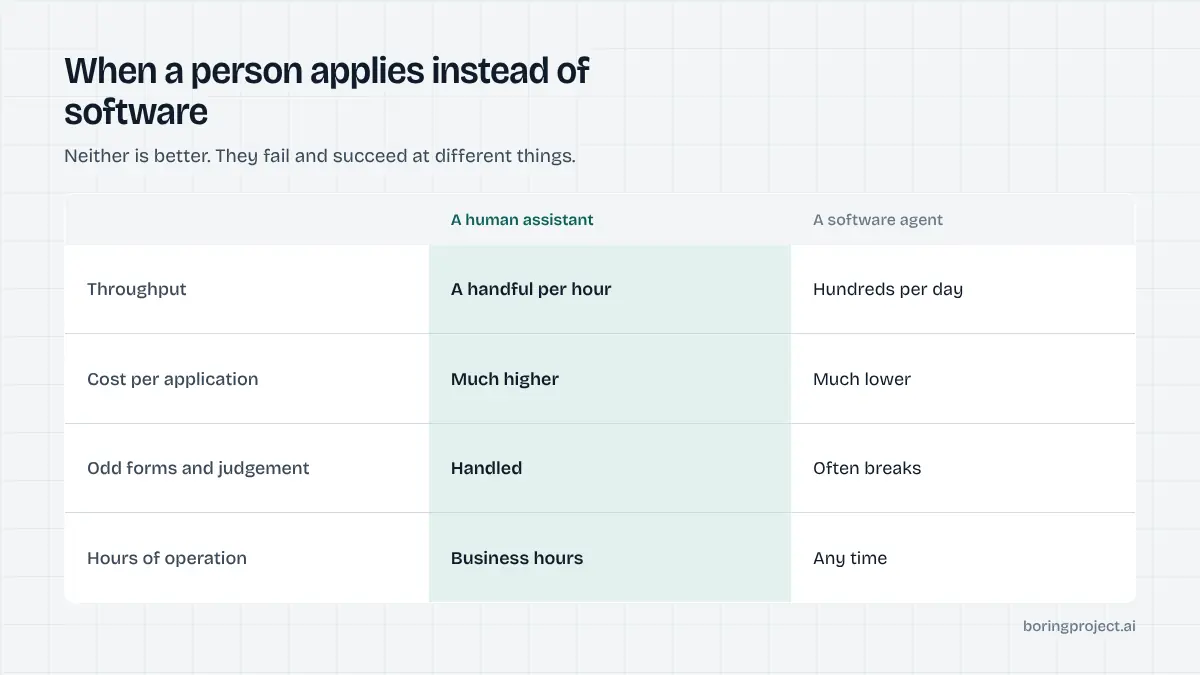
Throughput is the big one. A person completing careful applications works at a rate measured in a handful per hour, not hundreds per day, so the volume you can buy is bounded by labour rather than by compute. Cost per application follows directly from that and sits an order of magnitude above software.
Turnaround changes too: humans work in business hours and in a timezone, so a request made in your evening is handled in theirs. In return you get judgement. Odd form layouts, unusual screener questions and the small decisions that break an automated agent are exactly where a person is worth paying for.
Which bottleneck do you actually have
That framing resolves most of this choice. If your problem is volume — hundreds of roles, repetitive forms, the same history retyped — labour is the expensive way to solve it and software is the cheap one. If your problem is complexity — a small number of high-stakes applications with awkward requirements — a person is worth the money and automation will frustrate you.
Plenty of people have the first problem and buy the second solution.
What to establish in writing
The four questions
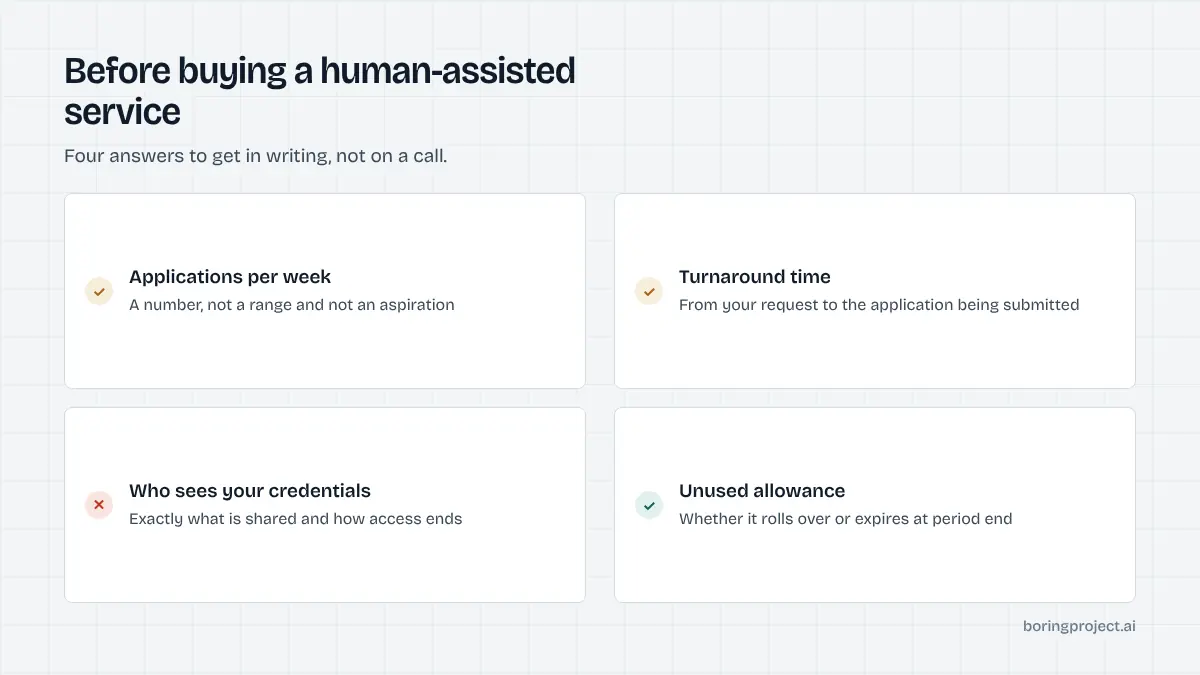
Applications per week, stated as a number rather than a range. Turnaround from your request to submission. Who at the company can see your credentials, and how that access ends when you stop paying. And whether unused allowance rolls over or expires, because with human delivery it usually expires.
The credentials question deserves particular attention. Any service where a person submits on your behalf needs some access to do it, which is not sinister, but you should know exactly what is shared and how it is withdrawn. A vague answer is an answer.
Our position, declared
We sell the software side of this, so we are not neutral. The Boring Project files applications across Workday, Greenhouse, Lever and 40+ other systems, from $99 a year for 3,600 applications, with a receipt for every attempt.
The honest comparison is the one above rather than a verdict: those two numbers only make sense against each other if volume is what you need. For a dozen careful applications to roles that matter, a person may well serve you better than we would.
Frequently asked questions
Is Scale.jobs legit?
Yes. It holds 4.5 out of 5 from 252 Trustpilot reviews, a mid-sized sample that is well above most of this market, where 79 of the 100 tools we checked had no review presence at all.
Is Scale.jobs a scam?
No evidence supports that. A 252-review base averaging 4.5 describes a service that mostly delivers what it promises. The search term reflects general wariness about paid job services rather than anything specific here.
Does a human or software do the applying?
Human assistants complete the applications. This is the single most important thing to understand before buying, because it changes throughput, cost per application and turnaround compared with a software agent.
Is a human service better than auto-apply software?
It is different rather than better. Humans handle odd forms and judgement calls that break automation, but they work in business hours, apply at far lower volume and cost considerably more per application. Pick based on whether your bottleneck is volume or complexity.
What should I ask before buying a human-assisted service?
Applications per week in writing, turnaround time from request to submission, who at the company can see your credentials and how access is removed, and whether unused allowance rolls over or expires.
Do I have to give them my account passwords?
Ask directly, because any service where a person submits applications for you needs some access to do it. Find out exactly what is shared, who can see it, and how access ends when you stop. Treat a vague answer as the answer.